[SMM Flash] China's Chrome Ore Port Stocks Hold Near Record Highs Even After Easing From July Peak

Published: Aug 7, 2026 22:35

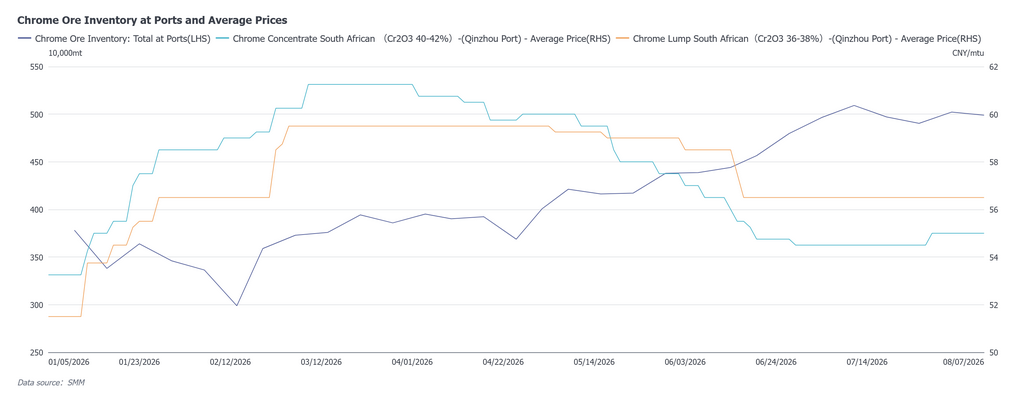
SMM's own port inventory tracking shows China's total chrome ore stockpiles have remained near record levels through the second half of 2026, even after a modest pullback from their 10 July peak. Inventories touched 509.14 (10,000mt) — roughly 5.09 million tonnes — on that date, before easing to approximately 490.15 (10,000mt), or 4.90 million tonnes, by early August, a drawdown of just 3.7%. Set against the trajectory of the year, that decline barely registers: stocks climbed from a trough near 300 (10,000mt) in late February to above 500 (10,000mt) by mid-year, and the current level remains well above anything seen in the first four months of 2026, confirming that the market is still working through a substantial ore overhang at Chinese ports rather than genuinely destocking.

Pricing at Qinzhou Port has firmed alongside this marginal pullback rather than because of any real supply tightening. SMM data shows South African chrome concentrate (Cr2O3 40-42%) at 54.5 CNY/mtu and South African chrome lump (Cr2O3 36-38%) at 56.5 CNY/mtu as of 10 July 2026, with concentrate pricing subsequently climbing to 59.61 CNY/mtu by early August — a gain of close to 9% in under a month. That move should be read cautiously against the inventory backdrop: with port stocks still hovering near their 2026 high, the price recovery looks more like a technical bounce or short-term restocking behavior than evidence of a genuine tightening in the underlying supply-demand balance.

Bottom line: China's chrome ore port inventories remain near record highs despite the recent dip, and SMM's data suggests the market has not meaningfully worked through this year's substantial stock build. Until inventories fall more decisively from current elevated levels, the recent price firmness at Qinzhou Port is likely to remain vulnerable to renewed downward pressure, particularly if South African arrivals continue at their current pace.
Data Source Statement: Except for publicly available information, all other data are processed by SMM based on publicly available information, market communication, and relying on SMM's internal database model. They are for reference only and do not constitute decision-making recommendations.

For any inquiries or for more information, please contact: lemonzhao@smm.cn
For more information on how to access our research reports, please contact:service.en@smm.cn
Related News
[SMM Analysis] South Africa's High-Carbon Ferrochrome Exports Dip Slightly in June, Reflecting Supply Constraints
1 hour ago
[SMM Analysis] South Africa's High-Carbon Ferrochrome Exports Dip Slightly in June, Reflecting Supply Constraints
Read More
[SMM Analysis] South Africa's High-Carbon Ferrochrome Exports Dip Slightly in June, Reflecting Supply Constraints
[SMM Analysis] South Africa's High-Carbon Ferrochrome Exports Dip Slightly in June, Reflecting Supply Constraints
1 hour ago
[SMM Analysis] South Africa's Chrome Ore Exports Hold Above 2.4 Mt in June as China's Dominance Grows Amid Policy Shifts
1 hour ago
[SMM Analysis] South Africa's Chrome Ore Exports Hold Above 2.4 Mt in June as China's Dominance Grows Amid Policy Shifts
Read More
[SMM Analysis] South Africa's Chrome Ore Exports Hold Above 2.4 Mt in June as China's Dominance Grows Amid Policy Shifts
[SMM Analysis] South Africa's Chrome Ore Exports Hold Above 2.4 Mt in June as China's Dominance Grows Amid Policy Shifts
1 hour ago
While Lithium Beneficiation Advances, Zimbabwe's Chrome Sector Still Awaits Its Own Toll-Processing Model
1 hour ago
While Lithium Beneficiation Advances, Zimbabwe's Chrome Sector Still Awaits Its Own Toll-Processing Model
Read More
While Lithium Beneficiation Advances, Zimbabwe's Chrome Sector Still Awaits Its Own Toll-Processing Model
More than six weeks after Zimbabwe's Mines Minister Dr Polite Kambamura promised "very soon" to roll out targeted policy interventions for the chrome sector — including a toll-processing model allowing small-scale miners to process ore for a fee rather than sell it to foreign-owned smelters — chrome producers say they are still waiting. Speaking during a technical media tour of Prospect Lithium Zimbabwe in Goromonzi on 17 July, Kambamura highlighted lithium beneficiation as a policy success story, pointing to Zimbabwe's first locally produced lithium sulphate, exported from the Arcadia plant in April, alongside further lithium processing facilities under construction at Kamativi and Sinomine Bikita. Chrome, by contrast, came up in the same discussion as the sector where that model has yet to take hold for smaller producers. Shelton Lucas, business development director at Naivo Mining — which operates chrome, antimony and tungsten projects in Mashava, Ngezi and Kadoma, and who also chairs the Chrome Miners Association of Zimbabwe — said his company remains unable to capture the value of its own raw chrome. "For our raw chrome, we are now forced to sell to local Chinese smelters where they underpay us," Lucas said, adding that unlike antimony, where he has the resources to build a value-addition plant, the cost of chrome processing infrastructure remains prohibitive. His comments echo concerns he raised in early June, when he described local buying prices for chrome ore — then around US$70 per tonne, against international CIF China values several times higher — as reflecting a "predatory price regime." At the time, Kambamura pointed to an existing MMCZ fund intended to capacitate small-scale chrome miners and said he would soon announce policy interventions, including toll processing through government-linked facilities such as ZimAlloys. Zimbabwe's broader mining outlook remains strong: the Chamber of Mines projects 10% sector growth for 2026, with export earnings potentially reaching US$7.5–11 billion, and the Ministry has separately outlined plans for regional beneficiation hubs that would let chrome-producing areas specialize in ferrochrome and chromium alloys. But the gap between that national-level ambition and the lived experience of small-scale chrome producers, still selling raw ore to a limited pool of local smelter buyers more than six weeks after relief was first promised, illustrates a recurring theme in Zimbabwe's beneficiation drive: policy announcements and on-the-ground implementation are not always moving at the same pace, even as the government's own flagship example — lithium — demonstrates what a fully realized beneficiation pathway can look like.
1 hour ago