A four-tier minimum import price regime, downstream tariffs and onshoring incentives will take effect on December 4, 2026, widening the gap between US and Asian solar prices.
On August 6, US President Donald Trump signed a proclamation setting out import adjustment measures following the Section 232 investigation into polysilicon and its derivatives. The measures will take effect at 12:01 a.m. Eastern Time on December 4, 2026, and cover polysilicon, silicon ingots and wafers, solar cells and modules.
Unlike a conventional tariff increase, the new framework combines minimum import prices, or MIPs, with additional tariffs on downstream products and incentives for domestic investment. SMM believes the policy should not be read as a blanket 15% tariff on every product in the polysilicon value chain. Its central objective is to rebuild the US solar pricing system through a combination of price floors, cumulative tariffs and conditional relief.
Low-priced imports will face a substantially greater constraint than products already trading at higher prices. The impact is also expected to move progressively through the supply chain, from polysilicon and wafers to cells and finished modules.
Four price floors introduced; the 15% tariff mainly applies downstream
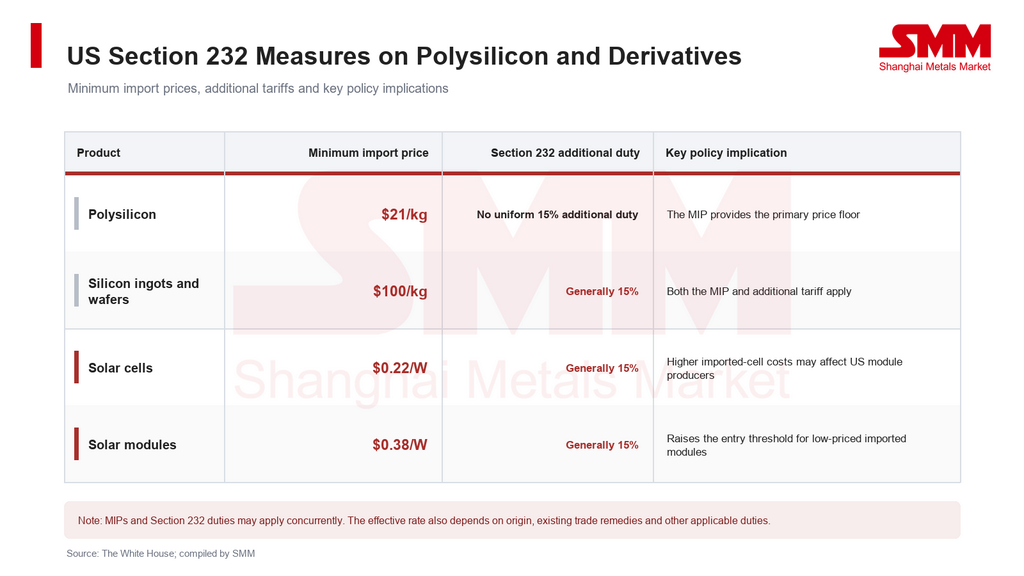
According to the White House proclamation and its annexes, the United States has established minimum import prices of $21/kg for polysilicon, $100/kg for silicon ingots and wafers, $0.22/W for solar cells and $0.38/W for solar modules.
An important distinction applies to raw polysilicon. The material is covered by the MIP program, but the 15% additional ad valorem duty set out in paragraph 4 of the proclamation applies to silicon ingots, wafers and downstream derivatives. It would therefore be inaccurate to state that every product across the polysilicon value chain is subject to a uniform additional 15% tariff.
Rates also vary by origin. For products from European Union member states, Japan, South Korea, Chinese Taipei, Switzerland and Liechtenstein, the combined Column 1 general duty and Section 232 duty is set at 15%. Products from the United Kingdom are subject to a 10% Section 232 additional duty. Other origins are generally subject to a 15% additional duty, which may be applied alongside anti-dumping duties, countervailing duties and other applicable charges unless otherwise specified.
The measures establish a new import-protection framework following the expiry of the Section 201 safeguard in February 2026. Compared with the previous safeguard, the Section 232 regime has a much broader reach. It places silicon ingots and wafers within the additional tariff framework and introduces price floors at four stages from raw material to finished module.
Customs enforcement turns the MIP into a binding threshold
The MIP is not simply a reference quotation. When entering goods, importers may submit documentation showing that the first arm's-length transaction price in the United States is no lower than the prescribed threshold. They may also document that the transaction is being executed under a fixed-term contract with fixed terms signed before August 6, 2026.
If documentation is submitted but the entered value remains below the MIP, US Customs and Border Protection may impose a specific duty equal to the gap between the declared price and the price floor. If the required documentation is not submitted, the importer may face a specific duty equal to the full MIP. For silicon ingots, wafers, cells and modules, the relevant ad valorem tariff may then be added on top of that amount.
The effective barrier could therefore be considerably higher than the headline 15%. For a module from a generally applicable origin, a first arm's-length US transaction price of $0.38/W would still need to absorb the 15% additional tariff and any other applicable duties. If the transaction price is below $0.38/W, the importer could also face a specific duty that fills the gap to the MIP. For suppliers that previously competed primarily on price, the MIP may have a greater commercial effect than the ad valorem tariff itself.
The proclamation also provides for strict enforcement. Materially false supporting documents could result in the importer and its affiliates being permanently barred from importing covered products. The Department of Commerce will monitor abnormal stockpiling before December 4 and may coordinate with Customs to restrict subsequent imports where companies are found to have accelerated shipments or built excessive inventories. The nearly four-month transition period should therefore not be interpreted as an unrestricted stockbuilding window.
US price floors sit far above current Asian supply-chain prices
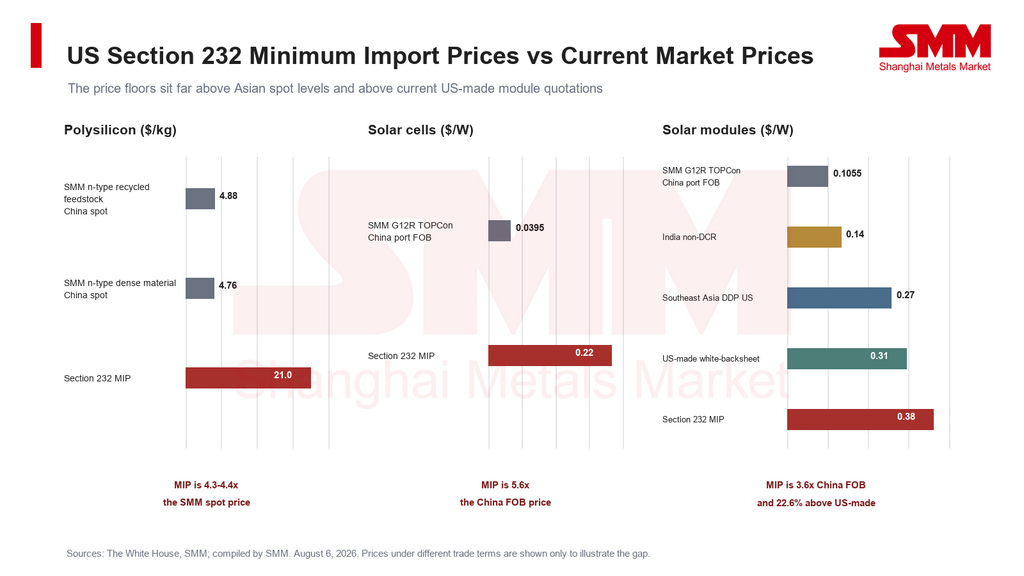
As of August 6, SMM assessed average prices for n-type recycled feedstock and n-type dense polysilicon in China at RMB 32.95/kg and RMB 32.15/kg, respectively. Both had fallen by approximately 12.7% and 13.1% from April 1.
Using an exchange rate of RMB 6.7483 per US dollar, the two prices were equivalent to approximately $4.88/kg and $4.76/kg. They were 76.7% and 77.3% below the US polysilicon MIP of $21/kg. Put differently, the US price floor is approximately 4.3-4.4 times the current Chinese spot price for n-type polysilicon.
The gap is even wider downstream. SMM assessed G12R TOPCon modules at a China port FOB average of $0.1055/W. The US module MIP of $0.38/W is about 3.6 times that level. SMM's China port FOB assessment for G12R TOPCon cells stood at $0.0395/W, making the US cell MIP of $0.22/W approximately 5.6 times the Chinese export price.
These comparisons do not represent identical trade terms. China port FOB prices exclude ocean freight, insurance, customs clearance, distribution and financing costs incurred after the product leaves China, and they are not equivalent to the first arm's-length transaction price in the United States. Even so, the scale of the gap shows that the policy is not a marginal adjustment to import pricing. It is an attempt to establish a protected US price curve that is materially detached from Asian spot levels.
According to SMM research, average quotations for US-made white-backsheet modules were recently around $0.31/W. Southeast Asian modules delivered duty paid to the United States were quoted at approximately $0.27/W, while Indian non-DCR modules were around $0.14/W. On a nominal-price basis, the $0.38/W module MIP is approximately 22.6% above the US-made module quotation. Once applicable Section 232 duties are added, the cost gap between imported and domestically produced modules could widen further, strengthening the relative competitiveness and pricing power of US manufacturers.
US solar assets continue to expand despite lower module imports
The ultimate cost impact of the new tariffs and price floors will depend on the pace and structure of US solar deployment. EIA data show that cumulative operating solar net summer capacity increased from 138.3 GW at the end of 2023 to 175.3 GW at the end of 2024 and 209.3 GW at the end of 2025. By the end of May 2026, it had reached 222.7 GW, a net increase of approximately 13.4 GW from year-end 2025.
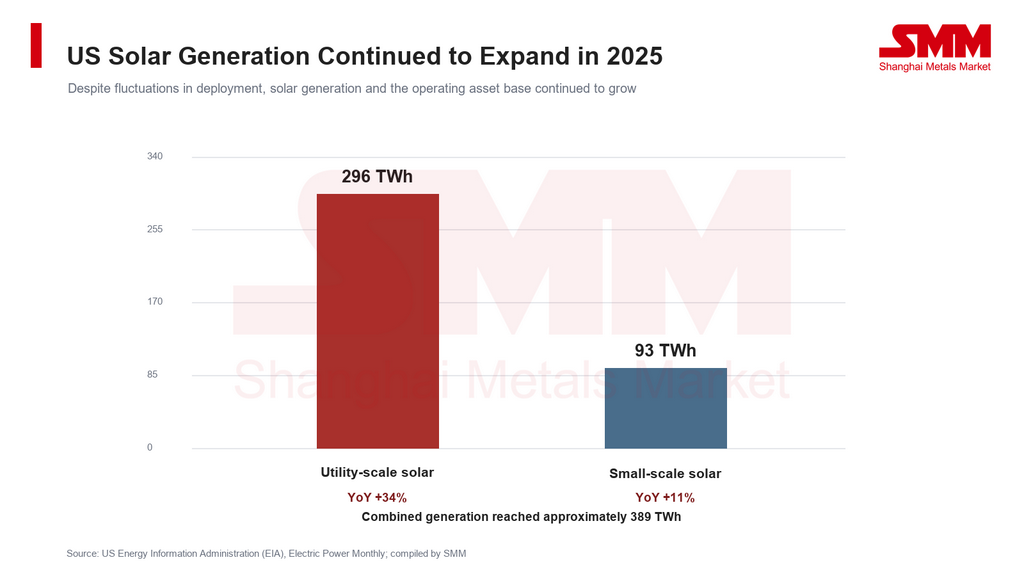
Solar generation also continued to grow. In 2025, US utility-scale solar generation reached approximately 296 TWh, up 34% year on year, while small-scale solar generation rose 11% to around 93 TWh. Combined output was approximately 389 TWh. The data indicate that the operating asset base and actual solar generation continued to expand even as finished-module imports declined.
The cost effect of Section 232 therefore cannot be assessed from short-term import movements alone. If US solar capacity continues to grow while domestic wafer and cell projects ramp more slowly than module assembly, the import price thresholds will be more readily passed through to module and project costs. If construction slows because of financing, permitting or interconnection constraints, the policy may instead be reflected mainly in greater pricing power for domestic manufacturers rather than an immediate physical shortage.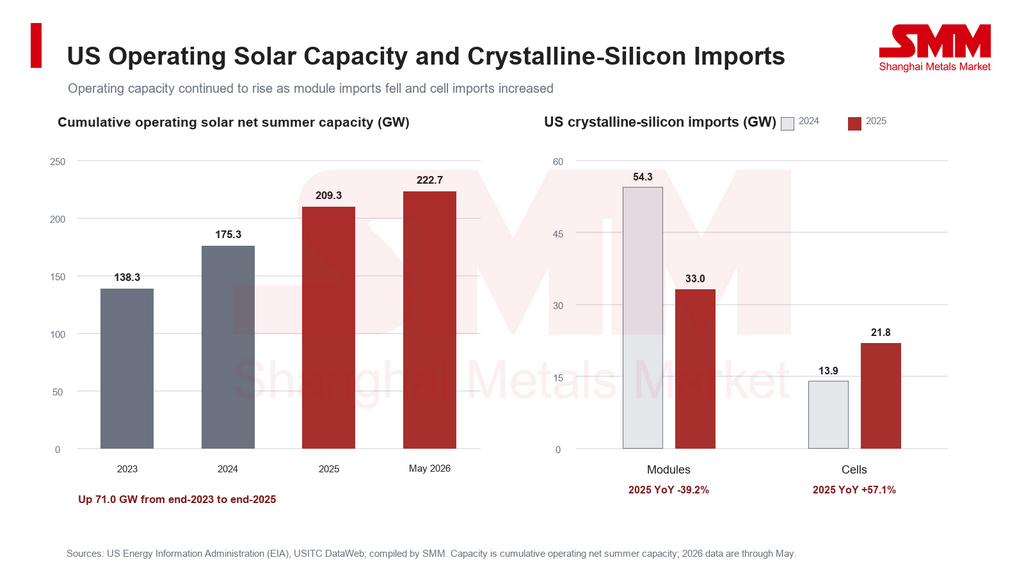
Module imports fell 39%, while cell imports rose 57%
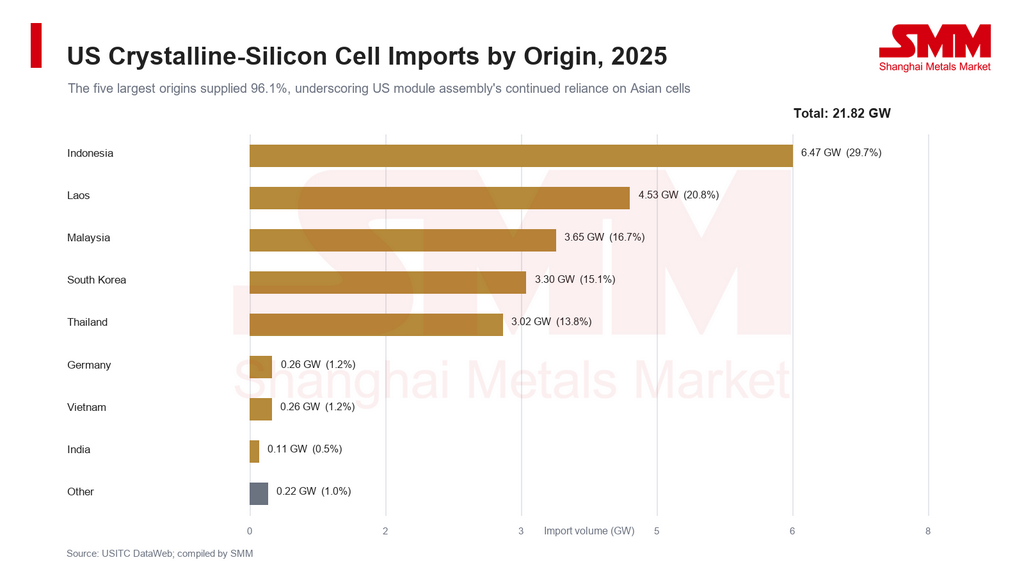
USITC data reveal a clear structural shift in the US solar supply chain. In 2024, the United States imported 54.3 GW of crystalline-silicon modules and 13.89 GW of crystalline-silicon cells. In 2025, module imports fell 39.2% year on year to approximately 33.0 GW. Cell imports, aggregated from country-level data, rose 57.1% to about 21.82 GW.
The divergence between declining module imports and rising cell imports shows how the expansion of US module assembly is changing the import mix. A growing portion of demand is being met through imported cells assembled into modules in the United States rather than through direct imports of finished modules.
This shift does not mean that the US solar manufacturing chain has achieved full localization. On the contrary, it highlights cells as the most important import-dependent link at this stage.
Import volumes and newly installed capacity cannot be matched on a watt-for-watt basis because of inventory changes, manufacturing lead times and differences in statistical scope. Nonetheless, the opposite direction of cell and module imports in 2025 clearly indicates that the United States is moving from a finished-module import model toward one in which imported cells support domestic module manufacturing. The next stage of localization may extend further upstream into wafers and polysilicon.
The US Department of Energy has also noted that cells, wafers and polysilicon require more capital and generally have longer design, permitting, construction and ramp-up cycles than module assembly. The rise in cell imports to 21.82 GW in 2025 provides trade-data evidence that rapid module-capacity growth has not yet reduced US reliance on foreign cells.
Against this backdrop, the $0.22/W cell MIP and the additional 15% tariff will have two effects. They may protect domestic cell projects and create more room for upstream investment, but they could also raise production costs for US module plants that still depend on imported cells before domestic cell capacity is fully available.
Whether companies can obtain relief under the onshoring program, and whether US cell projects begin production and ramp on schedule, will determine whether the measure functions primarily as protection for domestic manufacturing or becomes an upstream cost squeeze on downstream module producers.
Import origins have shifted, but Section 232 narrows the scope for rerouting
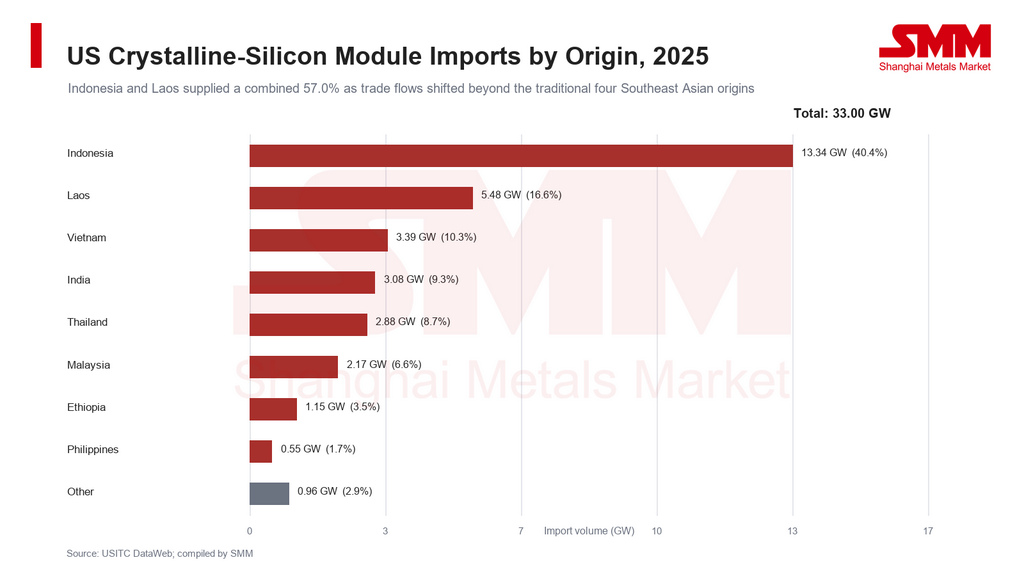
Indonesia supplied 13.34 GW, or 40.4%, of US crystalline-silicon module imports in 2025. Laos supplied 5.48 GW, or 16.6%. Together, the two countries accounted for 57.0% of the total. Imports from Vietnam, India, Thailand and Malaysia reached approximately 3.39 GW, 3.08 GW, 2.88 GW and 2.17 GW, respectively.
Cell imports were even more concentrated. In 2025, the United States imported approximately 6.47 GW of cells from Indonesia, 4.53 GW from Laos, 3.65 GW from Malaysia, 3.30 GW from South Korea and 3.02 GW from Thailand. The five largest origins accounted for 96.1% of the total, while Indonesia and Laos together represented around 50.5%.
Country-level data show that US module sourcing has moved beyond the four Southeast Asian countries traditionally targeted by trade cases and has diversified toward Indonesia, Laos, India, Ethiopia and the Philippines. Unlike anti-dumping and countervailing duty investigations focused on named countries, the Section 232 MIPs cover products from a broad range of origins. This will substantially reduce the ability of suppliers to preserve low-cost access to the US market simply by changing the location of module assembly or cell exports.
US solar manufacturing stocks rose, but the benefit differs by company
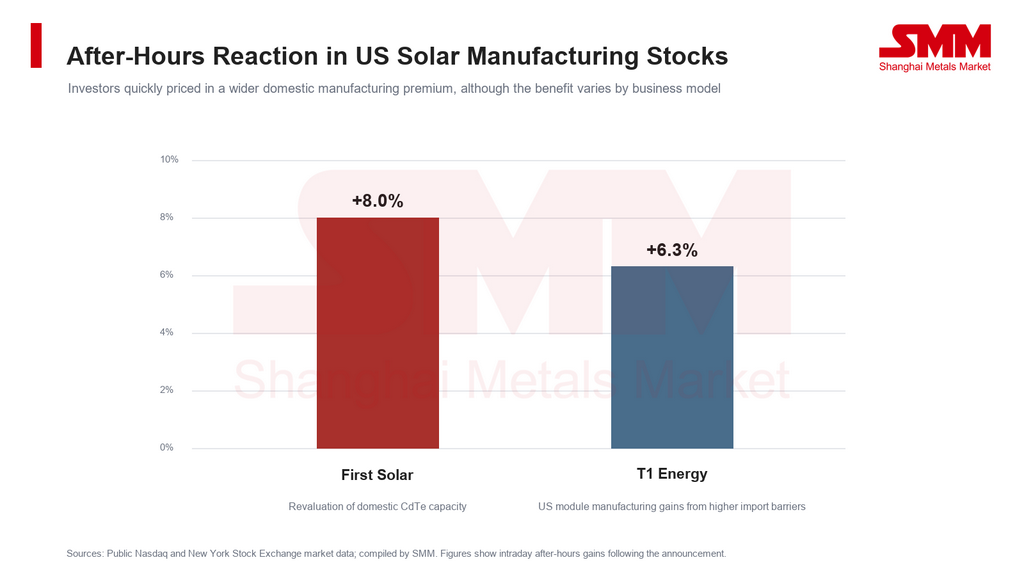
US-listed solar manufacturing stocks responded quickly after the policy announcement. Public market data show that First Solar rose as much as approximately 8% in after-hours trading, while T1 Energy gained as much as 6.3%. The reaction reflects investor expectations that the domestic manufacturing premium will widen.
First Solar uses cadmium telluride thin-film technology and does not rely on the crystalline-silicon polysilicon chain. Its main benefit would come from improved relative competitiveness if imported crystalline-silicon modules become more expensive. However, the cell and module tariff lines listed in the annex cover both crystalline-silicon products and other photovoltaic products. Whether imported thin-film modules fall within the final measures will depend on customs classification and implementation guidance. First Solar's share-price response is therefore better understood as a revaluation of its US manufacturing advantage rather than a direct benefit from lower polysilicon costs.
T1 Energy operates module manufacturing capacity in the United States and is developing domestic cell capacity. Its US manufacturing position stands to benefit from a higher import threshold for finished modules. Before its domestic cell lines are fully ramped, however, the cell MIP could also raise input costs. The company's net benefit will depend on the pace of its US cell buildout and whether it can secure Section 232 relief for qualifying equipment and covered products under an approved onshoring plan.
For domestic polysilicon producers such as Hemlock Semiconductor and Wacker's US operations, the $21/kg MIP offers more direct price protection. For integrated manufacturers such as Qcells, which is building wafer, cell and module capacity in the United States, the framework could narrow the cost gap between domestic production and Asian imports.
US manufacturers gain protection, but project costs face upward pressure
In the short term, some existing contracts and in-transit orders may retain transitional treatment before December 4, and US importers may accelerate the delivery of compliant orders. The anti-stockpiling provisions will limit excessive front-loading, however, creating a distinction between the earlier delivery of normal orders and restricted abnormal inventory accumulation.
Over the medium term, the $0.38/W module MIP, together with additional tariffs, will significantly narrow the low-cost advantage of imported crystalline-silicon modules. US module manufacturers should gain greater pricing flexibility and improved order visibility, while developers face higher capital expenditure and levelized electricity costs. Projects already under pressure from the phase-down of federal incentives, interconnection queues or financing costs may need to recalculate returns or delay procurement.
The scale of the impact will also depend on the structure of US demand. If solar deployment maintains its current growth trend and domestic capacity can cover the required power classes and delivery specifications, lower imports may be partly replaced by domestic supply and inventories. If demand from data centers and utility-scale projects shifts more rapidly toward higher-power and higher-efficiency products while US wafer and cell capacity ramps more slowly than expected, the supply gap could amplify price increases and project-delay risks.
Direct exports from China may face limited incremental impact, but third-country supply chains face greater pressure
Chinese solar products already face US anti-dumping and countervailing duties, forced-labor enforcement, country-of-origin scrutiny and other trade restrictions. The incremental effect of the new Section 232 measures on direct exports from China may therefore be smaller than the size of the MIPs alone suggests.
The new measures are broad in both tariff classification and origin, however. Producing wafers, cells or modules in Southeast Asia, India or other third countries will no longer provide the same scope to secure US market access through low prices alone. Companies that rely on imported cells for US module assembly, or that plan to expand in third countries to serve the US market, will face higher costs and compliance pressure.
As the US price threshold rises, some modules originally intended for the United States may be redirected to Europe, Latin America, the Middle East and other Asia-Pacific markets, intensifying competition for orders in those regions. Chinese companies will need to go beyond changing export destinations. They should reassess US investment, supply-chain traceability, tariff classification, related-party pricing and contract structures with local customers.
Onshoring relief creates an investment route, but the threshold is high
The proclamation authorizes the Department of Commerce to establish an onshoring incentive program. Companies that commit to building, refurbishing or expanding US capacity for polysilicon, silicon ingots, wafers or cells, and begin construction by January 20, 2029, may submit a company-level onshoring plan.
During construction, approved companies may import necessary production equipment and covered products at a volume linked by Commerce to the scale of the new investment without paying the applicable Section 232 duties.
The framework does not close the US market entirely. Instead, it seeks to tie import relief to domestic capital expenditure. The policy may accelerate investment decisions in US wafer and cell production, but effective supply will still depend on construction schedules, equipment delivery, skilled labor, energy costs and downstream orders.
If a company fails to meet its commitments, the relief may be withdrawn. Fraud or misrepresentation could also result in retroactive revocation.
Outlook: trade protection will interact with the expiry of project tax credits
SMM believes the Section 232 measures upgrade US solar trade protection from country-specific anti-dumping and countervailing duty actions into a price-management system spanning the value chain and multiple origins. The central constraint is not the nominal 15% rate alone, but the combined barrier created by MIPs, additional duties, existing trade remedies and strict certification and enforcement.
In the short term, the US market may see faster delivery under existing contracts, higher domestic module quotations and contract renegotiations by developers. The medium-term impact will depend on three variables: how the Department of Commerce defines eligibility and relief volumes under the onshoring program; whether US wafer and cell capacity comes online on schedule; and whether trading partners such as the EU, Japan and South Korea adopt MIP systems that the United States regards as substantially equivalent, potentially triggering tariff adjustments.
The Section 232 measures must also be considered alongside the termination schedule for US clean electricity tax credits. Under the current rules, solar projects that begin construction after July 4, 2026 and enter service after December 31, 2027 will generally no longer qualify for the Section 45Y clean electricity production tax credit or the Section 48E clean electricity investment tax credit.
Projects that satisfied the applicable construction-start requirements before July 5, 2026 may still seek transitional eligibility under the physical-work and continuity rules. The entire US solar market will not lose tax credits at the end of 2027; the deadline primarily constrains new projects that did not begin construction within the transition window.
This schedule could bring demand forward. From the second half of 2026 through 2027, some developers may accelerate equipment orders, construction and grid connection to complete projects before the tax-credit deadline. If the Section 232 MIPs take effect at the same time, concentrated procurement and higher import costs could reinforce each other, lifting domestic module quotations and equipment budgets.
From 2028, project performance is likely to diverge more sharply. Projects with transitional eligibility, long-term power purchase agreements or demand support from high-load customers such as data centers may continue. Projects that cannot claim the 45Y or 48E credits and are highly sensitive to equipment costs may renegotiate contracts, reduce scale or delay development.
If the imported-module MIP remains at $0.38/W while domestic production costs have not fallen materially, the loss of project-side tax credits and elevated equipment prices will create a double squeeze on project economics.
Section 45X should be distinguished from Section 48E. The Section 45X advanced manufacturing production credit does not end in 2028. Under current IRS rules, qualifying modules, cells, wafers and polysilicon remain eligible for the full manufacturing credit through the end of 2029. The credit then falls to 75% in 2030, 50% in 2031 and 25% in 2032 before ending after December 31, 2032 for the relevant components.
The result could be a policy mismatch in 2028-2029: some demand-side projects will lose federal tax credits while manufacturers retain the full production incentive.
The Section 232 MIPs may therefore serve not only as trade protection, but also as a mechanism supporting domestic manufacturing margins before and during the Section 45X phase-down. If domestic capacity comes online rapidly with 45X support while project deployment slows following the termination of 45Y and 48E eligibility, US manufacturing capacity could grow faster than project demand. Conversely, if data-center load growth, power shortages and state procurement programs continue to support installations, the Section 232 price threshold may help domestic producers maintain higher selling prices as 45X support declines.
The central tension in the US solar market will consequently shift from competition between imports and domestic manufacturing toward whether the pace of manufacturing expansion can match installation demand without federal project-level tax credits.
For the global solar market, the United States is likely to develop an increasingly distinct domestic price system that is further decoupled from the low-cost Asian supply chain. US manufacturers will receive greater protection, but project development costs and supply-chain complexity will also increase. Competition will increasingly center on domestic capacity, technology, supply-chain traceability and policy eligibility rather than module price alone.
SMM will continue to track implementation guidance from the US Department of Commerce and Customs and Border Protection, adjustments to the minimum import prices, approvals under the onshoring program, and the subsequent impact on polysilicon, wafer, cell and module prices and company shipments.
Written by:
Ryan Tey Tze Yang | SMM PV Analyst
+60 127179370 | ryan.tey@metal.com
![[SMM PV News] Jilin Oilfield's 450,000 kW wind and solar power project fully connected to the grid and put into operation](https://imgqn.smm.cn/usercenter/rnXTf20251217171741.jpg)
![[SMM PV News] China Huadian 154.7 MW PV Power Station Project Officially Breaks Ground](https://imgqn.smm.cn/usercenter/GHTIQ20251217171741.jpg)
![[SMM PV News] Highest-Level Certification | Risen Energy’s Hyper-ion Heterojunction Anti-Glare Module Earns TÜV Rheinland AAA Certification](https://imgqn.smm.cn/usercenter/TtmPF20251217171741.jpg)