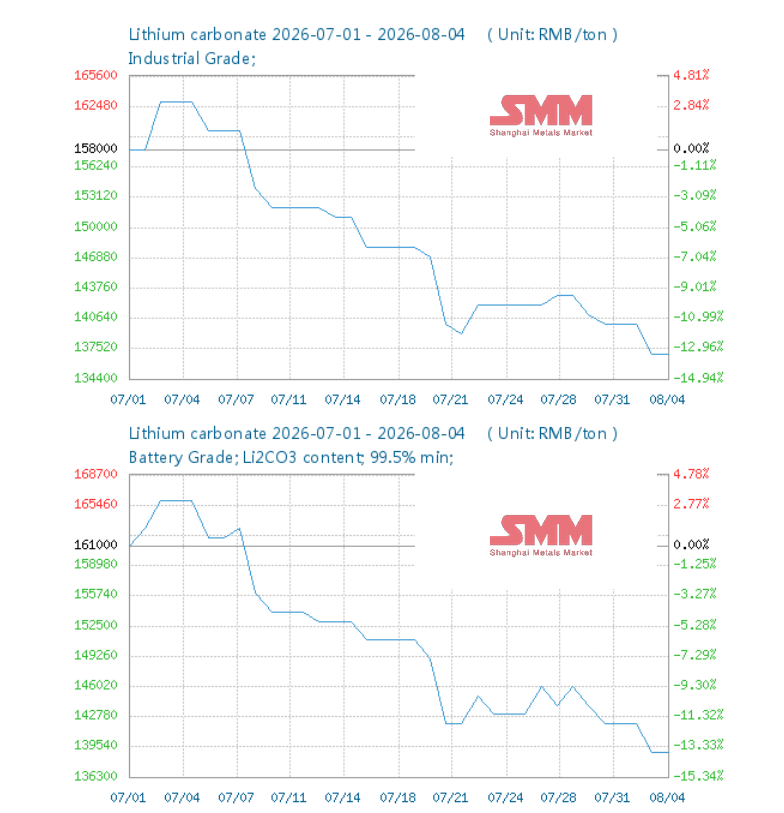
Battery-grade lithium carbonate stood at RMB 139,000/mt as of August 4, down 16.27% month-on-month, continuing a weak downward trend even as fundamentals strengthen a "strong reality, weak price" divergence now driving the market.
On the demand side, NEV and energy storage sectors remain robust, with domestic battery production schedules up 6-8% MoM in August and power battery demand steadily recovering, keeping utilization rates and rigid demand support above market expectations. On the supply side, overseas disruptions policy controls and geopolitical tension in lithium-rich countries, extreme weather in Argentina, and concentrated maintenance among domestic lithium salt producers continue to limit near-term supply growth.
Inventories have now declined for 12 consecutive weeks, with total social inventories falling to 114,300 mt as of the week ending July 30 and the pace of destocking accelerating. Downstream and distributor stocks are being steadily worked off, while only upstream smelters show slight accumulation, easing inventory pressure across the industry.
Despite this tightening spot picture, market funds have overdrawn pessimistic long-term expectations, with pricing logic now driven by forward supply demand outlook rather than current conditions. As H1 results from lithium battery producers confirm earlier optimism on energy storage demand, capital has rotated toward bearish positioning, focused on doubts over the sustainability of high-growth energy storage installation demand and expectations of an accelerated release of new production capacity pushing the market toward consensus on a looser future supply demand balance.
SMM view: Lithium carbonate is likely to maintain a "near-term strong, far-month weak" divergence rather than a unilateral trend. Continued destocking and resilient downstream demand should firm up spot prices as pessimistic sentiment gradually unwinds, while far-month contracts stay pressured by expectations of loose future supply and elevated industrial chain valuations. Close attention to supply-demand shifts is still warranted.
![[Solid-State Battery: ProLogium Technology Mass-Produces High-Energy-Density All-Solid-State Battery Gen3.5 Reaching 381 Wh/kg and 903 Wh/L]](https://imgqn.smm.cn/usercenter/nVnLo20251217171728.jpg)
![[SMM Analysis] Lithium Carbonate Prices Dip, Chile Exports 24,100 mt in August](https://imgqn.smm.cn/usercenter/MaxcL20251217171730.jpg)