A Standout Half-Year and What Sat Behind It
Valterra Platinum is one of the world's largest producers of platinum group metals, a family of six metals made up of platinum, palladium, rhodium, ruthenium, iridium and gold. It runs five mines in South Africa and Zimbabwe and it also buys and processes concentrate from other producers. For the six months to 30 June 2026 the company reported net revenue of R81.8 billion, up 93% and adjusted earnings before interest, tax, depreciation and amortisation of R33.4 billion against R6.6 billion a year earlier, which management described as a fourfold increase and the third highest interim profit in the company's history. Very little of the gain came from digging up more ore. Most of it came from prices and a meaningful part came from releasing metal the company had already mined and stored.
From Mine to Refinery: Valterra Sold More Metal Than It Mined
Mining and selling are separated by several months of processing. Ore is crushed and milled into a concentrate, that concentrate is smelted and only then is it refined into finished metal. Because of that delay, a company can refine and sell more metal in a given period than its mines produced, simply by working down the material sitting in the pipeline. That is what happened here. For Valterra, metal contained in concentrate rose only 4% to 1.52 million ounces, while refined production rose 25% to 1.74 million ounces. Refined output therefore ran at 1.15 times what the mines delivered, against 0.95 times a year earlier, a swing from adding 74,000 ounces to the pipeline to releasing 223,000 ounces from it.
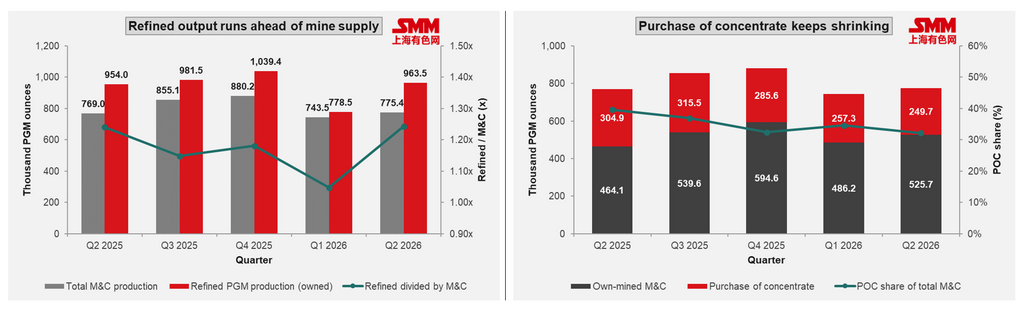
The second quarter alone ran at 1.24 times. The second chart shows where the raw material came from. Valterra's own mines produced 9% more at 1.01 million ounces, while concentrate bought from other producers fell 6% to 507,100 ounces. Third-party concentrate now accounts for 33.4% of total feed, down from 36.8% and just 32.2% in the second quarter.
Which Mines Delivered and What Else Came Out of the Ground
Valterra's mines are not interchangeable, because each orebody carries a different blend of metals. Mogalakwena is the largest by volume, producing 441,200 ounces in the half, including 188,800 ounces of platinum and 202,100 ounces of palladium. Amandelbult produced 274,100 ounces in total, less platinum than Mogalakwena at 137,800 ounces, yet more than twice as much rhodium at 25,100 ounces and more of the minor metals at 47,200 ounces. That matters, because rhodium and the minor metals were the strongest price performers in the period. Amandelbult also mines richer ore and milled 66% more of it than a year earlier, having been hit by flooding in the comparative period. Mototolo produced 126,800 ounces, Unki 103,500 ounces and Modikwa 66,200 ounces on Valterra's 50% share.
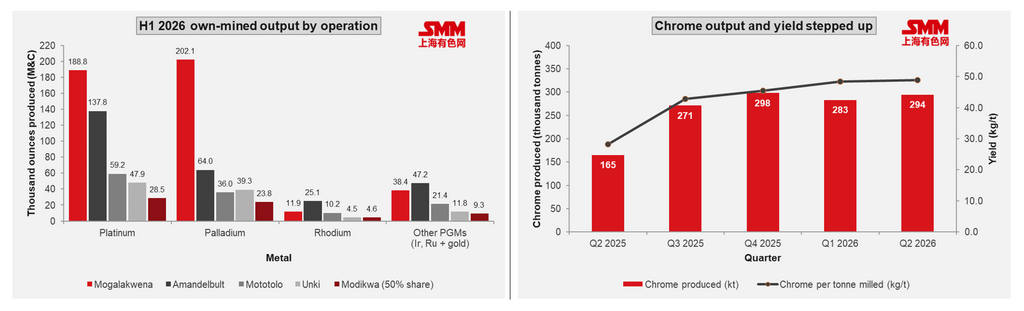
In addition, Chrome production rose 66% to 576,000 tonnes and the group recovered 48.5 kilogrammes of chrome for every tonne of ore milled, against 30.0 kilogrammes a year earlier. Chrome is produced at Amandelbult, Mototolo and Modikwa and the revenue it earns helps offset mining costs.
Prices: A Peak in the First Quarter, Then a Step Back
Because Valterra sells six metals at once, it reports an average price for the mix, known as the basket price. In dollars, that basket climbed from US$1,508 an ounce in the second quarter of 2025 to a peak of US$2,911 in the first quarter of 2026, then eased to US$2,710 in the second quarter. Averaged over the half it came to US$2,801, up 85% and the strongest six-month average the company has achieved since the first half of 2021. In rand the increase was smaller at 66%, reaching R45,993 an ounce, because the rand strengthened from R18.39 to R16.44 against the dollar and a stronger local currency converts each dollar of sales into fewer rand. The lesser-known metals led the move. Ruthenium prices rose 167%, platinum 106%, rhodium 94%, iridium 71%, palladium 59% and gold 56%.
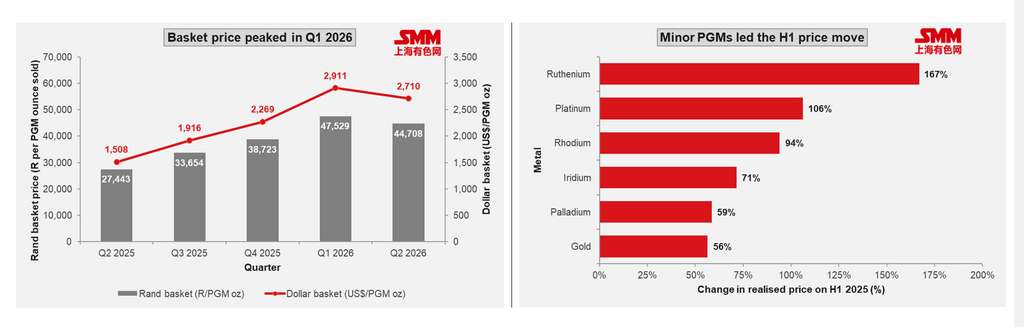
Valterra reports that every one of these metals peaked in the first quarter, several at multi-year or record highs, before softening in the second quarter while remaining well above 2025 levels.
Where the Money Came From: Amandelbult's Recovery and a Larger Chinese Order Book
The first chart below breaks the R26.8 billion increase in earnings down by operation and one asset stands out. Amandelbult swung from a loss of R1.1 billion to a profit of R7.8 billion, an improvement of R8.9 billion, or roughly a third of the group's entire increase. Mogalakwena added R5.8 billion, purchased concentrate and toll processing added R4.8 billion, Mototolo R2.6 billion, Unki R2.2 billion and Modikwa R1.2 billion, with a further R1.2 billion from trading, corporate items and other mined operations. The eighth chart turns to customers. China rose from 6.0% of gross sales revenue to 15.1%, worth about R12.2 billion, while Hong Kong fell from 8.1% to 3.6%, Japan from 29.5% to 24.4% and the United Kingdom from 28.5% to 26.9%.
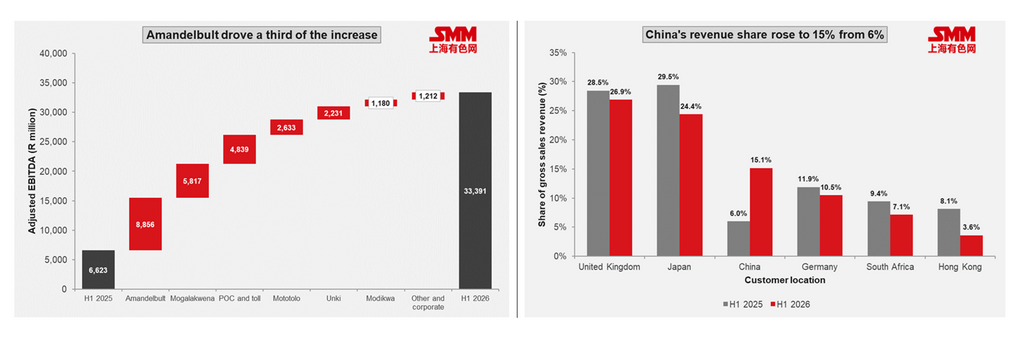
One caution is worth stating plainly. These figures record where the customer is located, so they reflect contracting and trading routes as much as where the metal is finally used.
General Outlook
Valterra has kept its 2026 production target of 3.0 to 3.4 million ounces and expects a heavier weighting towards the second half, with capital spending of R17.0 to R18.0 billion. Costs held up well, with the cash cost of mining an ounce almost unchanged at R20,677 and the broader all-in sustaining cost falling 21% in dollar terms to US$996 an ounce, though most of that dollar improvement reflects the stronger rand and higher by-product income rather than genuine cost reduction. Input cost inflation ran at about 7.2%, of which roughly one percentage point, or R0.3 billion, is attributed to the Middle East conflict and management now expects unit costs at the upper end of guidance.
Three things deserve attention in the second half. First, the pipeline release that flattered refined output cannot repeat indefinitely. Second, purchased concentrate is guided down to 0.8 to 0.9 million ounces by 2028, which tightens the feed available to Valterra's processing plants. Third, guidance assumes R17.00 to the dollar against R16.44 actually achieved, so continued rand strength would trim rand revenue even if dollar prices hold. Unki's full-year target has already been cut to 200,000 - 220,000 ounces because of ground conditions in a higher-grade area, with planned tonnage unchanged, so this is a grade issue rather than a volume one.
On demand, vehicles account for about two thirds of platinum, palladium and rhodium consumption and it is expected that demand would fall to around 3% in 2026, while global mine supply of the three main metals is likely to decline about 3%. Valterra expects platinum to remain in short supply and it points to newer sources of demand including artificial intelligence and data centres, which are estimated at 200,000 - 400,000 ounces a year today, with the potential to grow up to fivefold by 2030. Partnerships with Umicore in Germany, Pujing Chemicals in China, Sibanye-Stillwater and Johnson Matthey are aimed at building that industrial demand.

![[SMM Precious Metals Express]](https://imgqn.smm.cn/usercenter/nQsOk20251217171736.jpg)