August 3, 2026
The precious metals markets remained highly volatile over the past several days while continuing to trade within what has ultimately been a relatively narrow range. Gold began the week with an upside gap and rallied to US$4,116, only to retreat to US$3,996 shortly before yesterday's Federal Reserve interest rate decision. Following the announcement, prices rebounded back to US$4,116 within hours before coming under renewed pressure late in the session and during early Asian trading, falling to US$4,042 and US$4,028, respectively. Overall, however, little has changed compared to last week's close of US$4,054. Silver traded within a range of US$56.62 to US$60.09 over the same period. Both metals remain locked in an uncertain sideways consolidation as they continue searching for a clear bottom and a decisive trend reversal.
Two Time Horizons, One Market
The precious metals market continues to be influenced by two very different time horizons. On one hand, a structural demand story unfolding over many years—driven largely by China—continues to provide strong fundamental support for gold. On the other hand, Federal Reserve policy, bond market developments, corrections in technology and semiconductor stocks, and the escalating conflict with Iran continue to generate short-term shocks that affect not only gold and silver but virtually every financial market sector.
The Fed Holds Steady While the Market Tightens Financial Conditions
This tension between long-term fundamentals and short-term volatility was highlighted once again by the Federal Reserve's latest policy decision. The U.S. central bank left interest rates unchanged at 3.50%–3.75% for the fifth consecutive meeting. More noteworthy than the decision itself, however, was the reaction in the bond market. While two-year Treasury yields declined, the 30-year Treasury yield surged to approximately 5.21%, its highest level in nearly two decades. Fed Chair Warsh deliberately avoided providing forward guidance, instead pointing to the increases already taking place across the yield curve. The result is an unusual situation: although the Fed has left its policy rate unchanged, the bond market is effectively tightening monetary conditions on its own through rising long-term yields.
Real Yields Versus Currency Debasement
For gold and silver, this environment creates conflicting forces. Rising long-term real interest rates traditionally weigh on precious metals, while declining confidence in long-duration government bonds and growing concerns about fiscal deficits and currency debasement strengthen gold's appeal as an alternative store of value.
Geopolitics Continues to Fuel Inflation Concerns
The already complicated picture has been further intensified by the military escalation between the United States and Iran. Following Iranian missile attacks on U.S. positions, CENTCOM responded with strikes against Islamic Revolutionary Guard Corps (IRGC) targets. Brent crude oil briefly climbed above US$94 per barrel amid concerns over the Strait of Hormuz, through which roughly one-fifth of global oil shipments normally pass. Higher energy prices continue to increase inflationary pressures worldwide, reinforcing the Federal Reserve's cautious approach toward monetary policy.
Selling Pressure from Financially Stressed Holders
While geopolitical risks continue to support inflation concerns, they have also created selling pressure in the gold market. Financially strained Gulf states and countries such as Turkey have reportedly sold portions of their gold reserves to stabilize their currencies. These transactions temporarily increase supply but do not alter the longer-term demand trend. Instead, they represent a transfer of gold from weaker holders to long-term strategic buyers, particularly in Asia.
China's Strategic Gold Accumulation Remains the Dominant Long-Term Story
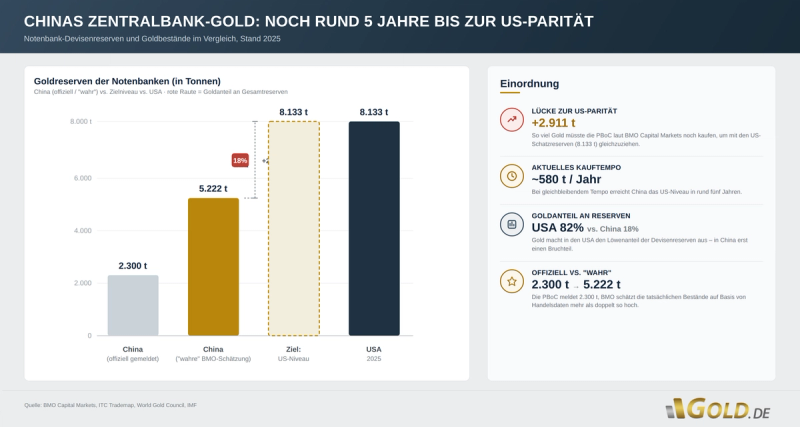
Zentralbank-Goldreserven China vs USA, vom 27. Juli 2026. © BMO, Gold.de
The recent market turbulence has overshadowed what remains the dominant long-term narrative: China's systematic accumulation of gold. According to a recent BMO analysis, China has accumulated approximately 29,500 tonnes of above-ground gold since 1949, compared with an estimated 32,200 tonnes held by the United States. Remarkably, 93% of China's total gold accumulation has occurred during the past 25 years.
The People's Bank of China officially reports gold reserves of around 2,300 tonnes, but discrepancies between reported central bank purchases and actual gold flows from the United Kingdom and Switzerland since 2022 suggest China's true holdings could be closer to 5,200 tonnes.
Two Targets, One Timeline
Based on these estimates, BMO outlines two potential milestones. China would require approximately 2,911 additional tonnes to match U.S. official central bank reserves, a target that could be reached in roughly five years at the current pace of purchases. To match total U.S. above-ground gold holdings, China would need only around 2,700 tonnes, a level that could potentially be reached in as little as two years.
Shanghai and Hong Kong Are Emerging as a New Pricing Hub
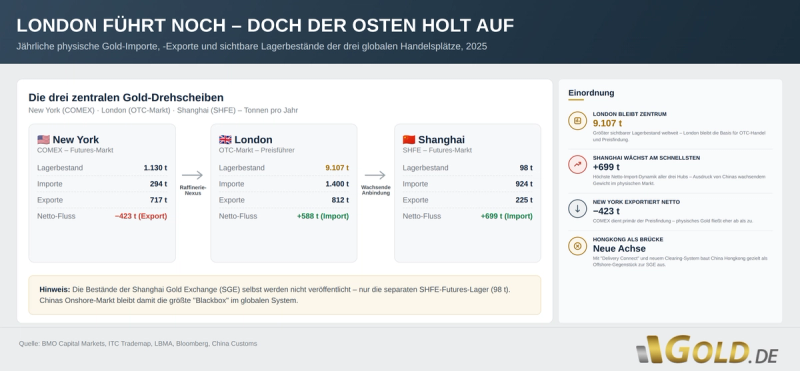
Globale Gold Handelsplätze, vom 27. Juli 2026. © BMO, Gold.de
At the same time, China continues expanding the Shanghai Gold Exchange while strengthening Hong Kong as an offshore gold trading center through new clearing systems, the Delivery Connect program, and the reintroduction of U.S. dollar-denominated gold futures. Together, these initiatives are creating a second global pricing hub alongside the London Bullion Market Association (LBMA) and New York's COMEX, while supporting the broader internationalization of the renminbi.
Gold Remains Resilient Despite Strong Headwinds
Despite the challenging macroeconomic backdrop, gold has shown remarkable resilience. The actively traded August futures contract gained 0.91% yesterday to close at US$4,065.50, a respectable performance considering both the geopolitical escalation and the Federal Reserve meeting. BMO continues to forecast additional upside during the second half of 2026, targeting approximately US$4,750 by the fourth quarter once inflation concerns related to the conflict begin to ease. The Jackson Hole symposium at the end of August is widely viewed as the next major catalyst.
Silver Caught Between Conflicting Forces
Silver currently finds itself in a particularly difficult position. Historically, silver follows gold's direction, often with considerably higher beta. If gold successfully maintains support around US$4,000 and resumes its recovery, silver could potentially deliver even stronger gains.
Unlike gold, however, silver lacks one critical pillar of the China investment thesis: there is no structural central bank demand providing long-term support. Instead, silver remains much more dependent on two other factors—the direction of real interest rates and industrial demand, particularly from the solar energy sector, which has remained relatively resilient despite inflationary pressures and higher energy costs.
Silver Forms a Potential Wedge Pattern
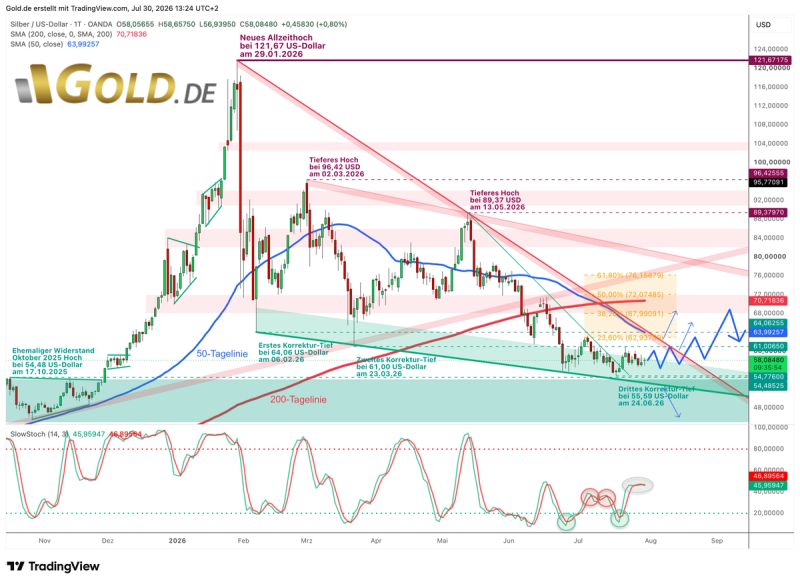
Silber in US-Dollar, Tageschart vom 17. Juli 2026. ©Gold.de
Since late June, silver has been attempting to establish a slow, narrow and rather confusing bottoming formation. Prices remain well below both the declining 50-day moving average at US$63.99 and the relatively flat 200-day moving average at US$70.71. At the same time, bears have repeatedly tested the broad support zone between US$55 and US$60 without achieving any meaningful downside follow-through, leaving a potentially bullish wedge pattern intact.
Daily stochastic indicators have yet to generate meaningful upside momentum and continue to drift sideways, reflecting the fading media attention toward precious metals and the typically quieter summer trading environment.
Nevertheless, prospects for a recovery remain favorable. Seasonally, silver has historically performed well between late June and early September, making a return toward the rapidly declining 50-day moving average appear entirely plausible later this summer.
Given the growing number of bearish forecasts calling for gold to fall toward US$3,500, the market could just as easily remember that precious metals remain within a long-term secular bull market. Only six months ago, gold and silver had outperformed nearly every other asset class. A sudden shift in market sentiment could therefore transform the current setup into what many investors would view as an attractive "buy-the-dip" opportunity.
Conclusion: Silver's Bottoming Process Remains Complicated
The precious metals sector continues to move through a complex period in which long-term structural trends are colliding with short-term macroeconomic shocks. While gold remains fundamentally supported by China's ongoing accumulation strategy and growing concerns about currency debasement, rising long-term real yields, the Federal Reserve's cautious stance, weakness in technology stocks, and escalating geopolitical tensions continue to weigh on near-term price action.
Silver, meanwhile, remains trapped between US$56 and US$60, searching for a decisive trend reversal. Seasonal patterns and the emerging wedge formation continue to support the case for a recovery later this summer.
The central investment thesis for the second half of the year remains unchanged. Once inflation concerns related to the geopolitical conflict begin to ease and interest-rate uncertainty subsides, gold could resume its advance. Given silver's historically higher beta, it would likely outperform during such a move. Unlike gold, however, silver lacks the powerful structural support provided by central bank buying and therefore remains more dependent on industrial demand—particularly from the solar sector—and on the direction of real interest rates.
Overall, the current consolidation can still be viewed as a potential buy-the-dip opportunity within an ongoing secular bull market, although investors continue to await more convincing technical confirmation, such as a sustained move back above silver's 50-day moving average.
Source:https://goldinvest.de/en/silver-a-complex-bottoming-process-continues