1. Phenomenon: Within the same computing power leasing industry chain, lease contract terms for domestic GPU servers and Nvidia GPU servers
There is a clear divergence in contract terms between domestic computing power leasing and Nvidia computing power leasing. Domestic servers can be rented on an annual basis, while Nvidia servers generally require a minimum of three-year fixed contracts.

Domestic cards fall into a "buyer’s market" : Ascend 910B2 sees high vacancy rates and lower quotations in some regions. Operators and lessors offer one-year short-term contracts in exchange for liquidity, reflecting typical oversupply pricing.
Imported cards fall into a "seller’s market" : For H100/H200, not only is the minimum lease term fixed, but a five-year fixed contract is only about 3,000–5,000 yuan/month cheaper than the three-year one (according to SMM sources) — if a buyer signs a five-year contract to save costs, the discount is not enough to cover the risk of the additional two-year lock-in period. The fact that buyers are willing to accept this just shows the core demand is "securing card access in the next five years," rather than price .
SMM Analysis: Contract term clauses have become a tool for the supply side to "screen clients by contract length" — domestic cards use short contracts to attract clients, Nvidia cards lock in clients with long contracts.
2. Supply Side: Nvidia GPU embargo sanctions lock in supply
Below is a timeline of US Department of Commerce controls on exports of high-end chips like Nvidia H100 and B300 to China:
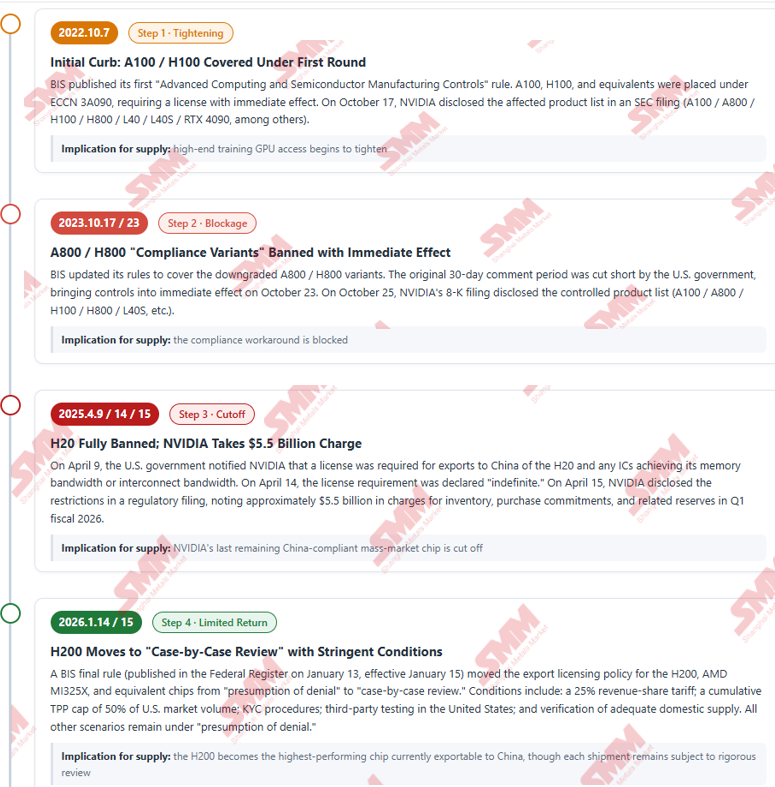
SMM Insight: From H100, H800 to H200, the supply of high-end cards to China over the past four years has been in a cycle of "control—tightening—limited clearance"; the "case-by-case review" for H200 also means that each shipment delivery is fraught with uncertainty. For lessees, if they don’t lock in resources today, they may not be able to purchase them tomorrow — this is the most fundamental supply-side logic behind 3-year/5-year fixed contracts.
3. Demand Side: Intelligent computing power enters a period of explosive growth, and the supply-demand scissors gap widens
The explosion of intelligent computing demand has turned "resource locking" from an option into a necessity in computing power leasing:
Total intelligent computing capacity increased substantially : According to data disclosed by the MIIT on July 20, 2026, as of the end of June 2026, China’s intelligent computing capacity reached 2,185 EFLOPS (FP16) , up about 37% from approximately 1,590 EFLOPS at the end of 2025. Among this, the western region accounted for 32.6%, and the national computing facility utilization rate was 71.4%.
Scissors gap widens : According to data from CAICT, in Q1 2026, domestic AI computing demand surged 417% YoY , while supply growth was only around 128% — demand growth was about 3.3 times that of supply.
Structural gap : According to public industry estimates, the effective supply of high-end computing power required for long-cycle training of large models in China can only meet less than 47% of market demand, and the shortfall in high-end training computing power accounts for about 35% of effective demand.
SMM Insight: Nvidia GPU supply is locked by trade controls, while intelligent computing demand grew by 417%. The high-end computing power supply-demand gap is unlikely to close in the visible future of the next 3–5 years, which corresponds exactly to the lock-in periods of fixed contracts.
4. Substitution Side: Domestic cards still lag behind the CUDA architecture in terms of development environment
The structural driver for the three-year minimum lease for Nvidia GPU servers is the current gap in replacing Nvidia with domestic computing power. In terms of development environment, the popularity of Nvidia’s CUDA ecosystem leads that of domestic development environments (global data; China’s AI development environment is homogeneous):
GPU market share : Nvidia holds about 86%–92% of the global data center GPU market (according to Silicon Analysts 2026.2 / Jon Peddie Research Q3 2025).
Developer scale : According to Nvidia, 6 million developers worldwide use CUDA, and over 400 optimized libraries (cuDNN/NCCL/TensorRT, etc.) have been accumulated on top of it.
Framework de facto standard : The default GPU backends for PyTorch and TensorFlow are both CUDA; approximately 85% of deep learning papers use PyTorch (over 90% at top conference NeurIPS), and about 87% of models on Hugging Face are in PyTorch format.
Ecosystem chasm : The official nvidia/cuda image has been pulled about 105 million times cumulatively, while the closest AMD ROCm image has been pulled less than 1 million times — an order-of-magnitude gap .
SMM Insight: Huawei’s Ascend 910B2 pure computing power has approached or even slightly surpassed Nvidia A100, and the actual throughput gap in inference scenarios is often narrowed to 10%–15%. What is truly difficult to replace is large-scale training, FP8 precision, and the migration cost of the CUDA/CANN ecosystem (Ascend model migration requires rewriting operators, with a cycle of about 1–4 weeks). Therefore, high-end training clients would rather accept a 3-year fixed contract for imported cards than settle for a one-year short-term contract for domestic cards — it is not a price issue, but a matter of actual task delivery and execution .
5. Frontline Observations: Project managers shift from "running the demand side" to "running the supply chain upstream"
Micro signals of supply chain tightness have already been transmitted from quotation sheets to the daily routines of practitioners. According to SMM understanding , the daily focus of telecom operators’ computing power project managers is undergoing a role shift:
In the past : The main battlefield for project managers was on the client side — expanding demand, negotiating business, and competing on prices, corresponding to a market where computing power was oversupplied and they had to seek out clients.
Now : The main battlefield has shifted to the upstream equipment suppliers in the supply chain — scheduling production, scrambling for quotas, sorting out high-end computing device channels, and locking in goods with server OEMs, corresponding to a market where high-end computing power is extremely scarce. At the same time, the computing power leasing transaction market is chaotic, lacking unified and standardized quotations; there are many intermediaries and agents in the industry. In a 200-person computing power leasing WeChat group with active transaction information, there are 76 intermediaries, accounting for as much as 38%. Identifying genuine computing power equipment supply channels that can directly connect to the cargo owner is also a difficulty in the daily work of operator managers.
Public evidence is equally clear: the delivery lead time for domestic AI servers has stretched from an average of 4 weeks in 2025 to 16–20 weeks in Q2 2026—"running the supply chain" rather than "chasing clients"—the most authentic market footnote to tight server supply.
VI. Conclusion and Outlook: Closed-End Contracts as a “Hedging Tool” Amid Tight Supply Chain
SMM believes: Nvidia GPU rentals commonly require three- or five-year closed-end contracts, which essentially establish a hedging and lock-in mechanism to cope with equipment supply shortages and tight supply under sanctions pressure —the lessee trades duration liquidity for “computing power availability + price certainty,” while the lessor locks in scarce capacity and stable cash flow through long-term agreements. Contract duration thus becomes the most direct gauge of high-end computing power scarcity. The key difference is that the one-year short contract for domestic cards reflects oversupply; Nvidia’s three-year closed-end contract embodies undersupply— the same contract terms write overcapacity on one side and supply chain crisis on the other . When contract duration begins to price the market, computing power leasing has already evolved from renting machines into a business model centered on resources, duration, and credit.
Outlook for the Computing Power Leasing Industry:
Short term (3–6 months): With export controls remaining firm and the case-by-case review pace for H200 unchanged, the three-year closed-end starting lease will stay the mainstream term for computing power lessors in western China and the Yangtze River Delta, while five-year closed-end concessions will remain low.
Medium term (6–12 months): If HBM/CoWoS capacity ramp-up (new supply expected to be released starting H2 2026) eases global tightness, import card closed-end discounts may widen slightly; but the “resource lock-in” logic will not reverse.
Long term (over 1 year): The core variable lies in the actual breakthroughs of domestic substitution—if Huawei Ascend 950 and subsequent iterations substantially fill the training ecosystem gap, the “dual-track system” of contract durations will converge as the bargaining power of domestic cards rises; at that point, the boundary between one-year short contracts and three-year closed-end contracts will be redrawn in favor of the domestic camp.

![[SMM Computing Power Express] A certain intelligent computing service provider: H100 3-year term starting from 75,000 yuan/month](https://imgqn.smm.cn/usercenter/yhuhG20251217171735.jpg)
![[SMM Computing Power Express] 20 non-networked 5090 8-card machines for rent in South China, monthly rent 13,000](https://imgqn.smm.cn/usercenter/kLgYV20251217171736.jpg)