Background: Pangkalpinang Case Triggered Wider REE Scrutiny
Indonesia’s recent rare earth element (REE), or Logam Tanah Jarang (LTJ), inspection issue appears to have been triggered by stricter government scrutiny following the Pangkalpinang case. The initial case was linked to alleged irregularities involving around 390 tonnes of REE-containing material and involved PT Putraprima Mineral Mandiri, PT Sucofindo, and the Pangkalpinang Customs office. This raised a broader regulatory question: when a mining product contains rare earth elements or radioactive elements as associated content, should it still be treated as its main export product, or should it fall under rare-earth-related export restrictions?
This issue quickly affected Indonesia’s wider mineral export chain. Products such as NPI, ferronickel, MHP, alumina, and tin-related products are not exported as rare earth products. However, they may contain trace amounts of associated REE or radioactive elements. As a result, surveyors and customs became more cautious, causing delays in LS issuance and customs clearance for some cargoes.
For the nickel industry, the issue became an immediate concern because both NPI/ferronickel and MHP exports were affected by additional testing requirements. Market feedback indicated that some cargoes were temporarily stuck, and the disruption was not limited to one company. Some traders also reported that QMB-related cargoes could not be shipped smoothly during the disruption period.
Why REE Matters: Indonesia Moves to Protect Critical Mineral Value Before Export
REE matters because rare earth elements are strategic materials used in high-value industries such as electric vehicles, permanent magnets, electronics, renewable energy, and defense-related materials. For Indonesia, the issue is not only about export clearance, but also about resource-value control. The government is increasingly focused on identifying and protecting critical mineral value before it leaves the country.
The challenge is that REE often appears not as a standalone product, but as an associated or trace element in other mineral products. If every product containing small REE content is treated as a restricted rare earth export, normal mineral shipments could be delayed. However, if REE content is not monitored at all, Indonesia may lose control over strategic mineral value.
The 17 rare earth elements generally include lanthanum, cerium, praseodymium, neodymium, promethium, samarium, europium, gadolinium, terbium, dysprosium, holmium, erbium, thulium, ytterbium, lutetium, yttrium, and scandium. In the recent market discussion, testing was understood to cover these 17 REE elements, while radioactive elements such as thorium and uranium also became part of the inspection concern.
The problem is that rare earth elements are often not produced as standalone products. They can appear as associated elements in other mining products. This creates a regulatory grey area. If every exported product containing trace REE must be treated as a rare earth export, then many normal mineral shipments could be delayed. But if associated REE content is not checked at all, Indonesia risks losing control over strategic mineral value.
Therefore, the market concern is not only whether nickel exports are blocked. The larger concern is whether Indonesia is entering a new phase where exports of mineral products require more detailed chemical-content verification.
What Happened in the Market: LS Delays and Additional Testing Disrupted Mineral Shipments
According to SMM’s market understanding, the recent inspection requirement temporarily affected exports of several Indonesian processed mineral products. For nickel products, the impact was mainly reflected in three areas.
- LS issuance slowed down. The LS report is a key export document, so delays directly affected customs clearance and shipment release. According to SMM’s understanding on July 24, it is reported that around 102 surveyor reports were delayed due to differences in interpretation regarding REE checks during export verification.
- Some cargoes were temporarily stuck at ports. Market participants reported delays in NPI and MHP shipments, while some traders also mentioned that QMB-related cargoes faced similar obstacles.
- Exporters had to organize additional testing. The government required checks on 17 REE elements and radioactive elements in certain products. Some companies were still waiting for test results or clarification from surveyors and customs.
- Therefore, this was not a direct export ban on nickel products. It was mainly a temporary administrative and testing bottleneck caused by unclear implementation standards for associated REE and radioactive elements.
Impact on the Nickel Market: NPI and other Nickel Product Exports Affected Mainly Through Shipment Delays
For the NPI and ferronickel market, the short-term impact was mainly reflected in shipment timing rather than production. Some port-side cargoes were delayed because LS reports and customs clearance were affected. According to SMM’s latest market understanding, LS reports are currently being issued in batches, and some high-grade NPI cargoes at ports have started to be released.
As the current disruption mainly occurred during the export documentation and clearance process, the direct impact on NPI production was limited. If LS issuance and customs clearance continue to normalize, the impact on the overall NPI market is expected to remain limited. At this stage, the issue is more related to temporary export procedure disruption rather than a confirmed structural restriction on NPI exports.
For the MHP market, some shipments were also affected by the REE-related inspection requirement. According to market feedback, certain MHP cargoes, were temporarily unable to be shipped smoothly during the disruption period. Similar to NPI, the key issue was mainly related to LS issuance, testing requirements, and customs clearance rather than a direct restriction on MHP production.
The government’s latest coordination result clarified that export procedures should refer to the main mining product and its derivatives, rather than automatically treating associated REE or radioactive elements as the basis for export restriction.
Market Feedback and Industry Concerns: Lack of Technical Standards Created Uncertainty for Exporters
Market feedback shows that the REE-related inspection requirement has created practical disruption for Indonesia’s mineral export chain. According to FINI Chairman Arif Perdanakusumah, at least 120 commodity vessels were unable to sail or leave ports due to the requirement to test rare earth element content. He noted that the situation caused losses not only for companies, but also for the government, mainly because there was still no clear regulation providing technical guidance on REE content limits.
Industry associations generally understand that the policy is part of the government’s effort to improve mineral governance. However, they also emphasized that the technical implementation needs to be reviewed, especially because many mining products contain REE only as associated or trace elements rather than as the main product. This distinction is important for commodities such as nickel, bauxite, tin, and copper, where companies are licensed and designed to produce the main commodity, while REE content may naturally appear as a by-product or associated element.
The bauxite industry also raised similar concerns. ABI Chairman Ronald Sulistyanto stated that the REE issue should be returned to its core technical framework and handled by the Ministry of Energy and Mineral Resources, as the ministry has the relevant mining and mineral expertise. He stressed that the key question is whether REE is the main product or only an associated element. If it is the main product, then specific export restrictions may apply. However, if it is only an associated element, the issue requires more detailed technical clarification rather than broad export disruption.
IMA Executive Director Sari Esayanti also highlighted that most mining companies are currently oriented toward their main licensed commodity and existing processing design. In many commodities such as tin, bauxite, nickel, and copper, REE generally appears as an associated element. She also noted that most mining companies do not yet have sufficient facilities or technology to identify, separate, or economically utilize REE elements. As a result, new interpretations around REE reporting or export obligations have created uncertainty for business players.
From the industry’s perspective, the most urgent requirement is technical certainty. Companies need clearer parameters, testing methodology, and reporting mechanisms so that all exporters, surveyors, and customs authorities apply the same standard. Without consistent technical guidance, similar shipment delays could occur again even if the current bottleneck is gradually resolved.
Government Update and Resolution
The most important update came from the Indonesian government coordination letter dated July 31, 2026. According to the letter, Indonesia’s Coordinating Ministry for Economic Affairs held a coordination meeting on July 30 to discuss export obstacles related to REE and/or radioactive content in mining products and derivatives.
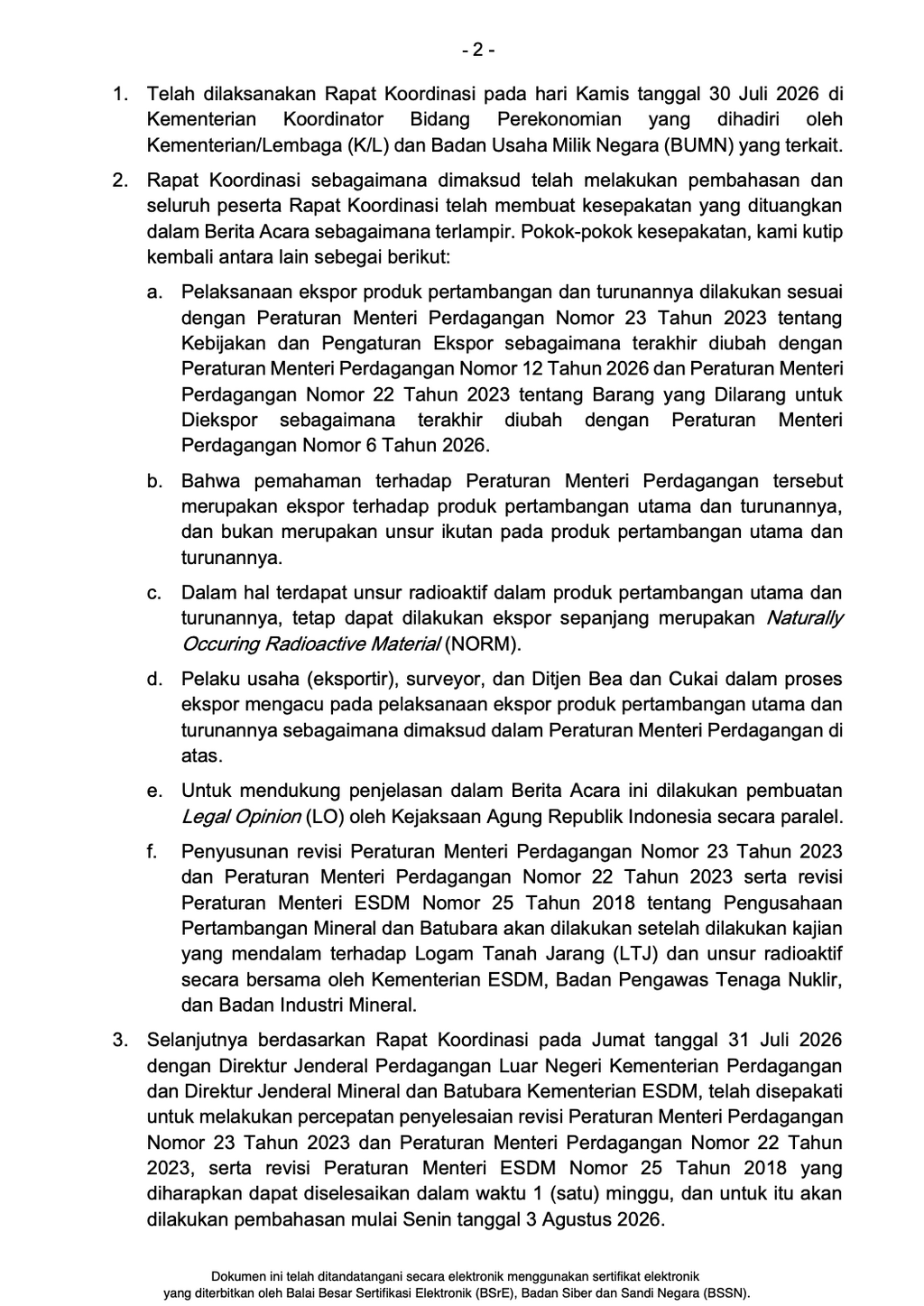
Key points from the government coordination result:
- Exports should continue to follow existing trade regulations, including Minister of Trade Regulation No. 23/2023 on export policies and arrangements, and Minister of Trade Regulation No. 22/2023 on prohibited export goods, as amended by later regulations.
- The regulation should apply to the main mining product and its derivatives, not automatically to associated elements contained in those products. This is the most important clarification for NPI, ferronickel, MHP, alumina, and other processed mineral products.
- Products containing radioactive elements may still be exported if the content is classified as Naturally Occurring Radioactive Material, or NORM. This helps reduce the risk that trace radioactive content automatically blocks exports.
- Exporters, surveyors, and customs should refer to the main product classification when processing exports.This provides a basis for LS issuance and customs clearance to gradually resume.
- A Legal Opinion from the Attorney General’s Office will be prepared in parallel to support the regulatory clarification.
- The government plans to accelerate revisions to Minister of Trade Regulation No. 23/2023, Minister of Trade Regulation No. 22/2023, and Minister of ESDM Regulation No. 25/2018. Discussions are expected to start on August 3, 2026, with completion targeted within around one week.
SMM View: Short-Term Export Disruption, but a Longer-Term Signal of Stricter Mineral Supervision
SMM believes the REE inspection issue is a short-term disruption, but also an important policy signal. In the short term, the impact on NPI and MHP exports should gradually ease as LS reports are issued and customs interpretation becomes clearer. If cargo clearance continues to normalize, the impact on overall nickel supply-demand balance should remain limited.
However, the event shows that Indonesia is strengthening supervision over critical mineral content, export documentation, and resource-value protection. Even after the current disruption is resolved, exporters may face stricter testing, clearer reporting requirements, and closer coordination among surveyors, customs, ESDM, the Ministry of Trade, and other agencies.
Going forward, the market should monitor:
-
Whether all delayed LS reports can be fully cleared.
-
Whether future shipments will require full REE and radioactive-content testing.
-
Whether the government will set clear thresholds for REE, thorium, uranium, and NORM classification.
-
Whether the revised regulations clearly distinguish main export products from associated trace elements.
-
Whether NPI, ferronickel, MHP, alumina, and tin-related products will face different implementation standards.
Overall, this event should not be interpreted as a direct ban on NPI or MHP exports. It is more accurately a regulatory clarification process triggered by Indonesia’s stronger focus on rare earth and radioactive element content in mineral products. If implementation becomes clear quickly, the impact will remain temporary. If rules remain vague, shipment delays and administrative friction could reappear.
![[SMM Nickel Midday Review] On August 26, nickel prices edged up, and Iran said the Strait of Hormuz will not be reopened immediately.](https://imgqn.smm.cn/usercenter/OjGlE20251217171734.jpg)
![[SMM Stainless Steel Flash] US-Canada Trade Talks Collapse, 50% Tariffs on Canadian Steel and Aluminum Remain](https://imgqn.smm.cn/usercenter/qKBjc20251217171650.jpg)