Key Points:
Technology Path: Lithium-sulfur battery developed based on the 3D Graphene platform, completely eliminating nickel, cobalt, manganese, and graphite, with a theoretical energy density of 2,600 Wh/kg and a maturity target of 600 Wh/kg;
Dip-Buying Acquisition: Approximately $5 billion to acquire Northvolt's core European assets, including Sweden's Ett (16 GWh existing capacity), Poland's Dwa (BESS manufacturing), Sweden's Labs (R&D center), and Germany's Drei (110-hectare site under construction);
Capacity Plan: Nevada's 10 GWh gigafactory to commence production in 2027, Sweden's Ett to resume commercial sales in H2 2026, and Germany's Drei to sign an exclusive MoU with the deal expected to close in Q3 2026;
Market Strategy: Avoid long-cycle automotive certifications and prioritize entry into short-cycle, high-value markets such as AI data centers, national defense, and drones;
Production Period: The first batch of test batteries to be produced in Q3 2026, with mass production commencing between the end of 2026 and Q1 2027.
Preface
In the global solid-state battery race, a lithium-sulfur battery startup from Silicon Valley in the US is rapidly rising with a unique "dip-buying acquisition" strategy. Lyten, through successive acquisitions of core assets from the bankrupt European battery giant Northvolt, has secured 16 GWh of existing capacity, Europe's largest battery R&D center, and over 100 GWh of expansion space at a significant discount to valuation. Meanwhile, Lyten's lithium-sulfur battery technology, built on its patented 3D Graphene platform, completely eliminates nickel, cobalt, manganese, and graphite in its material system, carving out a technological path fundamentally different from traditional solid-state batteries.
On July 1, 2026, Lyten, a global leader in the battery and energy storage sector, announced the signing of an exclusive memorandum of understanding (MoU) to acquire Northvolt Drei assets located near Heide, Germany. The MoU was jointly signed by Lyten, KfW (German state-owned development bank), Northvolt Drei Project GmbH, and its shareholder LG Batterie GmbH.

Northvolt Drei, formerly owned by Northvolt AB, is a battery gigafactory project under construction covering 110 hectares, with considerable site preparation and the installation of electricity and utilities already completed. Under the MoU and an exclusivity agreement with the government of Schleswig-Holstein, Lyten will bear costs related to asset maintenance and employee salaries. All parties are working toward signing a final sale agreement in Q3 2026, with the transaction subject to customary regulatory and closing conditions.
Lyten CEO and co-founder Dan Cook stated, "We are very pleased to formally take the next step in completing the acquisition of Northvolt Drei assets. Europe has entered a period of sustained infrastructure investment growth, with power demand from electrification, AI data centers, and national defense driving long-term expansion. We plan to develop Drei into a clean battery and industrial manufacturing hub in Germany, synergized with AI infrastructure. The site benefits from abundant renewable energy and exceptional regional talent. This is a multi-decade strategic asset for Lyten."
Over the past 12 months, Lyten has completed acquisitions of multiple former Northvolt assets in Europe, including Northvolt Ett in Skellefteå, Sweden (one of Europe’s largest battery manufacturing sites), Northvolt Dwa in Gdańsk, Poland (one of Europe’s largest BESS manufacturing sites), and Northvolt Labs in Västerås, Sweden (one of Europe’s largest battery R&D centers).
The following concerns Lyten’s solid-state battery layout. This article will systematically outline Lyten’s strategic deployment in next-generation batteries from dimensions such as technology roadmap, product performance, capacity planning, company background and partnership dynamics.
1. Technology Roadmap
Lyten pursues a lithium-sulfur battery technology route, which differs significantly from conventional solid-state batteries (sulfide/oxide all-solid-state) in material systems and electrolyte form.
Lyten’s core technology is its proprietary “Lyten 3D Graphene” platform. The technical principle of this platform is to convert greenhouse gases into solid carbon and hydrogen, in which the carbon is permanently sequestered in the form of a three-dimensional metamaterial—3D Graphene. This 3D graphene features a tunable hierarchical pore structure spanning nano-, micro- and meso-scales, serving as an ideal host for the sulfur cathode. It physically confines sulfur and its intermediate polysulfides, effectively suppressing the “shuttle effect” common in lithium-sulfur batteries.
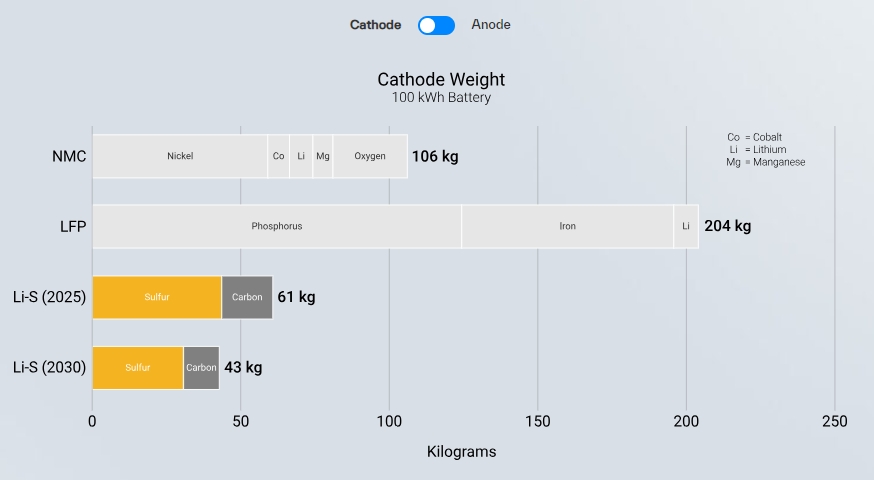
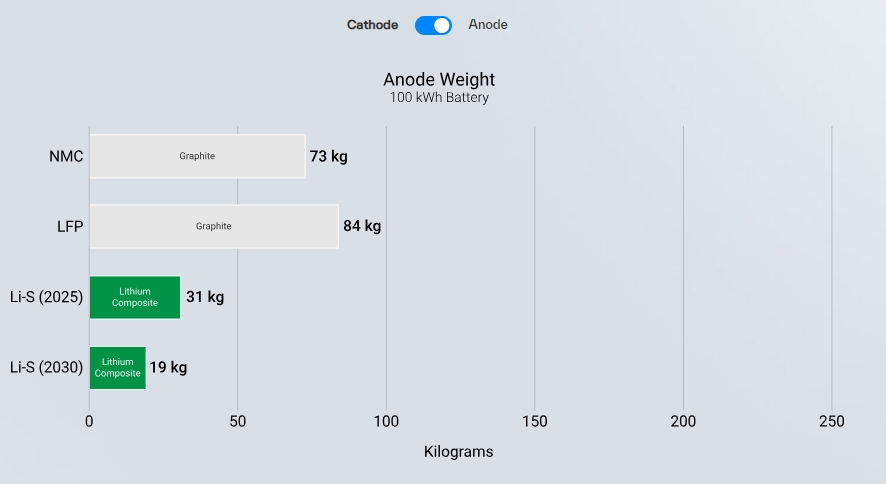
In terms of battery material systems, Lyten’s lithium-sulfur battery completely eliminates nickel, cobalt, manganese and graphite used in conventional lithium-ion batteries, instead adopting sulfur—abundant, low-cost and environmentally friendly—as the cathode material. The theoretical energy density of lithium-sulfur batteries reaches up to 2,600 Wh/kg, far exceeding the theoretical limit of conventional lithium-ion batteries.
Lyten’s 3D Graphene platform is highly tunable, enabling customization at the molecular level to meet specific battery application requirements—improving energy density, enhancing temperature performance, and achieving 20-minute fast charging. Beyond batteries, the platform is also widely applied in sensors, composites, adhesives and other fields.
2. Battery Introduction
The core advantages of Lyten’s lithium-sulfur battery lie in its fundamental material system innovation and high energy density potential.
Chart: Core Performance Indicators
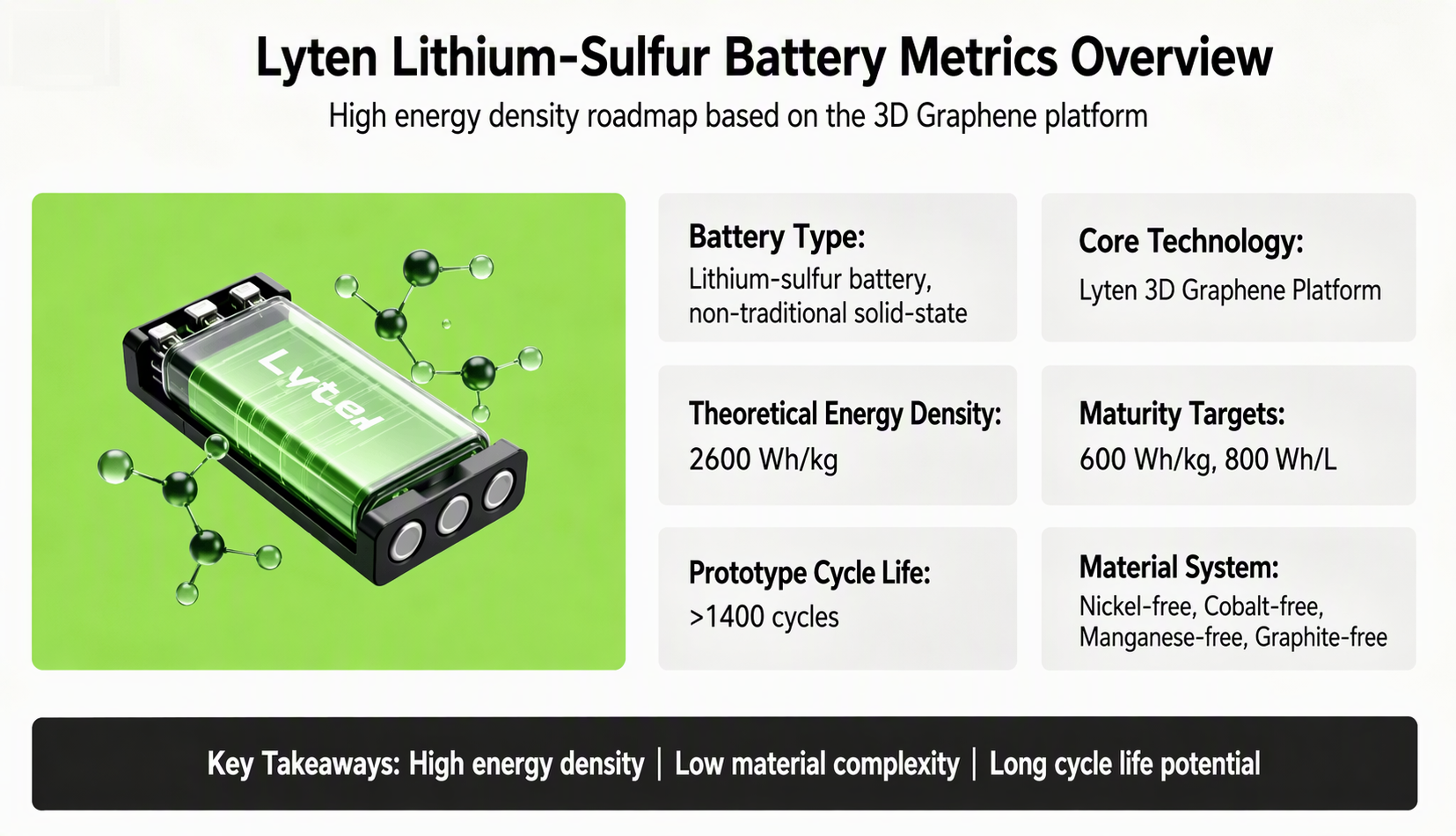
Compared with mainstream lithium-ion batteries, Lyten’s lithium-sulfur battery can double energy density while significantly reducing battery weight. In terms of lightweighting, lithium-sulfur batteries using 3D Graphene can cut battery weight by 50% and reduce ore mining requirements by 85%. Supply side, this technology can be produced using localized, low-cost, and resource-abundant material supply chains.
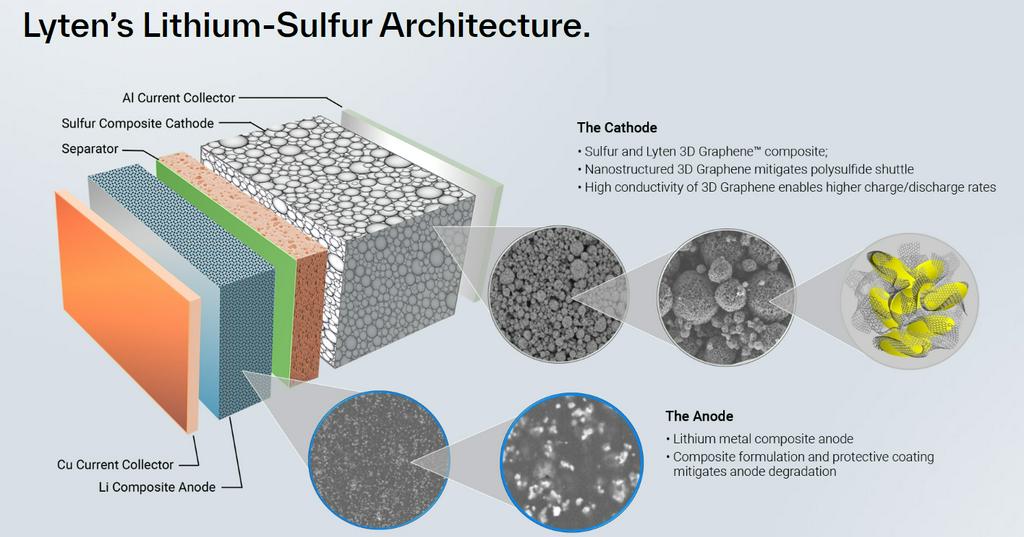
In terms of safety performance, Lyten’s lithium-sulfur battery has demonstrated excellent characteristics in safety testing. Regarding temperature adaptability, the battery features a wider operating temperature range.
In terms of application positioning, given the lengthy battery certification process in the automotive industry, Lyten adopted a diversified client strategy, shifting its market focus to AI data centers, national defense, and industrial applications, rather than focusing solely on EVs.
3. Planned Capacity
Lyten’s capacity layout features a dual-engine approach of self-built and acquired capabilities:
3.1 Nevada Gigafactory (Self-built)
In October 2024, Lyten announced an investment of over $1 billion to build the world’s first lithium-sulfur battery gigafactory near Reno, Nevada, planned to start operations in 2027 with an annual capacity of 10 GWh.
3.2 Acquisitions: Northvolt Asset Acquisitions (Dip-buying Expansion)
Through a series of acquisitions, Lyten obtained Northvolt’s core assets at a steep discount far below their valuation:
November 2024: Acquisition of Northvolt’s aviation battery plant Cuberg in California, US.
Early July 2025: Acquisition of Europe’s largest battery energy storage system (BESS) production site — Northvolt’s Dwa plant in Poland.
Late July 2025: Acquisition of Northvolt’s BESS product and IP portfolio.
Aug 2025: Acquisition of all remaining Northvolt assets in Sweden and Germany.
The total valuation of the acquired assets was approximately $5 billion, encompassing 16 GWh of existing battery manufacturing capacity, over 15 GWh of capacity under construction, infrastructure and plans expandable to over 100 GWh, and Europe’s largest and most advanced battery R&D center (Västerås).
3.3 Swedish Industrial Hub Operations
On February 27, 2026, Lyten officially completed the acquisition of Northvolt’s Swedish assets and announced the establishment of its first Lyten Industrial Hub in Skellefteå, Sweden. This industrial hub will leverage the infrastructure built by Northvolt and abundant clean hydropower resources to create a synergistic layout integrating battery manufacturing with AI data centers and supporting industrial operations.
Lyten plans to immediately launch the recommissioning of Northvolt Ett and Northvolt Labs. The Ett plant will produce lithium-ion NMC batteries for the BESS, automotive, and diversified mobility markets. Lyten expects commercial battery cell sales from the Ett plant to commence in H2 2026, with initial supply to its BESS manufacturing plant in Poland. Northvolt Labs in Västerås will continue developing long-life lithium-ion NMC batteries and collaborate with Lyten’s Silicon Valley team to advance gigawatt-scale manufacturing of lithium-sulfur battery technology.
Lyten is expected to produce its first test batteries in Q3 2026 and initiate mass production from the end of 2026 to Q1 2027. Over the next year, Lyten will add approximately 600 employees in Sweden, continuously expand capacity, and actively negotiate to acquire Northvolt's Heide plant in Germany.
4. Company Profile and Patents
4.1 Company Profile
Founded in 2015 and headquartered in San Jose, California's Silicon Valley, US, Lyten is a metamaterials application company. The company focuses on developing lithium-sulfur batteries as a more environmentally friendly alternative to lithium-ion batteries.
Lyten's core positioning is as a metamaterials application company, with its 3D Graphene platform spanning four major application fields: batteries, sensors, composites, and adhesives. In the battery field, Lyten is committed to achieving twice the energy density of traditional lithium-ion batteries through lithium-sulfur battery technology, while completely eliminating dependence on nickel, cobalt, manganese, and graphite.
4.2 Financing and Valuation
As of 2025, Lyten had received over $625 million in equity investment. In July 2025, the company completed a $200 million Series C funding round. Additionally, Lyten obtained a $650 million letter of intent for financing from the Export-Import Bank of the United States. The company was selected as a newly promoted "unicorn" enterprise in North America in 2023.
Major investors include: Prime Movers Lab, Luxembourg Future Fund, Stellantis (parent company of Jeep), FedEx, Honeywell, and Walbridge Group.
4.3 Patents
Lyten has laid out multiple patents covering the preparation processes and tools for 3D Graphene materials, and materials needed for lithium-sulfur battery production. Its patents cover the entire chain of technology, from converting greenhouse gases into three-dimensional graphene, to manufacturing cathodes for lithium-sulfur batteries, and to designing battery modules.
5. Financing and Cooperation
5.1 Strategic Investors
Lyten's investor lineup encompasses both industrial capital and financial investment institutions. Core investors include:
Prime Movers Lab (Lead Investor)
Stellantis (the world's fourth-largest automotive group, parent company of brands such as Jeep, Peugeot, and Fiat)
FedEx (global logistics giant)
Luxembourg Future Fund
Honeywell
Walbridge Group
5.2 Technical Cooperation
Cooperation with Hofer Powertrain: Hofer Powertrain has developed a next-generation battery module based on lithium-sulfur batteries for Lyten. According to Hofer's projection, this module will achieve twice the energy density of lithium-ion batteries and maintain excellent performance over a wider temperature range.
5.3 Data Center Cooperation
While completing the acquisition of Northvolt's Swedish assets, Lyten announced a cooperation with EdgeConneX, an EQT portfolio company. EdgeConneX plans to acquire from Lyten a data center site in Skellefteå, which has the potential to expand into a 1 GW data center campus and will become one of Europe's largest data center facilities.
5.4 Government Support
Lyten received a $650 million letter of intent for financing from the Export-Import Bank of the United States to support its lithium-sulfur battery capacity expansion in California and Nevada.
6.1 Completion of Northvolt Swedish Asset Acquisition (February 2026)
On February 27, 2026, Lyten officially announced the completion of its acquisition of Northvolt's Swedish battery assets, with a total value of nearly $5 billion, covering Northvolt Ett and the Ett expansion project, and Northvolt Labs. On the same day, it announced the establishment of the first Lyten industrial hub in Skellefteå.
6.2 Restart of Northvolt Plant Operations (2026)
Lyten plans to immediately initiate the restart process for Northvolt Ett and Northvolt Labs. Ett will produce lithium-ion NMC batteries and is expected to achieve commercial battery cell sales in H2 2026.
6.3 First Test Battery Production (Q3 2026)
Lyten is expected to produce its first test batteries in Q3 2026 and initiate mass production from the end of 2026 to Q1 2027.
6.4 Market Focus Shift to AI Data Centers and Defense (2026)
Due to the long certification cycle for batteries in the automotive industry, Lyten has adopted a diversified client strategy, shifting its market focus to areas such as AI data centers, defense, and industrial applications. Its products have been primarily supplied to the fast-growing drone and defense markets, and in the coming months, its lithium-sulfur batteries will also enter the International Space Station.
6.5 Dual-Base Layout in North America and Europe
Lyten is building a battery manufacturing landscape spanning North America and Europe: Nevada Gigafactory (10 GWh, to be operational in 2027) + Swedish Northvolt assets (16 GWh existing capacity + 15 GWh under construction) + Poland BESS plant, while actively negotiating to acquire Northvolt's German Heide plant.
Conclusion:
Lyten has embarked on a development path distinct from mainstream solid-state battery enterprises. Technologically, centered on its 3D Graphene platform, the company has created a lithium-sulfur battery system that eliminates nickel, cobalt, manganese, and graphite, with a theoretical energy density of up to 2,600 Wh/kg and achieving 600 Wh/kg at maturity. In terms of commercial strategy, through precise "dip-buying acquisitions," Lyten acquired Northvolt's core European assets worth approximately $5 billion at a significant discount, rapidly gaining 16 GWh of existing capacity, the largest battery R&D center in Europe, and vast expansion space. In terms of market positioning, Lyten avoids the long-cycle automotive certification path and prioritizes entering short-cycle, high-value markets such as AI data centers, defense, and drones. With the gradual commissioning of the Nevada Gigafactory (2027) and Swedish assets, Lyten is accelerating the gigawatt-scale manufacturing of lithium-sulfur battery technology and is expected to occupy a unique ecological niche in the next-generation battery technology competition.
Finally, we recommend SMM's premium conference. Current progress and some participating enterprises and representatives:
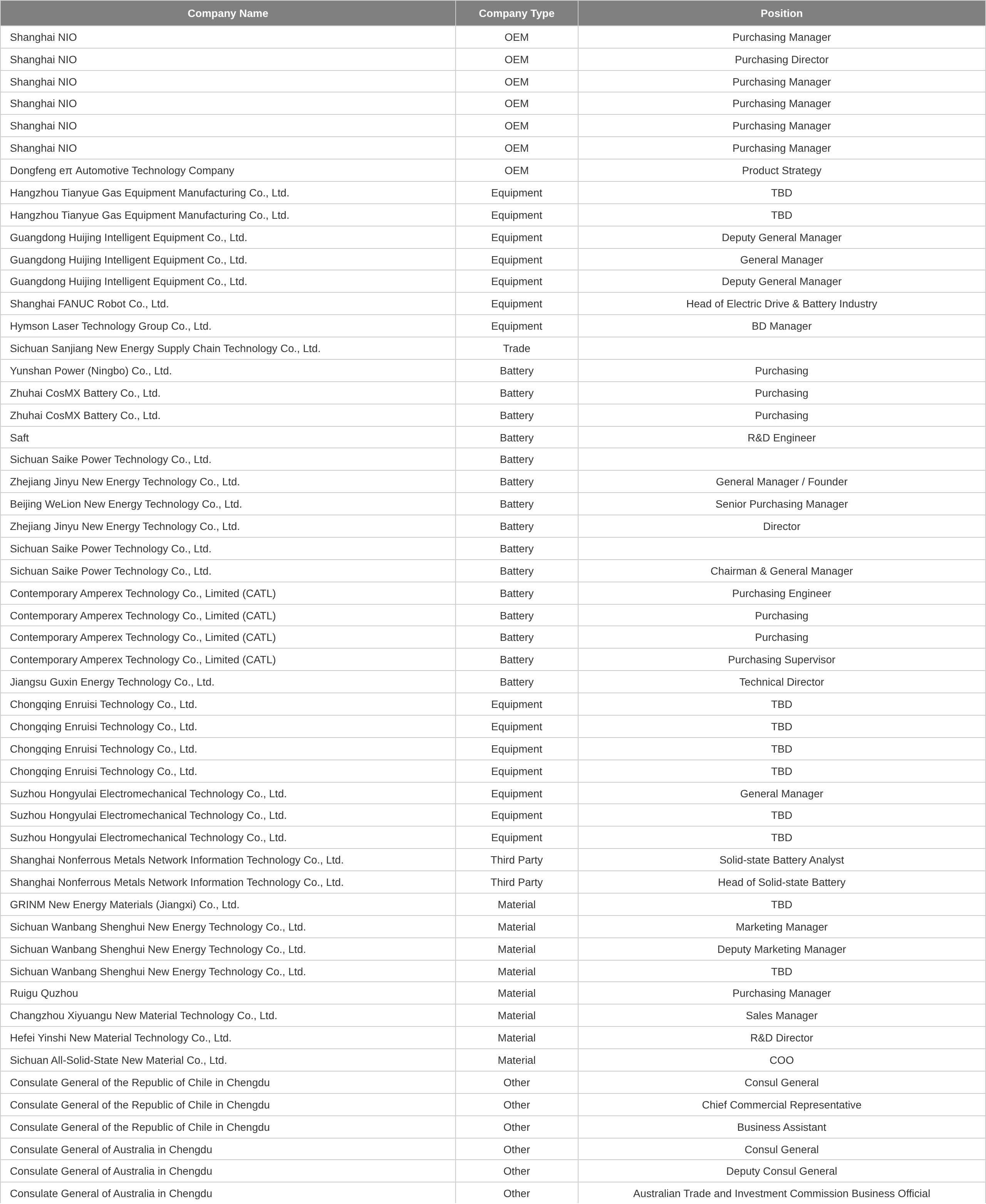
Tel: 021-20707860 (or add WeChat 13585549799) Yang Chaoxing, thank you!
Related Information
![[Automotive: FAW Jiefang, CATL, And Tgood Jointly Establish Jiefang Times]](https://imgqn.smm.cn/usercenter/lzgUR20251217171731.jpg)
![[Lithium Battery: CCC Certification For EV Charging Piles Becomes Mandatory On August 1]](https://imgqn.smm.cn/usercenter/BQoXd20251217171731.jpg)