The NEV Market Recovered, but Domestic Sales and Exports Were Driven by Different Segments
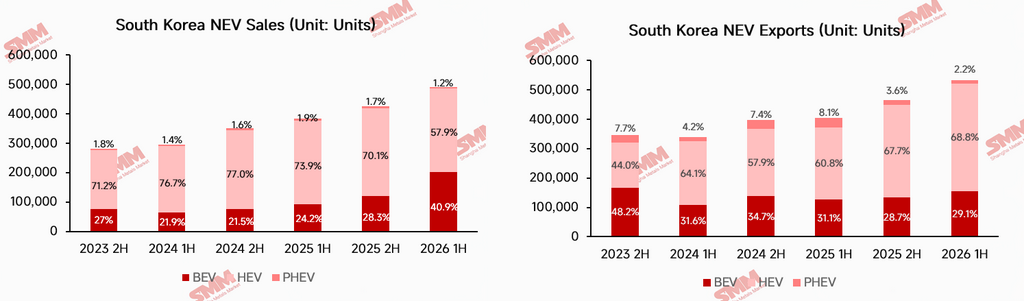
South Korea’s domestic NEV sales reached approximately 491,000 units in the first half of 2026, up around 28% year on year. NEV exports rose by approximately 32% to about 533,000 units over the same period, indicating a clear recovery in both domestic and overseas markets.
However, the composition of growth differed significantly. In the domestic market, BEV sales more than doubled year on year to approximately 201,000 units, driving most of the overall increase. A substantial portion of this growth reflected the low base created by weak sales in early 2025. Nevertheless, monthly sales remained relatively strong through the latter part of the first half, suggesting that demand also underwent a degree of normalization.
HEVs still accounted for the largest share of the domestic market. Sales remained broadly flat year on year at approximately 284,000 units, but represented about 58% of total NEV sales. This indicates that HEVs continue to provide the main demand base for Korea’s electrified vehicle market, as consumer concerns over EV pricing, charging convenience, battery safety and residual values have not been fully resolved.
The export market showed an even stronger HEV bias. HEV exports increased by approximately 49% year on year to around 367,000 units, accounting for nearly 69% of total NEV exports. BEV exports also increased, but at a more moderate rate of approximately 23%. Consequently, most of the growth in Korea’s NEV exports during the first half came from HEVs.
This composition means that growth in NEV sales and exports should not be interpreted as an equivalent recovery in battery demand. HEVs carry substantially smaller battery packs than BEVs, meaning that vehicle sales growth does not translate into the same rate of growth in cell and cathode-material consumption.
Domestic Cell Production Declined Despite Higher Vehicle Sales
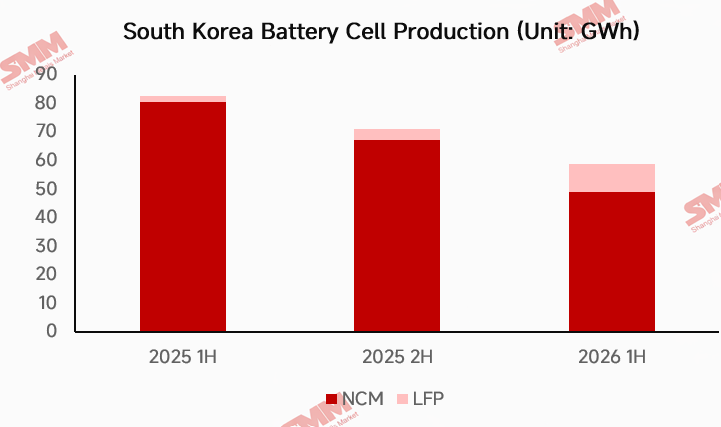
In contrast to the increase in NEV sales and exports, combined domestic NCM and LFP battery production by major Korean manufacturers was estimated at approximately 59 GWh in the first half of 2026, down around 29% year on year.
NCM battery production declined by approximately 39%. Given that Korea’s domestic battery production base remains heavily concentrated in ternary batteries for EV applications, the decline indicates that demand for premium and mid-to-large BEVs, as well as order recovery from major customers, remained insufficient.
The divergence between vehicle sales and battery production reflects both the composition of demand and the continued localization of overseas production. Although BEV sales recovered in the domestic market, export growth was led primarily by HEVs. At the same time, Korean battery and automotive manufacturers have expanded production in North America and Europe, weakening the direct link between overseas vehicle sales and cell production in Korea.
Accordingly, vehicle sales volumes and export values alone are becoming less effective indicators of Korean battery-material demand. Analysis increasingly needs to incorporate battery capacity per vehicle, the share of Korea-produced cells in vehicle supply, production allocation among overseas plants and utilization rates at domestic cell facilities.
LFP-Based ESS Is Emerging as a New Growth Pillar
While overall battery production declined, LFP output expanded rapidly. LFP battery production by major Korean manufacturers was estimated at approximately 10 GWh in the first half of 2026, more than four times the level recorded a year earlier. As a result, LFP’s share of combined NCM and LFP production increased from approximately 3% in the first half of 2025 to around 17% in the first half of 2026.
This does not mean that the Korean battery industry is shifting its core technology platform from NCM to LFP. NCM remains central to premium and mid-to-large EV applications, where energy density and driving range continue to be key requirements. LFP, by contrast, is expanding mainly through ESS applications, where cost competitiveness, safety and cycle life carry greater importance.
In the domestic market, the centralized ESS procurement market and longer-term deployment policies are creating initial demand. Korean battery manufacturers are also expanding their ESS businesses through North American projects and localized supply chains. Rather than competing solely on cell prices with Chinese suppliers, they are seeking to differentiate themselves through local production, system safety, fire-prevention technologies and long-term operating reliability in non-Chinese markets.
However, the expansion of LFP production remains insufficient to offset the decline in total battery output. LFP production increased by roughly 8 GWh year on year in the first half, while NCM production fell by approximately 31 GWh. Although ESS is beginning to establish itself as a meaningful new demand channel, the contraction in traditional NCM demand remains significantly larger.
Outlook
The first half of 2026 showed that structural changes in downstream demand were more significant than the headline recovery in vehicle sales. Domestic BEV sales rebounded from a low base, but HEVs continued to represent the largest portion of the market. In exports, HEVs accounted for most of the overall growth. As a result, stronger automotive indicators did not lead to a broad recovery in domestic NCM battery and material demand.
Meanwhile, LFP-based ESS is emerging as a new growth channel, supported by domestic policy demand and overseas projects. The strength of Korea’s battery-market recovery will therefore depend less on headline NEV sales growth and more on whether the BEV share continues to expand and whether rising LFP production for ESS applications can gradually offset the decline in the existing NCM production base.
![[MIIT Green Industry Plan (15th FYP)]](https://imgqn.smm.cn/usercenter/aXRJI20251217171728.jpg)