I. Import & Export Data: Volumes Are Rising
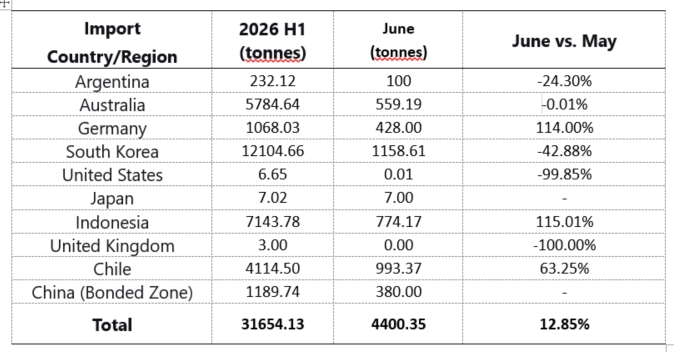
According to customs data, China imported 4,400 tonnes of lithium hydroxide in June 2026, up 12% month-on-month and nearly triple year-on-year. Of this, 1,159 tonnes came from South Korea, accounting for 26% of the month's total imports; Chile ranked second with 993 tonnes; while imports from Indonesia remained low, with 774 tonnes arriving in June.
On the export front, China exported 6,018 tonnes of lithium hydroxide in June, up 70% month-on-month, driven primarily by quarter-end shipment concentration and a modest recovery in overseas demand. Of this, 5,032 tonnes were exported to South Korea and 679 tonnes to Japan.
Since 2026, China has shifted from a net exporter to a net importer of lithium hydroxide. Cumulative data shows that total imports for January–June reached 31,700 tonnes, a nearly threefold increase from the 8,000 tonnes imported during the same period last year, reflecting a certain degree of resilience in domestic demand.
The surge in imports is now an established fact. Behind it lie both the cyclical advantage of domestic demand and prices over overseas markets, as well as traders' strategic moves to establish a foothold ahead of potential exchange listings. Yet regardless of the driving factors, a more practical question emerges — with import volumes climbing to record highs, can importers sustain profitability? Below, we assess the profit margins of imported lithium hydroxide through two pathways: direct resale and carbonation processing.
II. Profitability of Direct Resale of Imported Lithium Hydroxide
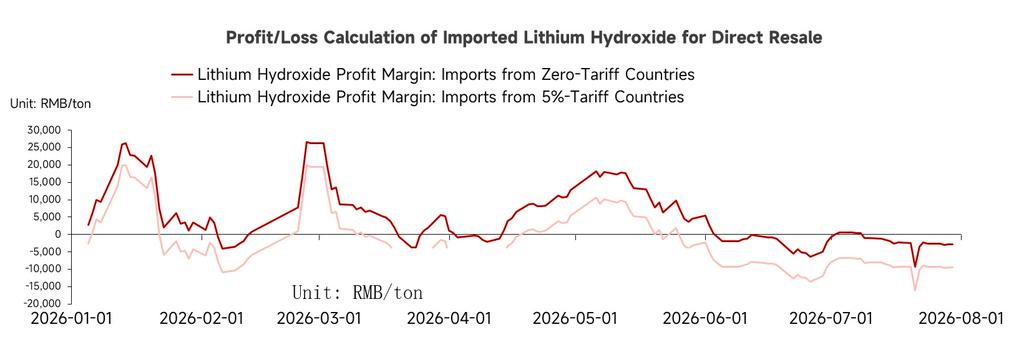
The following profit calculations are based on a comparison between the imported CIF cost (including tariffs, VAT, and port & agency fees) and the domestic SMM battery-grade lithium hydroxide spot price. A phased breakdown is provided below.
January–May (First Half): Import profits were generally substantial, with margins reaching as high as RMB 25,000/tonne or more. During this period, domestic lithium hydroxide prices were on an upward trajectory, while overseas demand remained sluggish and price increases lagged noticeably. Coupled with high overseas inventory levels, foreign holders showed a strong willingness to offload amid the elevated domestic prices, offering certain discounts on actual transactions, which allowed domestic buyers to enjoy margins better than theoretical estimates.
June–July: Profitability narrowed significantly. By mid-to-late July, even imports from zero-tariff sources such as South Korea and Australia were hovering around the breakeven point. During this phase, domestic lithium hydroxide prices entered a downward channel, while overseas price declines lagged behind in tandem. At the same time, overseas demand picked up modestly, and holders — having largely cleared their earlier inventories — turned more reluctant to release cargoes, with widespread stockpiling behavior. As a result, the price drop overseas did not keep pace with the decline in China, compressing import margins further toward breakeven.
It should also be noted that the above margin calculations implicitly rely on a key assumption: that imported lithium hydroxide can clear customs within a short storage timeframe and be sold at the SMM battery-grade lithium hydroxide (coarse particle) spot price. In practice, however, this assumption may not hold across all scenarios.
The realities facing traders when importing lithium hydroxide into the Chinese market are twofold. On the one hand, major domestic cathode material manufacturers have long-standing relationships with leading domestic brands, with well-established supplier qualification systems and process parameters — replacing an imported brand requires a lengthy requalification cycle and faces limited downstream acceptance. On the other hand, lithium hydroxide from different source countries varies in particle size distribution, magnetic material content, and impurity profiles, making it not a straightforward "drop-in" substitute.
These factors mean that imported lithium hydroxide often struggles to transact directly at domestic hydroxide spot prices in practice. Instead, it must be sold at a discount — either through an outright price reduction or by pricing reference to the main carbonate futures contract. This implies that actual profits are not as generous as the apparent figures would suggest.
III. Profitability of Carbonation Processing of Imported Lithium Hydroxide
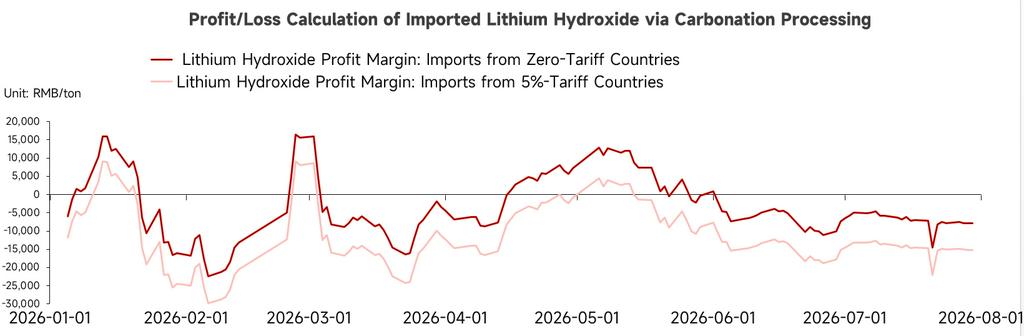
Core assumptions are as follows: imported material is purchased at a 94%–98% discount to the SMM battery-grade lithium hydroxide spot price, and the carbonation process recovery rate is estimated at 95%–98%. Under these conditions, after the imported lithium hydroxide is carbonated into lithium carbonate, profitable opportunities emerge only in isolated months, with overall margins remaining fairly narrow.
Summary
Import volumes are growing, and for most of the first half of the year profitable import windows were available (notably in March and May). However, from June onward, apparent profits have narrowed rapidly toward the breakeven point. When further factoring in the discount required for direct resale or the margin compression from carbonation processing, the actual profitability of lithium hydroxide imports in recent months becomes even more limited. For importers aiming to sustain profitability in this space going forward, relying on simple price arbitrage will no longer suffice. Instead, competitive advantages must be built through downstream channel partnerships, quality premiums, and exchange rate risk management.
Note: The import margin calculations in this report are based on a specific CIF benchmark. Actual transaction prices may vary by source country, brand, and purchase volume, while discount levels and carbonation costs are market-based estimates and are provided for reference purposes only.
Data source: SMM & China Customs
![[SMM Lithium Policy] Zambia Pushes for Pan-African Minerals Exchange, With Implications for Africa's Lithium Trade](https://imgqn.smm.cn/usercenter/ajAmi20251217171726.jpg)