China's benchmark stainless steel futures contract lost ground this week but found a floor midweek. The most-active SS2609 contract on the Shanghai Futures Exchange (SHFE) closed Friday at approximately $2,169/mt (RMB 14,635/mt), down about $20/mt (RMB 135/mt), or 0.91%, from the previous Friday's close of roughly $2,189/mt (RMB 14,770/mt). Closes ranged from about $2,151/mt (RMB 14,515/mt) to $2,177/mt (RMB 14,690/mt) — a spread of only RMB 175/mt, indicating the decline was absorbed rather than sold through. There was no contract rollover during the week.
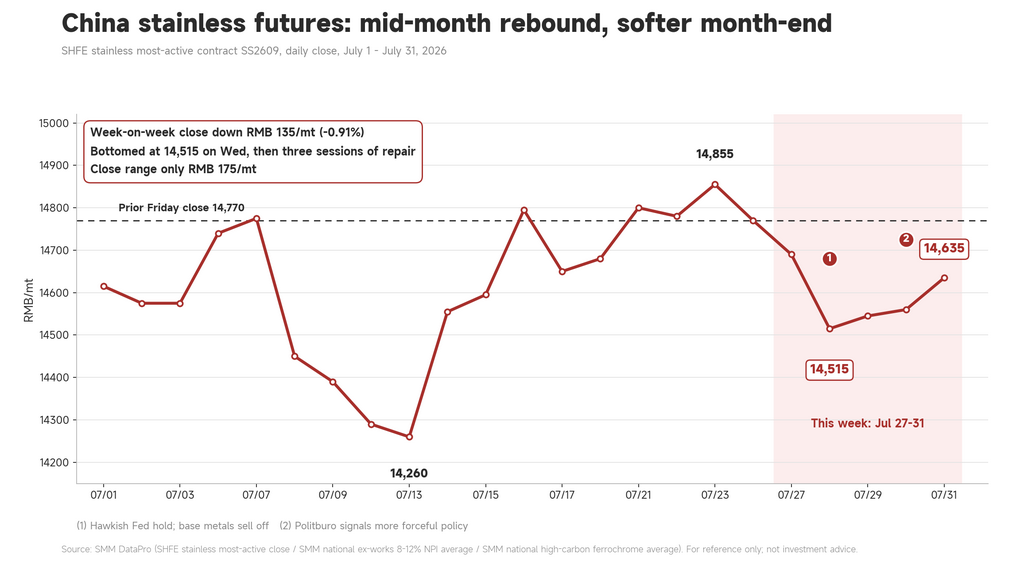
The more telling development was a shift in the futures-spot relationship. Futures bottomed on Wednesday and recovered over the following three sessions, while physical prices, pinned down by off-season selling pressure, barely followed. Spot premiums for 304/2B in Wuxi, Jiangsu — a major stainless trading center in eastern China — narrowed from RMB 430-830/mt ($64-123/mt) on July 28 to RMB 370-770/mt ($55-114/mt) on July 30, a passive compression driven by futures recovering faster than the physical market.
A hawkish Fed set the tone, then Beijing's policy signal cushioned the fall
The US Federal Reserve held its July 28-29 meeting and left the federal funds target range unchanged at 3.50%-3.75%. The decision carried an unusual 9-3 split, with three members favoring a 25-basis-point hike — read by the market as a hawkish hold. Expectations of a rate increase later this year did not fade, which pressured dollar-denominated commodities and directly triggered the contract's Tuesday-Wednesday slide.
The dollar index provided some offset, briefly breaking below 101 and closing down 0.59% at 100.81 after the decision. That cushion was not enough to reverse the tightening signal itself. Meanwhile, US-Iran tensions eased early in the week, pushing oil lower and softening inflation concerns, before geopolitical risk re-escalated. The result was a wider trading range rather than a clear direction.
Domestically, the Politburo of the Communist Party of China — the body that sets China's top-level economic policy direction — met on July 30. It called for more forceful and efficient macro policy, faster deployment of fiscal spending and bond proceeds, accelerated work on the "two majors" (major national strategies and security capacity) and "two news" (equipment upgrades and consumer goods trade-ins) programs, stabilization of the property market, and deeper capital market reform. That constructive tone underpinned the commodity complex on Thursday and Friday and explains the contract's recovery off its low.
Off-season effects bite: inventories turn from draw to build
SMM's most recent social inventory reading was 929,900 mt as of July 23, covering the Wuxi and Foshan markets combined — Foshan, Guangdong is China's largest stainless distribution and processing hub. That is 0.93% above the 921,300 mt recorded on July 9 and marks the first build after a sustained destocking run. The July 30 reading had not yet been published at the time of writing; SMM's assessment is that the modest build continued this week.
The turn arrived inside the traditional off-season window of late July, meaning the low-inventory condition that had been supporting spot prices is now weakening. Three forces are behind the build. Typhoon disruption that had been holding back arrivals has passed, releasing a concentrated wave of delayed cargo into warehouses. Mills that had suspended production earlier have restarted, and normal mill allocations continue, leaving supply into the market ample. End-user demand remains constrained by the off-season, so rigid-demand offtake cannot absorb the incremental volume, and traders are more willing to move material than to defend price.
Spot prices consequently traded sideways rather than tracking the futures recovery. Average prices for 304/2B mill-edge cold-rolled coil in Wuxi and Foshan fell RMB 50/mt (about $7/mt) on July 28 and a further RMB 25/mt on July 29 before recovering RMB 25/mt on July 30, leaving a net decline for the week. Wuxi 201/2B cold-rolled coil dropped RMB 50/mt on July 30, and 316L/2B cold-rolled coil fell RMB 75/mt on July 28, showing that 200-series and high-nickel grades came under heavier pressure. The gap between the futures recovery and the muted spot response confirms that buyers still resist higher-priced material.
Raw materials split: nickel firms while chrome slips
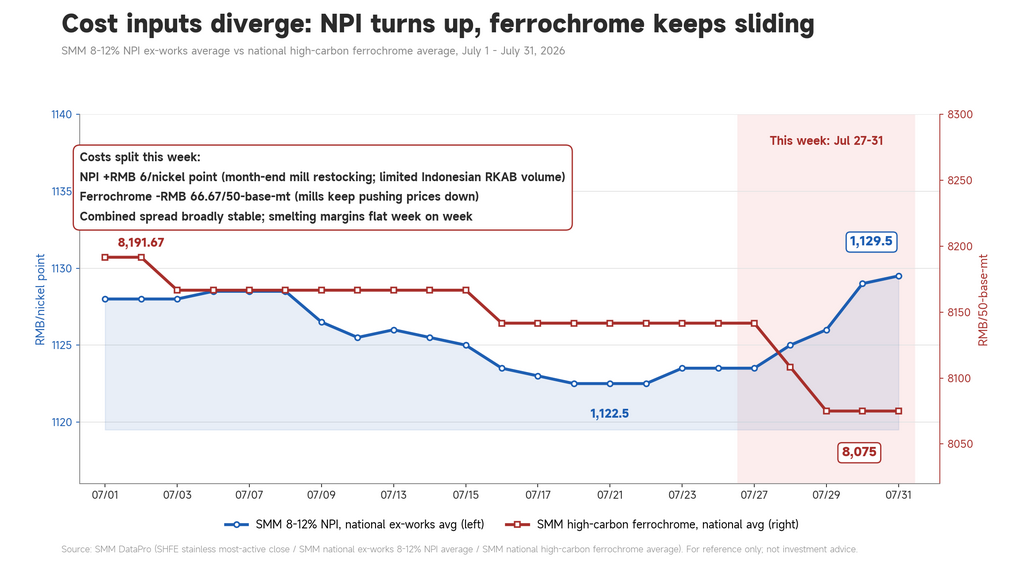
Nickel Pig Iron (NPI) — the low-grade ferro-nickel alloy produced in China and Indonesia from laterite ore that supplies most of China's stainless nickel units — moved higher. SMM's national ex-works average for 8-12% NPI rose from RMB 1,123.5/nickel point last Friday to RMB 1,129.5/nickel point on July 31, a gain of RMB 6/nickel point (roughly $166.5 to $167.4 per nickel percentage point). The move came from month-end restocking by some stainless producers, reinforced by continued expectations that Indonesia's RKAB supplementary mining quota round will add limited ore volume — a view that has kept a floor under nickel.
High-carbon ferrochrome went the other way. SMM's national average fell from RMB 8,141.67 to RMB 8,075 per 50-base-mt over the week, down RMB 66.67 (about $1,206.5/mt to $1,196.6/mt on a 50-base-mt basis), as mills kept pushing supplier prices down and stayed cautious on procurement. With one input rising and the other falling, the combined finished-product-to-raw-material spread held roughly steady and mill smelting margins were flat week on week.
Stable margins mean there is no economic trigger for output cuts. Mills that had halted production restarted during the week, adding marginal supply, and the medium-term picture of ample supply is unchanged. Cost, in other words, is acting as a floor under the market rather than a driver of higher prices.
Outlook
Two forces priced this week: a hawkish external monetary signal that pushed the contract lower into midweek, and month-end restocking plus a firm nickel floor that lifted it off the low on Thursday and Friday. The net result was a recovery from the bottom within a week that still closed lower.
August remains in the back half of the traditional off-season, and the variable to watch is whether the inventory build persists. If arrivals normalize now that typhoon disruption has cleared while end-user demand fails to recover, continued building would cap any rebound in futures. If buyers step in for tactical restocking after the price decline, the inventory turning point could be pushed back. On the cost side, the question is whether the NPI-ferrochrome divergence narrows, and how Indonesia's ore quota policy is implemented from here.
The benchmark contract is likely to hold a range in the near term, caught between macro sentiment and cost support, with a directional break waiting on a clearer fundamental signal. Industry participants should treat macro-driven volatility on its own terms, watch the actual pace of off-season inventory accumulation and the strength of end-user offtake, and manage exposure conservatively.
![[SMM Analysis] Macro sentiment recovered this week, combined with destocking outside China, nickel prices drifted higher](https://imgqn.smm.cn/usercenter/LNpBh20251217171732.jpeg)