I. India’s JSW Steel to Invest in a New 600,000 Tons/Year High-Grade Non-Oriented Silicon Steel Project
JSW Steel is India’s largest private steelmaker. It has recently been aggressively expanding its silicon steel capacity to back India’s industrial development roadmap. The roadmap targets doubling India’s national steel production capacity by 2030, and this capacity expansion by JSW is a key initiative in response to the national industrial plan.
To be located at JSW Steel’s Vijayanagar plant in Toranagallu, the project will produce non-oriented electrical steel, widely deployed in new energy vehicle motors and general-purpose electric motors.
The project entails the design and construction of three silicon steel processing lines:
1 normalizing and pickling line (APL) with an annual capacity of 600,000 tons;
2 annealing and coating lines (ACL), each with an annual capacity of 270,000 tons.
II. China Faces Overcapacity in Non-Oriented Silicon Steel, with Nearly 10 Million Tons of New Capacity Yet to Be Commissioned
Source: Publicly Available Data
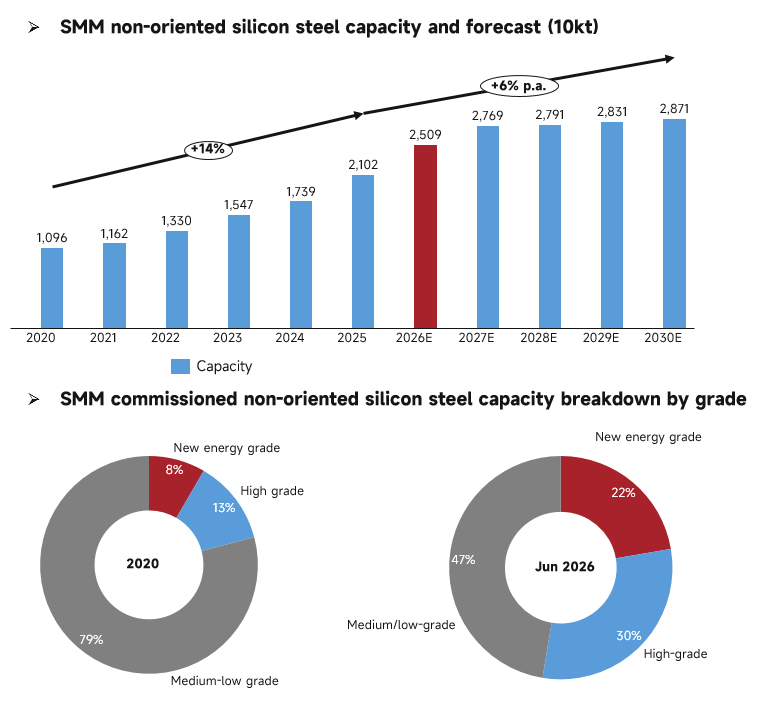
In terms of production capacity, the total capacity of the non-oriented silicon steel industry is projected to reach 25.09 million tons in 2026, marking the end of the rapid capacity expansion cycle spanning 2020 to 2026. Capacity growth will slow down starting from 2026, with a modest and steady annual growth rate of only 6% forecast for 2027 through 2030.
From the perspective of product mix, a substantial grade upgrade has been realized for commissioned non-oriented silicon steel capacities as of June 2026. In sharp contrast to the low-end product structure in mid-2020 when medium and low grades accounted for 79%, their proportion dropped to 47% in 2026, while the share of high-grade products rose to 30%. More notably, the capacity proportion of new-energy-specific grades applicable to new energy vehicles, wind power and other sectors surged from 8% to 22%. This fully demonstrates the landmark transformation of the non-oriented silicon steel industry, featuring a shift in capacity growth momentum, premium product upgrading and structural iteration toward exclusive grades for new energy applications.
Source: Publicly Available Data
Pipeline Capacity to Be Commissioned
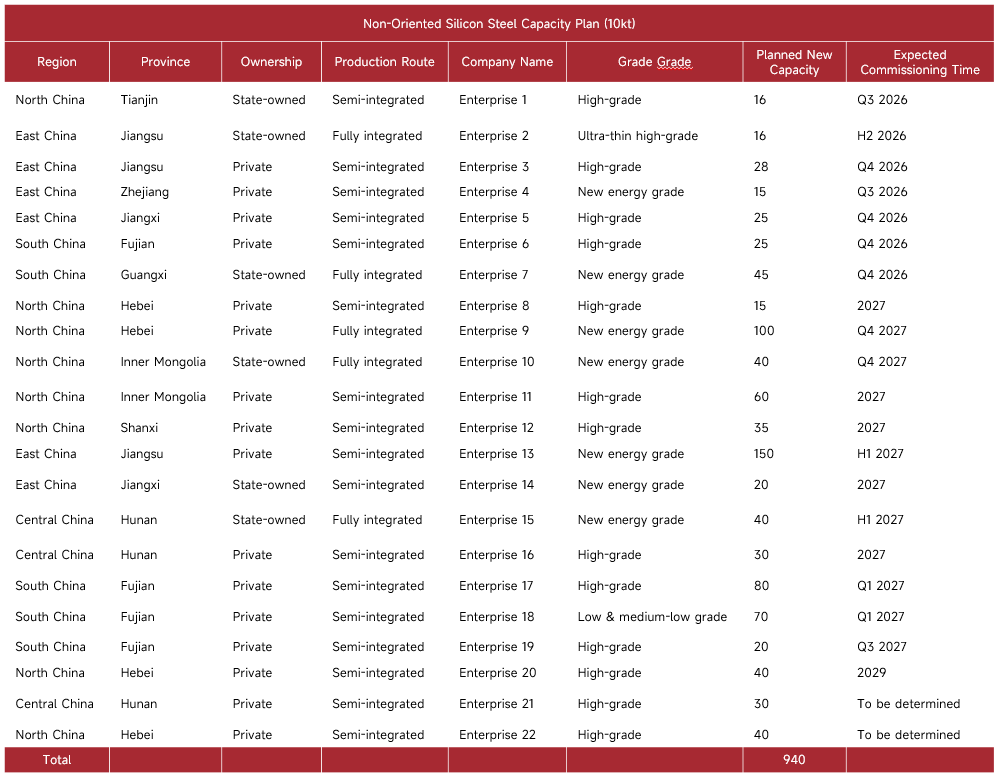
According to public statistics, the pending-to-launch capacity of non-oriented electrical steel totals approximately 9.4 million tons, scheduled to come online mainly from the second half of 2026 to 2027.
All projects set for commissioning in 2026 produce high-grade and new-energy-specific premium grades, located in North China (Tianjin), East China (Jiangsu, Zhejiang, Jiangxi), and South China (Fujian, Guangxi). Most adopt the semi-process production route, with deployment by both state-owned and private enterprises.
2027 will also be a peak year for capacity release, with massive incremental capacity rolled out across North, East and South China. While high-grade and new-energy-focused capacity will continue to be launched, a small volume of supplementary medium-and-low-grade capacity will also be added. Large-scale 1-million-ton-level new-energy-grade projects will emerge in Hebei, Jiangsu and other regions, accompanied by an increased share of full-process capacity, with private capital acting as the primary driving force for capacity expansion.
Regionally, East China and North China serve as the core areas for new capacity rollout. Production is dominated by the semi-process route, and the product mix is overwhelmingly composed of high-grade and new-energy-exclusive grades tailored for new energy vehicle motors and high-efficiency motors.
China has basically completed the structural transformation of its non-oriented electrical steel capacity, which can fully meet domestic market demand. Nevertheless, nearly 10 million tons of new capacity are still pending commissioning, which will further loosen the supply side of domestic non-oriented electrical steel.
III. Conclusion
China’s non-oriented electrical steel sector is currently undergoing intensive capacity expansion, with a large batch of planned high-end capacities being put into concentrated operation. The industry is already facing prominent overcapacity pressure, and the market expects overseas exports to digest part of surplus output and ease the domestic supply-demand imbalance.
However, market access barriers and surging overseas local supply have greatly undermined the feasibility of export-driven absorption:
To shield their domestic steel industries, multiple overseas economies have frequently launched anti-dumping and countervailing (AD/CVD) trade investigations targeting Chinese non-oriented electrical steel. They have drastically lifted market entry costs for Chinese products through hefty punitive tariffs and Technical Barriers to Trade (TBT), directly obstructing export shipments.
Foreign steelmakers have accelerated localized capacity deployment in parallel. Relying on local policy incentives and low energy costs, they have built new non-oriented electrical steel production lines to progressively achieve self-sufficiency in high-end silicon steel. This not only reduces their reliance on Chinese imports but also creates head-on competition with Chinese products in the global marketplace.
Under the compound impact of mounting domestic and external pressures, the export route for absorbing excess domestic capacity has encountered drastically heightened obstacles, making it far more difficult for the industry to clear surplus production. This compellingly pushes domestic manufacturers to accelerate differentiated product upgrading, extend business downstream to high-value-added new energy industrial chains, explore emerging overseas markets, and set up localized overseas production bases to break through the predicament.
![[SMM Daily Assessment of Sheets & Plates] Fundamentals Have Yet to Improve, Prices Face Upside Pressure](https://imgqn.smm.cn/usercenter/niwZw20251217171715.jpg)