2026 H1 China copper foil industry import and export market analysis [SMM analysis]

Published: Jul 31, 2026 14:26
[SMM Analysis: Import and Export Market Analysis of China's Copper Foil Industry in H1 2026] According to data from the General Administration of Customs, China's cumulative copper foil exports in January–June 2026 were 39,700 mt, up 72.83% YoY; cumulative copper foil imports in January–June were 45,100 mt, up 12.17% YoY, with import growth significantly lower than export growth...

According to data from the General Administration of Customs, from January to June 2026, China's cumulative copper foil exports reached 39,700 mt, up 72.83% YoY; cumulative imports stood at 45,100 mt, up 12.17% YoY, with import growth significantly slower than export growth.
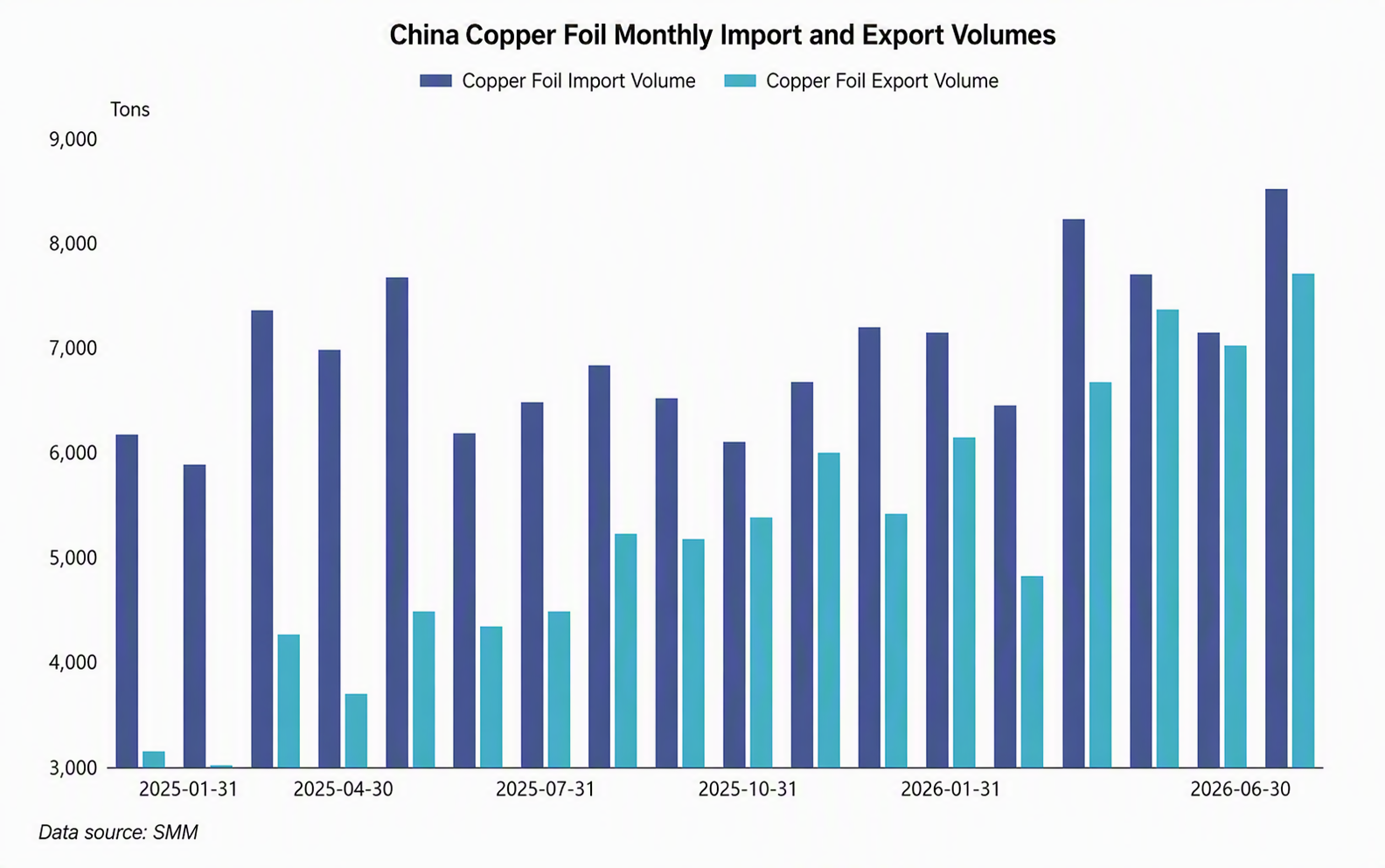
    In H1 2026, China's cumulative copper foil exports reached 39,700 mt, up 72.83% cumulatively YoY, with export value reaching $639.97 million, surging 117.5% YoY. The significantly faster growth in export value compared to volume directly evidenced the continuous rise in unit prices of exported copper foil, the steady increase in product value added, and the ongoing optimization of the export structure.
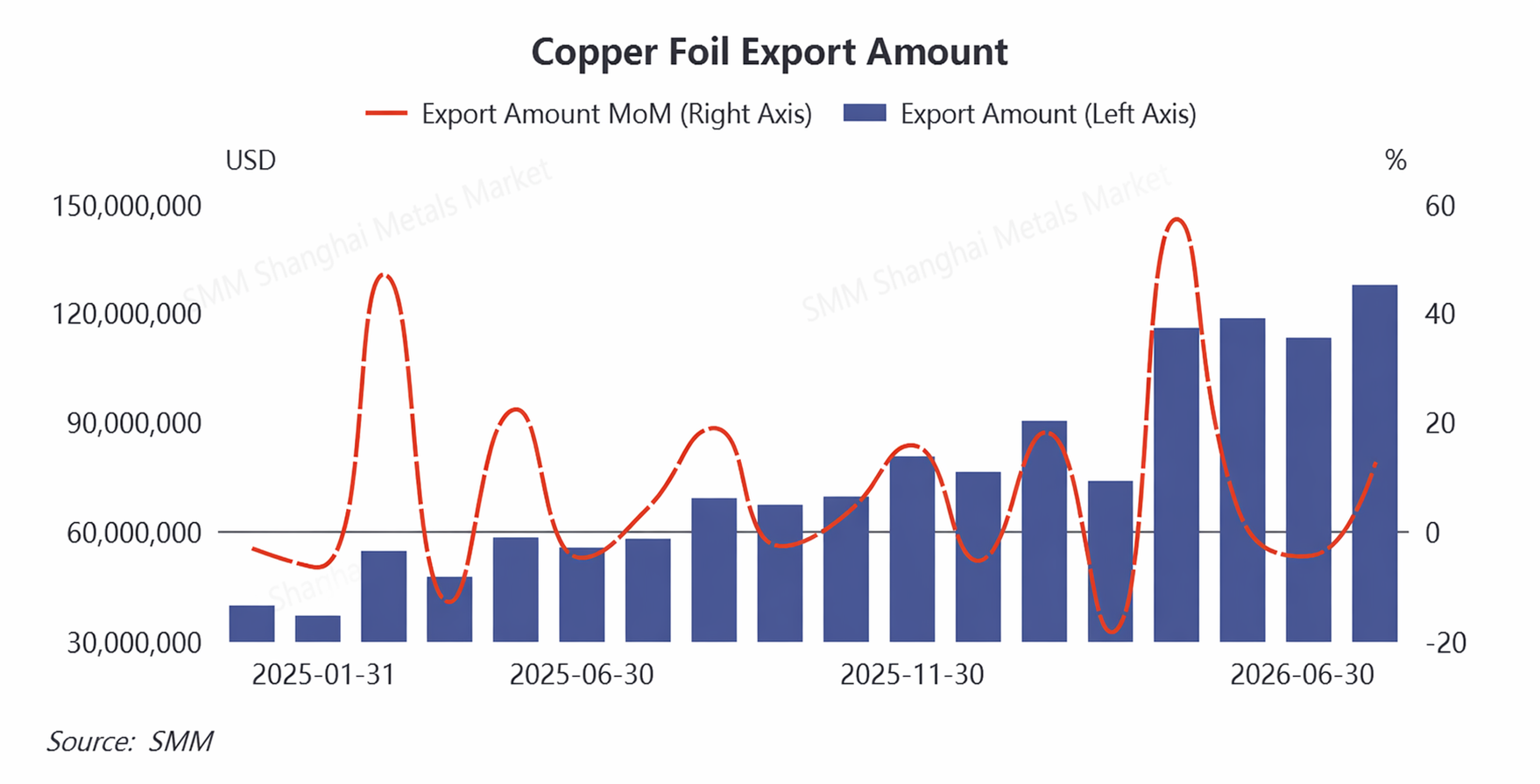
    The core driver of the significant export surge was the confluence of overseas supply gaps and end-use demand. Japanese and Taiwan, China-based enterprises accelerated shifting conventional capacity to high-end copper foils like HVLP, tightening the supply of traditional electronic copper foils outside China and opening a continuous window for export substitution for domestic copper foil enterprises. Meanwhile, in H1, robust global energy storage grid-connection demand, high scheduled production of power batteries, and large-scale construction of AI computing centers combined to continuously boost the rigid demand growth for copper foil outside China. In addition, domestic copper foil enterprises' operating rates stayed high, remaining solidly above 90%, which also provided ample supply support for the export surge.

    In terms of export destinations, in H1 China's copper foil was mainly exported to Southeast and East Asian countries such as Thailand, Malaysia, South Korea, and Vietnam. In these overseas regions, capacity in new energy and electronic manufacturing continued to expand, and supporting raw material demand steadily grew, continuously driving import demand for Chinese copper foil products, making them the core incremental markets for China's copper foil exports.

    In H1 2026, China's cumulative copper foil imports stood at 45,130.31 mt, up only 12.27% YoY, a growth rate far lower than that of exports; cumulative import value reached $969.0341 million, up 39.20% YoY. As domestic copper foil enterprises' capacity utilization rates and shipments continued to climb, self-sufficiency in low and mid-end products increased, and import dependence continued to decline. However, June imports rebounded to 8,509.40 mt, up 19.26% MoM, mainly due to the supply gap in the high-end segment. Currently, China's high-end copper foil remains highly dependent on imports, and rigid procurement demand has always existed, indicating that there is still ample room for import substitution and upgrading potential in the localization of high-end products in the domestic copper foil industry.
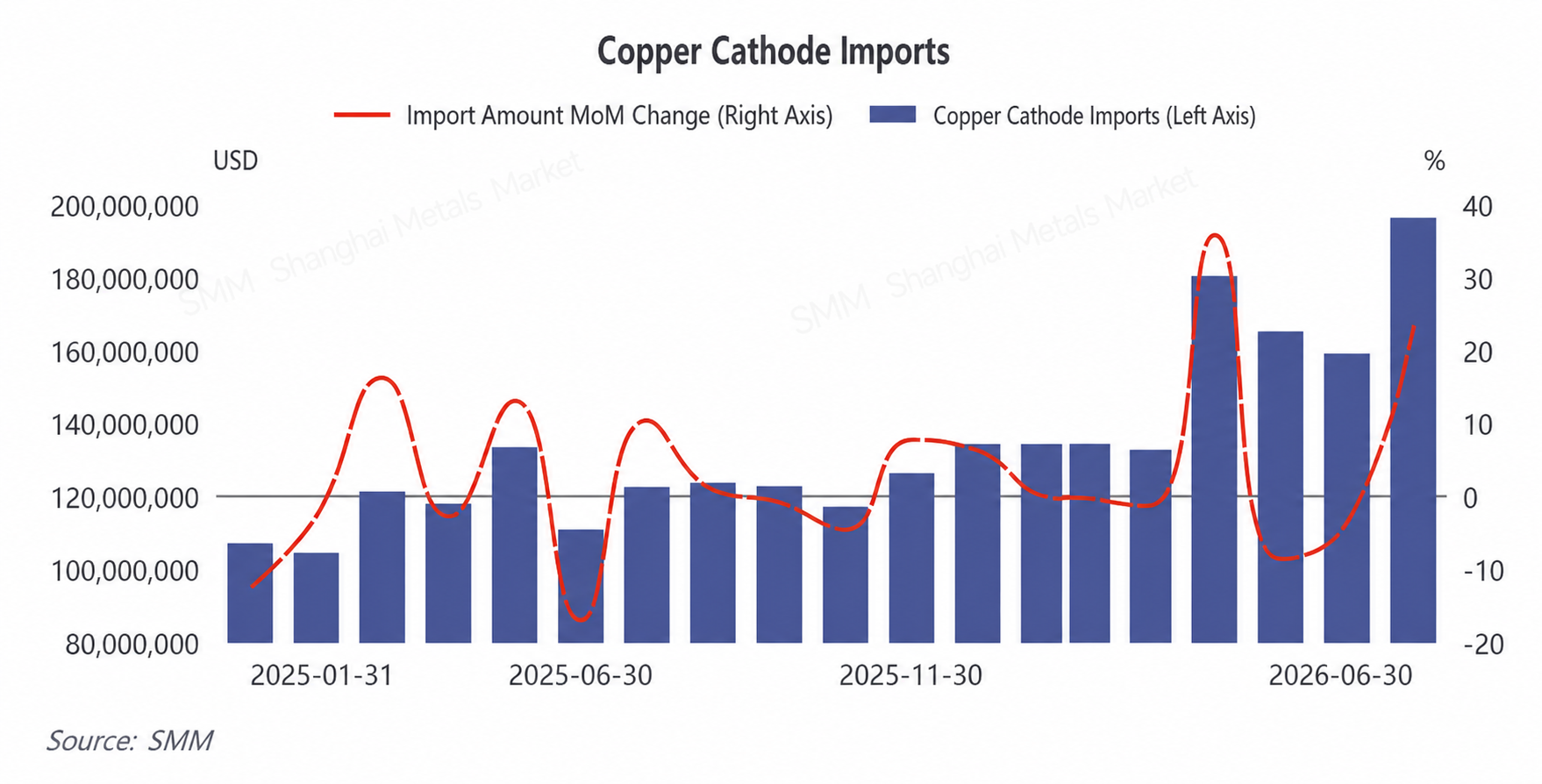
    In H1 2026, the overall copper foil trade deficit showed a narrowing trend. The industry's trade deficit shrank from approximately $103.14 million at the beginning of the year to $45.9 million in May. In June, affected by concentrated procurement of high-end products on the import side and rising unit prices, the monthly deficit rebounded to $68.8 million. However, from the overall H1 perspective, the industry's trade deficit scale still showed significant improvement compared to the same period last year, and the industry's overall competitiveness improved steadily.

    In H2, the rapid growth trend of China's copper foil exports is expected to continue. The window period for Japanese-invested and Taiwan, China enterprises to switch traditional capacity to high-end products remains, and the export substitution dividends for domestic enterprises will continue to be released; the global peak season for energy storage, NEVs, and consumer electronics will further support demand. Import side, with domestic capacity ramp-up and product mix upgrade, low and mid-end import substitution will continue to advance, and import dependence will further decrease; however, breakthroughs in the localisation of high-end HVLP products still need time, and the rigid import demand for high-end products will be maintained for a long time, becoming the core direction for subsequent domestic industry technology upgrading and capacity breakthroughs.

Data Source Statement: Except for publicly available information, all other data are processed by SMM based on publicly available information, market communication, and relying on SMM's internal database model. They are for reference only and do not constitute decision-making recommendations.

Images in this article contain AI-translated captions for reference only.

For any inquiries or for more information, please contact: lemonzhao@smm.cn
For more information on how to access our research reports, please contact:service.en@smm.cn
Related News
Data: SHFE, DCE market movement (Jul 31)
1 min ago
Data: SHFE, DCE market movement (Jul 31)
Read More
Data: SHFE, DCE market movement (Jul 31)
The following table shows the ferrous and nonferrous metals movement on the SHFE and DCE on 31 Jul , 2026
1 min ago
Kazakhstan Approves 300,000 mt Copper Smelting Project in Balkhash, Planned to Start Production in 2030
17 mins ago
Kazakhstan Approves 300,000 mt Copper Smelting Project in Balkhash, Planned to Start Production in 2030
Read More
Kazakhstan Approves 300,000 mt Copper Smelting Project in Balkhash, Planned to Start Production in 2030
On July 30, the Kazakh government announced that it had approved the investment agreement signed between the Ministry of Industry and Construction and Qazaq Smelter LLP for the Balkhash copper smelter project. The total private investment for the project is 750 billion tenge (approximately $1.58 billion). Construction is planned to start in 2027, with production commencing in 2030. The project is designed to produce 300,000 mt of copper cathode, 10 mt of gold, 300 mt of silver, and over 1.5 million mt of sulphuric acid annually, and will create around 1,200 permanent jobs. The Kazakh government expects that, once commissioned, the project will boost the country’s copper production by about 50% to above 800,000 mt, and increase exports of high-value-added copper products from 460,000 mt to 760,000 mt. Currently, the project is still at the stage of having its investment agreement approved, and the authorities have not yet disclosed its source of copper concentrates, process route, financing, or EPC arrangements. In addition, KAZ Minerals also plans to build another 300,000 mt/year copper smelter in the Abai Region, with a latest commissioning target of 2030–2031. If both projects proceed as planned, the combined new nominal copper cathode capacity in Kazakhstan will reach 600,000 mt/year, and the capacity for domestic smelting of copper concentrates may see a notable increase.
17 mins ago
Trump Invokes Defense Production Act to Limit Export of Recoverable Critical Materials
22 mins ago
Trump Invokes Defense Production Act to Limit Export of Recoverable Critical Materials
Read More
Trump Invokes Defense Production Act to Limit Export of Recoverable Critical Materials
President Donald Trump has signed a presidential determination granting the U.S. Commerce Department authority under the Defense Production Act (DPA) to restrict exports of industrial waste containing recoverable critical minerals and materials (CMMs). The executive measure targets end-of-life products—including spent lithium-ion batteries and permanent magnets, that hold significant reclaimable volumes of vital strategic elements. By invoking Cold War-era DPA powers, the White House aims to prevent secondary scrap feedstock from leaving the country, bolstering domestic processing capacity and curbing reliance on foreign supply chains, particularly China. Rather than relying solely on greenfield mining projects with extended lead times, the policy effectively establishes domestic industrial scrap as an immediately accessible strategic reserve. The move is expected to support U.S. recycling infrastructure, secure essential raw materials for defense manufacturing and high-tech sectors, and keep critical processing value added within American borders.
22 mins ago
Register to Continue Reading
Gain access to the latest insights in metals and new energy
Already have an account?Sign in here
2026 H1 China copper foil industry import and export market analysis [SMM analysis] - Shanghai Metals Market (SMM)