SMM, July 31 news:
Metals market:
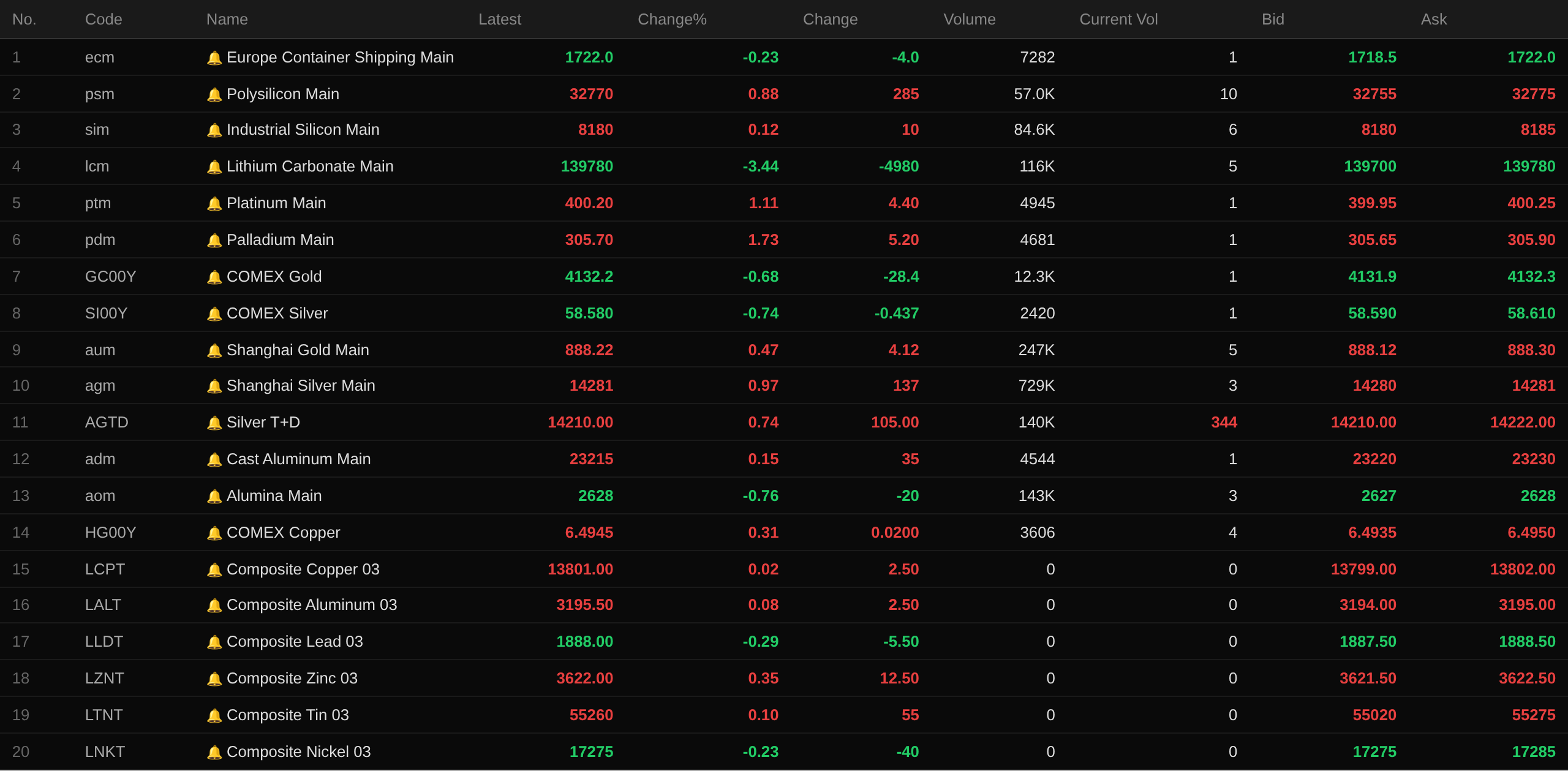
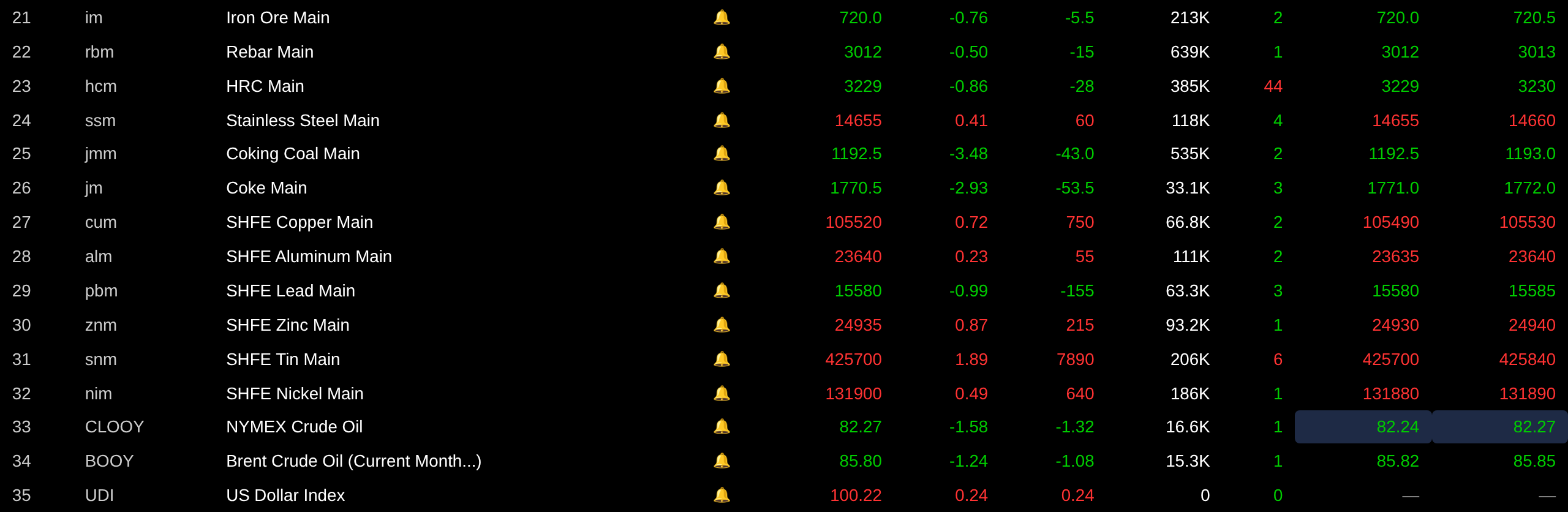
As of the midday close, base metals in the domestic market mostly rose. SHFE copper rose 0.72%, SHFE aluminum rose 0.23%. SHFE lead fell 0.99%. SHFE zinc rose 0.87%. SHFE tin rose 1.89%. SHFE nickel rose 0.49%.
In addition, the most-traded cast aluminum futures contract rose 0.15%, while the most-traded alumina contract fell 0.76%. The most-traded lithium carbonate contract extended the decline from the previous trading day, falling another 3.44%. The most-traded silicon metal contract rose 0.12%. The most-traded polysilicon futures contract rose 0.88%.
Ferrous metals mostly fell. Iron ore fell 0.76%, rebar fell 0.5%, hot-rolled coil fell 0.86%. Stainless steel rose 0.41%. Coking coal and coke: the most-traded coking coal contract fell 3.48%, and the most-traded coke contract fell 2.93%.
For base metals in the overseas market, as of 11:38, LME metals mostly rose. LME copper and LME aluminum edged up, with gains within 0.1%. LME lead fell 0.29%, LME zinc rose 0.35%. LME tin rose 0.1%. LME nickel fell 0.23%.
For precious metals, as of 11:38, COMEX gold fell 0.68%, COMEX silver fell 0.74%. For domestic precious metals: SHFE gold rose 0.47%, the most-traded SHFE silver contract rose 0.97%.
Additionally, as of the midday close, the most-traded platinum futures contract rose 1.11%, and the most-traded palladium futures contract rose 1.73%.
As of the midday close, the most-traded European container shipping futures contract fell 0.23% to 1,722 points.
As of 11:38 on July 31, some futures midday quotes:
Spot and fundamentals
Copper: Today, spot #1 copper cathode in Guangdong against the front-month contract: high-quality copper was quoted at 120 yuan/mt, down 30 yuan/mt from the previous trading day; standard-quality copper was at a premium of 40 yuan/mt, down 40 yuan/mt from the previous trading day; SX-EW copper was at a discount of 20 yuan/mt, down 40 yuan/mt from the previous trading day. The average price of #1 copper cathode in Guangdong was 105,790 yuan/mt, up 335 yuan/mt from the previous trading day; the average price of SX-EW copper was 105,690 yuan/mt, up 330 yuan/mt from the previous trading day. Spot market: Guangdong inventory fell for three consecutive days, mainly due to reduced arrivals...
Macro front
Domestic:
[NDRC: Recently working with relevant departments to expeditiously formulate an implementation plan for the strategy of expanding domestic demand, 2026-2030] Zhou Hongwei, deputy director of the Department of National Economy under the National Development and Reform Commission (NDRC), said at a press conference that recently, the NDRC is working with relevant departments to expeditiously formulate an implementation plan for the strategy of expanding domestic demand (2026-2030). Going forward, the NDRC will work with relevant departments to more forcefully and effectively expand domestic demand.
[NBS: July manufacturing PMI at 49.2%, business sentiment pulled back somewhat; high-tech manufacturing continued to expand] Data from the National Bureau of Statistics (NBS) showed that in July, the manufacturing Purchasing Managers' Index (PMI) was 49.2%, down 1.1 percentage points MoM, with business sentiment pulling back somewhat. In July, the non-manufacturing business activity index was 49.0%, down 1.2 percentage points MoM, indicating a decline in non-manufacturing business sentiment from the previous month. In July, the composite PMI output index was 49.3%, down 1.3 percentage points MoM, suggesting that China's enterprise production and business activities slowed down MoM. Huo Lihui, chief statistician of the NBS Service Survey Center, said that in July, the manufacturing PMI pulled back, while high-tech manufacturing continued to expand. Due to a high base from the rapid growth of the manufacturing sector earlier and the onset of the traditional production off-season for some manufacturing industries, the manufacturing PMI fell to 49.2%. Equipment manufacturing and high-tech manufacturing continued to play a supporting and leading role. The PMIs for equipment manufacturing and high-tech manufacturing were 51.4% and 53.3%, respectively, significantly above the overall manufacturing level, maintaining relatively fast expansion and driving the manufacturing sector towards new and better development; the PMIs for consumer goods and high energy-consuming sectors were 47.8% and 47.0%, down 2.4 and 0.1 percentage points MoM, respectively, reflecting a pullback in business sentiment.
[PBOC net injected 45 billion yuan via reverse repos today, open market operations net injected 421.5 billion yuan this week] The PBOC today conducted 134 billion yuan of 7-day reverse repos and 600 billion yuan of overnight reverse repos. With 89 billion yuan of 7-day reverse repos and 600 billion yuan of overnight reverse repos maturing today, a net injection of 45 billion yuan was achieved. This week, the PBOC conducted a total of 1,242 billion yuan of 7-day reverse repos and conducted 600 billion yuan of overnight reverse repos each day from the 29th to the 31st. With a total of 1,020.5 billion yuan of 7-day reverse repos and 400 billion yuan of 1-year MLF maturing this week, a net injection of 421.5 billion yuan was realized. (Jin10 data app)
US dollar:
As of 11:38, the US dollar index rose 0.24% to 100.22. Data released by the US government on Thursday showed that the US June PCE price index fell 0.1% MoM, the first monthly decline since the outbreak of the pandemic in 2020, further explaining why the Fed chose to keep rates unchanged this week. The annual PCE inflation rate slowed to 3.7% from the three-year high of 4.1% in May. However, it remains unclear whether inflation will continue to retreat. The cooling of inflation in June was mainly due to lower oil prices after the fragile temporary ceasefire between the US and Iran. The core PCE price index rose 0.1% MoM in June, below market expectations, and the YoY growth rate fell to 3.3% from 3.4%. The Fed considers the PCE price index, especially the core PCE, to be the most accurate indicator of US inflation trends. Currently, it shows that US inflation has been above the Fed's 2% target for the sixth consecutive year. According to CME "FedWatch": the probability that the Fed will keep rates unchanged in September is 36.6%, while the probability of a cumulative 25-basis-point rate hike is 63.4%. The probability that the Fed will keep rates unchanged in October is 26.9%, that of a cumulative 25-bps hike is 56.3%, and that of a cumulative 50-bps hike is 16.9%.
Citigroup economists Andrew Hollenhorst and Veronica Clark said that Fed Chairman Warsh hinted that other inflation indicators beyond the PCE price index will play a larger role in monetary policy, reducing the likelihood of a near-term Fed rate hike. The core PCE inflation rate in June fell to 3.3% from 3.4%. By comparison, the core Consumer Price Index (CPI) was 2.6%, closer to the Fed's 2% target. Hollenhorst and Clark said: "In the coming months, the market should see more clearly that the broader inflation measures Warsh is focusing on do not show worrisome signs of accelerating inflation." The market currently expects a 59% probability of a Fed rate hike in September. However, the two economists believe this expectation may be wrong. (Jin10 data app)
Other currencies:
[BOJ voted 8-1 to keep rates unchanged, will hike rates as conditions warrant] The Bank of Japan (BOJ) kept its policy rate at 1% on Friday, as expected, after having raised the benchmark rate to the highest since 1995 last month. BOJ board member Hajime Takata dissented, calling for a 25-bps hike, arguing that the situation has entered a new phase and the BOJ needs to adopt a flexible approach to deal with upside price risks and changes in overseas financial conditions. The BOJ said it will continue to raise rates in accordance with economic, price developments and financial conditions, that underlying inflation is approaching 2%, financial conditions remain accommodative, and significant downside risks to economic activity and upside risks to prices have both diminished. In its latest economic outlook, the BOJ lowered its core CPI forecast for fiscal 2026 to 2.5% from 2.8%, and raised its GDP growth forecast for fiscal 2026 to 0.6% from 0.5%. (Jin10 data)On the data front:
Today will see the release of the US Q2 Employment Cost Index (QoQ), US July Chicago PMI, US July University of Michigan Consumer Sentiment Index final reading, US July one-year inflation expectations final reading, US July one-year inflation expectations final reading, UK July Nationwide House Price Index (MoM), Switzerland June real retail sales (YoY), France July CPI (MoM) flash estimate, Germany July seasonally adjusted unemployment change, Germany July seasonally adjusted unemployment rate, Canada May GDP (MoM), Eurozone July CPI (YoY) flash estimate, Eurozone July CPI (MoM) flash estimate, Japan June unemployment rate, and Japan's central bank target interest rate as of July 31.
In addition, attention should be paid to: China's refined oil price adjustment window is set to open. Amazon and Apple reported earnings after the US market close on July 30. Kioxia, the Japanese NAND flash memory maker, reported earnings. The Bank of Japan released its interest rate decision and economic outlook report. BOJ Governor Kazuo Ueda held a monetary policy press conference.
On the crude oil front:
As of 11:38, both crude oil benchmarks fell, with WTI down 1.58% and Brent down 1.24%. Bullish and bearish factors intertwined: The US and Iran launched mutual airstrikes, posing geopolitical risks, while a recent uptick in shipping through the Strait of Hormuz eased some supply concerns. Traders remained cautious overall, with limited willingness to bet heavily on direction. (Wall Street CN)
The crude oil lightering service through the Strait of Hormuz, which had slowed recently, revived, helping to ship millions of barrels out of the strait. This transport method once again played a key role amid escalating hostilities in the Middle East. This transshipment model emerged during the peak of the conflict and became a vital lifeline for some oil-producing countries to maintain exports. The vessels involved bring crude oil out of the Persian Gulf—often with their Automatic Identification System (AIS) transponders turned off to avoid detection—and then conduct ship-to-ship (STS) transfers outside the Strait of Hormuz with another tanker, which then delivers the crude to buyers around the world. Although the volume of crude transported through the Strait of Hormuz remains below pre-war levels, the crude that has been successfully shipped has played an important role in easing concerns over surging oil prices. Two people with direct knowledge of the matter said at least two shipping companies involved in Strait of Hormuz transportation had seen transshipment volumes approach pre-escalation levels. (Jin10 Data APP)
According to Reuters, citing data from shipping data company Kpler, a total of 25 commercial cargo vessels passed through the Bab el-Mandeb Strait on Thursday, while shipping activity in the Strait of Hormuz remained low, with only two tankers passing through. Of the 25 vessels passing through the Bab el-Mandeb, 18 entered the waterway and 7 exited. These vessels included 2 VLCCs, 1 Suezmax tanker, and 5 Aframax tankers. Meanwhile, the two vessels that passed through the Strait of Hormuz were not carrying cargo. (Jin10 Data APP)
Spot Market Roundup:
►
►
►
Midday reviews for other spot metals will be updated shortly, please refresh to view.
![Month-end demand remains weak, end-user buying weakness pulls back North China premium slightly [SMM North China spot copper]](https://imgqn.smm.cn/usercenter/arNnt20251217171714.jpeg)
![With weak downstream consumption at month-end, suppliers had to lower prices to sell. [SMM South China Spot Copper]](https://imgqn.smm.cn/usercenter/JopQJ20251217171712.jpg)
![[SMM Analysis] Southeast Asia Aluminum Scrap Market Remains Range-Bound; ADC12 Stays Under Pressure, CBAM in Focus](https://imgqn.smm.cn/production/admin/votes/imageslvDRc20240314085754.png)