SMM, July 31:
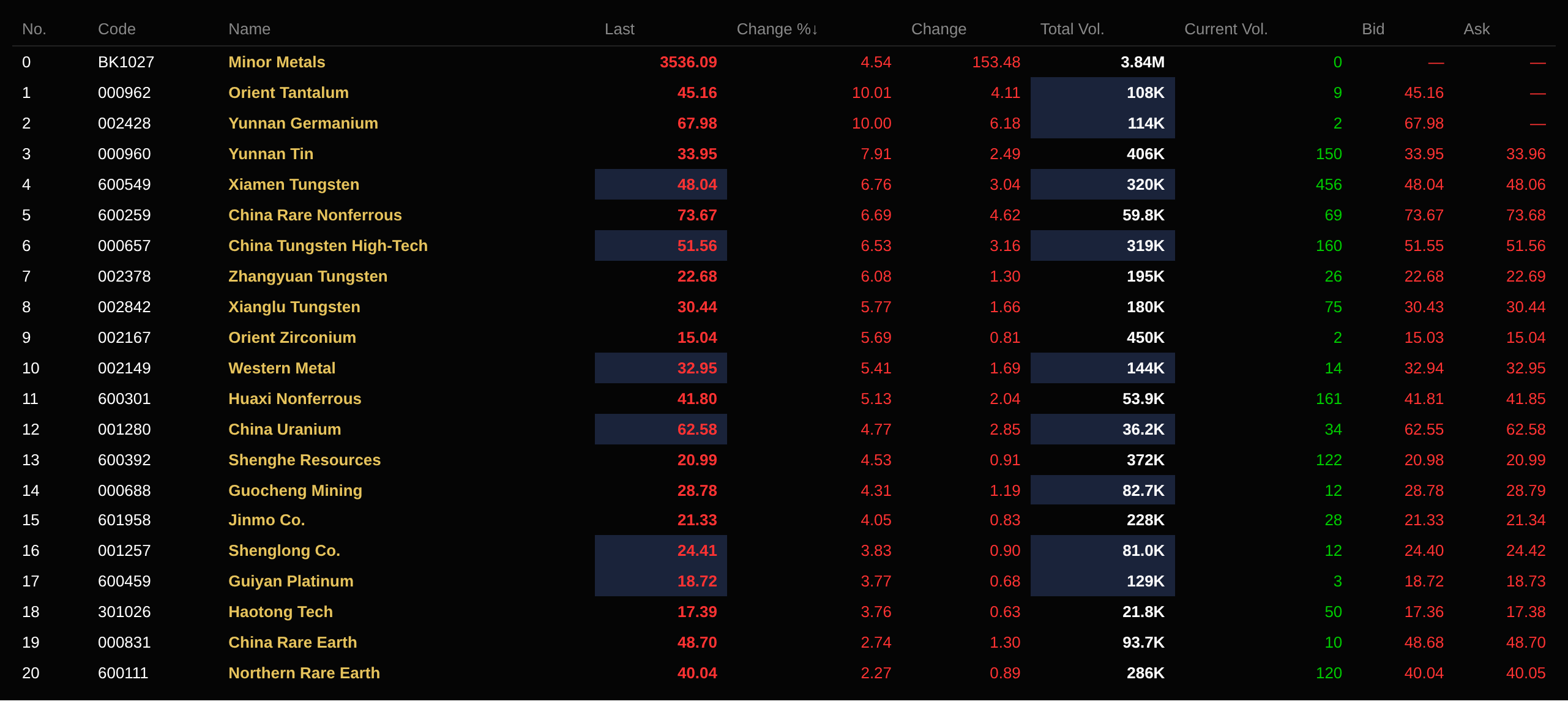
Sentiment in the A-share semiconductor industry chain futures market recovered, as improving industry chain fundamentals transmitted upward, driving a strong rally in the upstream strategic minor metal sector. As of around 10:15 on July 31, the minor metal sector index had risen 4.54%. Among individual stocks, Dongfang Tantalum and Yunnan Germanium hit their daily limit up, while Yunnan Tin, Xiamen Tungsten, China Rare Earth Nonferrous, China Tungsten High-Tech, Zhangyuan Tungsten, Xianglu Tungsten, and Dongfang Zirconium were among the top gainers. The rally in the minor metal sector was driven by the resonance of multiple industry dynamics. On one hand, demand for semiconductors and AI computing recovered, and expansion expectations for high-speed optical modules and AI servers improved. Germanium and tantalum, as core raw materials for semiconductor optoelectronic devices and high-end tantalum capacitors, saw continued strengthening of downstream demand from emerging industries. On the other hand, germanium and tantalum are strategic dispersed metals with concentrated global supply. Supply tightening expectations arose from geopolitical uncertainties outside China and domestic resource controls. Meanwhile, the ongoing localisation of high-end semiconductor materials further boosted market allocation sentiment, lifting the sector's performance.
News
[Yunnan Germanium: subsidiary signs major indium phosphide wafer supply contract worth 570 million to 855 million yuan; H1 net profit expected to rise YoY] Yunnan Germanium announced on July 24 that its controlling subsidiary Yunnan Xinyao recently signed a supply agreement with a client to sell indium phosphide wafers (substrates). The total contract value is estimated at between 570.08 million yuan and 855.12 million yuan (tax inclusive), representing 53.48% to 80.23% of the company's audited operating revenue in 2025. The contract will be performed from August 1, 2026, to December 31, 2027. Regarding the impact on the listed company, Yunnan Germanium stated: If the contract is successfully executed, it is expected to have a positive impact on the company's operating results for the performance years. The specific impact and the reporting periods affected will depend on the actual fulfillment of the contract and will be subject to the revenue confirmed by the company's audit.
[Dongfang Tantalum: domestic demand for high value-added products such as superalloys and semiconductor tantalum targets is gradually rising] Dongfang Tantalum stated during an institutional survey on July 23 that with the sustained development of China's high-tech and new infrastructure sectors, domestic demand for high value-added products such as superalloys, semiconductor tantalum targets, and high-purity niobium materials is gradually rising. In recent years, the company has been fully advancing the technological upgrading and capacity expansion of its production lines, rationally organizing production, and gradually releasing new capacity. Guided by the strategy of achieving self-reliance in the industry chain, the localisation substitution process has evolved from individual product breakthroughs to systematic solutions, providing a solid foundation for the growth of tantalum, niobium and their alloy products.
[Yunnan Tin: Expects H1 2026 Net Profit of 1.47–1.57 Billion Yuan, Up 38.43%–47.85% YoY]Yunnan Tin disclosed an earnings forecast on the evening of July 14, expecting attributable net profit in H1 2026 to be 1.47 billion to 1.57 billion yuan, up 38.43%–47.85% YoY; and recurring net profit is expected to be 1.88 billion to 1.98 billion yuan, up 44.23%–51.91% YoY.
Spot Market
Tin
Overnight, some US chip stocks rebounded, and the Philadelphia Semiconductor Index surged, boosting the performance of tin, known as the “computing metal.” SHFE tin opened higher on July 31, lifting spot prices.
In the tin spot market: On July 31, the average price of SMM 1# tin was 425,850 yuan/mt, up 1.51% from the previous trading day. As tin prices rose, spot market trading was sluggish.
Fundamentals: (1) Supply: Tight ore and ingot supply, low inventory, amplifying elasticity. Myanmar’s rainy season extends through end-August, with mine flooding and logistics disruptions; Wa State’s June tin ore output was only 6,392 mt in physical content. China’s tin ore imports in July are expected to be basically flat MoM. The slow pace of production resumptions in Wa State has been priced in ahead of time, with no major shutdowns in the near term, but supply contraction expectations during the rainy season have yet to fully materialize. Indonesia’s tin ingot imports in July are expected to show some recovery MoM. (2) Demand: Improved solder operating rates, but acceptance of high prices needs to be tested. The operating rate at solder enterprises was 78.8% in June, up 4.6 percentage points from May; however, after the sharp spot price rally on July 30, downstream users were cautious and stayed on the sidelines, and whether high-priced spot cargoes can be absorbed still requires verification. Stockpiling for new Apple/Huawei models in late August is the next demand trigger point.
Institutional Views
A research report from Minmetals Securities points out: Germanium accounts for 60% of applications in optical communication and satellite PV fields, making it a metal for “AI computing power + space energy.” With its excellent refractive index tuning capability and radiation resistance, germanium has become a key material for AI data center optical interconnects and low-earth-orbit satellite PV systems. Looking at changes in demand structure, from 2020 to 2026, downstream germanium consumption grew from 160 mt to 240 mt, with optical communication’s share rising to 40% and satellite PV’s share to 20%, together accounting for 60% of total downstream demand. It expects that 90% of the demand growth in 2027 will come from two high-growth sectors: AI hardware and satellite PV.
A research report from Caitong Securities shows: As AI computing power demand explodes, the market size of indium phosphide, used as a chip substrate material, will continue to expand. Indium resources are scarce and subject to policy restrictions, and product prices are entering an uptrend. High-purity red phosphorus is a very important semiconductor base material, with high purification technology barriers. Against the backdrop of accelerated AI application deployment driving related infrastructure construction, the indium phosphide substrate industry chain is expected to see dual opportunities from demand growth and domestic substitution. It is recommended to focus on enterprises with resource and technological advantages in the links of indium phosphide, indium, and high-purity red phosphorus.
A research report from Datong Securities shows that minor metals have staged an independent rally, with tightened supply combined with strategic attributes leading to a value revaluation. The rare earth sector is preemptively pricing in new regulatory controls, with Myanmar ore imports disrupted, tight spot supply of Pr-Nd oxide driving prices sharply higher; tungsten and antimony ore grades are declining along with environmental protection-driven production restrictions, widening the supply gap, while PV and hard alloy demand remains firm during the off-season, and inventories are at low levels. AI computing power and communications sectors are boosting demand for gallium and germanium, and coupled with export control policies, concentrated stockpiling outside China is widening the price spread between Chinese and overseas markets. Scarce resources are resonating with financial attributes, and the sector continues to be favoured by capital.
Recommended Reads: