Guinea-China bauxite freigh rates have rebounded recently amid renewed volatility in the Middle East and continued tightness in the dry bulk shipping market. As at least 70% of Guinea’s bauxite shipments are destined for China, sustained high freight rates on the Guinea-China route have not only lifted delivered logistics costs but also constrained shipments through weaker margins and limited vessel availability.
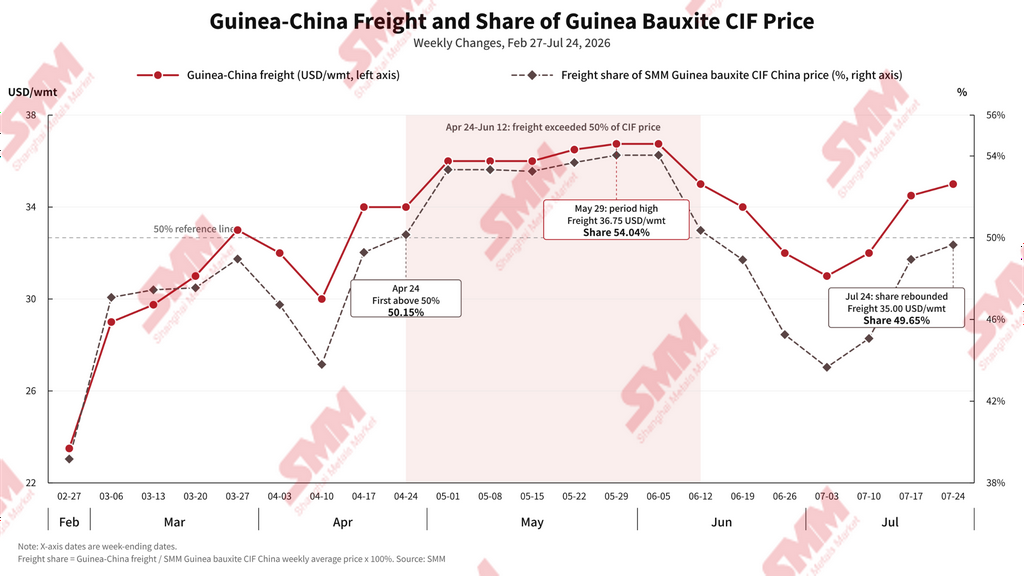
Freight rose much faster than CIF prices, briefly accounting for over half of delivered prices
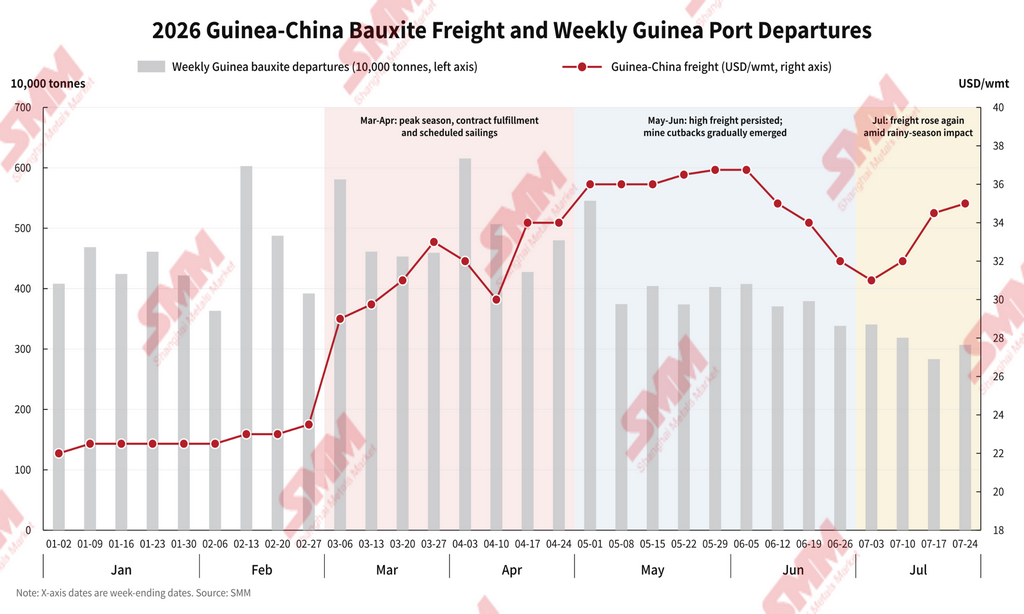
SMM data showed that Guinea-China bauxite freight rates rose from $23.50/wmt on February 27 to $36.75/wmt on May 29, an increase of 56.4%. Freight remained at the same elevated level in the week ending June 5.
Over the same period, the weekly average SMM Guinea bauxite CIF China price rose from $60.00/wmt to $68.00/wmt, an increase of only 13.3%, significantly lagging the rise in freight.
As a result, freight as a share of the SMM Guinea bauxite CIF China price increased from 39.17% to 54.04%, meaning that ocean freight at one point represented more than half of the assessed delivered price.
With CIF prices unable to fully absorb the additional shipping costs, pressure on miners’ and traders’ operating margins continued to build. According to SMM market contacts, the vast majority of surveyed Guinean mines reduced shipments to varying degrees after freight rates remained elevated, while some mines temporarily suspended loadings.
High freight costs have therefore become a major direct factor behind the recent slowdown in Guinea’s bauxite shipments.
In addition to prices, tight vessel availability has also restricted physical shipments. Traders and miners have widely reported difficulties securing spot bulk carriers, particularly for prompt cargoes. Some shipments have been delayed even where participants were prepared to accept prevailing freight levels, as vessels could not be secured in time and loading schedules had to be postponed.
Peak season and contractual obligations initially supported March-April shipments
Despite the sharp rise in Guinea-China freight rates from March, Guinea’s bauxite shipments remained relatively high during March and April.
March-April is traditionally a peak shipment period in Guinea, when mining, inland transport and port-loading conditions are relatively favourable. In addition, previously signed long-term contracts and vessels booked in advance still had to be fulfilled.
At the beginning of the freight rally, many market participants also expected the increase to be temporary. Miners therefore did not immediately make broad adjustments to existing shipment plans.
SMM data showed that average weekly bauxite shipments from Guinea stood at 4.98 million mt between March 6 and April 24. Shipments remained high even after freight exceeded $30/wmt, reaching a weekly peak of 6.15 million mt in the week ending April 3.
However, as elevated freight rates persisted into late April and May, the support from existing contracts, previously arranged vessels and the seasonal shipment peak gradually weakened. The impact of shipping costs became increasingly visible in outbound volumes.
Average weekly shipments fell to 4.00 million mt between May 1 and June 26, down 19.8% from the March 6-April 24 average.
Monthly data showed a similar trend. Guinea shipped 17.50 million mt in May, down 18.5% month on month, before shipments declined by another 10.0% to 15.74 million mt in June.
The timing of the decline broadly coincided with the prolonged period of high freight rates and increasingly tight spot vessel availability reported by market participants since late April.
Freight pressure eased briefly in late June before returning in July
Shipping-market pressure eased temporarily in the second half of June as more positive expectations emerged around Middle East negotiations.
Guinea-China bauxite freight rates fell from $36.75/wmt on June 5 to $31.00/wmt on July 3, while freight as a share of the SMM Guinea bauxite CIF China price declined from 54.04% to 43.66%.
However, shipments did not recover immediately. Restarting cargo programmes, securing vessels and reorganising loading schedules all require time. Guinea was also moving deeper into its rainy season, further limiting the speed of any recovery.
The rainy season generally runs from May to November, with the impact becoming more pronounced in July and August. SMM market feedback suggests that rainfall may reduce shipments by around 20% during the most disruptive period by affecting mine-to-port transportation, barge operations and loading efficiency.
Entering July, renewed escalation in the Middle East pushed Guinea-China freight rates higher again. Freight rose from $31.00/wmt on July 3 to $35.00/wmt on July 24, an increase of 12.9%.
Over the same period, the weekly average SMM Guinea bauxite CIF China price edged down from $71.00/wmt to $70.50/wmt, lifting the freight share back to 49.65%.
According to SMM market contacts, as freight rates rebounded and spot bulk carriers remained difficult to secure, some mines that had previously planned to resume shipments again reduced or suspended loadings.
Weekly shipments declined from 3.41 million mt in the week ending July 3 to 3.07 million mt in the week ending July 24, a decrease of 9.9%. Shipments fell as low as 2.83 million mt in the week ending July 17.
As of July 24, Guinea’s cumulative July shipments stood at 10.55 million mt, equivalent to an average of 439,500 mt per day, down 16.2% from June’s daily average.
SMM outlook
SMM believes that the recent pressure on Guinea’s bauxite shipments cannot be attributed solely to seasonal rainfall. Persistently high freight rates and tight spot vessel availability have become the main direct constraints on shipments, while the rainy season has amplified the disruption.
High freight rates continue to compress the operating room available to miners and traders, while scarce vessel availability is preventing some cargoes from progressing from planned sales to actual loading.
The traditional shipment peak, contractual obligations and previously arranged vessels delayed the transmission of higher freight costs into shipment volumes during March and April. However, as elevated freight rates persisted, the vast majority of surveyed miners gradually reduced shipments, while some temporarily halted loadings, with the impact becoming increasingly apparent from May.
In the near term, developments in the Middle East, fuel costs and dry bulk vessel availability in the West African market will remain key factors influencing Guinea-China freight rates. Should freight rates remain near $35/wmt or rise further, while tight spot bulk carrier availability shows no meaningful improvement, Guinean miners’ willingness to ship and their actual loading capacity may remain constrained. Combined with the impact of the July-August rainy season on mine-to-port transportation, barge operations and port-loading efficiency, Guinea’s weekly bauxite shipments are expected to remain volatile at relatively low levels, with marginal mines and spot cargoes facing greater pressure.
Looking ahead to the third quarter of 2026, under SMM’s base-case scenario of persistently high freight rates, tight vessel availability and continued rainy-season disruption, Guinea’s bauxite shipments are expected to remain subdued and fluctuate at low levels. Average daily shipments may mainly range between 370,000 mt and 400,000 mt, corresponding to monthly shipments of approximately 11.5 million-12.0 million mt, broadly in line with the monthly average recorded in the third quarter of 2025. Shipments could stage a temporary recovery should Middle East tensions ease, freight rates decline significantly and bulk vessel availability improve. Meanwhile, developments concerning Guinea’s bauxite export quota policy remain a key uncertainty for the supply outlook. Any substantive implementation of related measures could further alter the pace of shipments and expectations for the country’s total bauxite exports.
![Two Major Factors Boost Market Confidence, Short-Term Aluminum Prices Consolidate on a Strong Note [SMM Aluminum Price Weekly Review]](https://imgqn.smm.cn/usercenter/WOsGj20251217171651.jpg)