SMM, July 29:
Key Points: Warm isostatic pressing (WIP) is the core process for densifying solid–solid interfaces in sulphide-based all-solid-state batteries. However, the huge differences in compressive modulus and plastic deformation capability among anode and cathode active materials, the solid electrolyte, and the copper and aluminum current collectors lead to non‑uniform creep and interlayer slippage of the multi‑layer structure under 600 MPa isotropic high pressure. This can be tolerated in lab‑scale small battery cells, but when scaled up to vehicle‑grade large‑capacity cells, the yield simply crashes. The priority for solving this is clear: material modification (cure the root cause) > process optimization (palliate) > equipment upgrade (symptomatic treatment with obvious ceiling). The hardware gap with domestic WIP equipment continues to narrow, but the weak links remain the process database and turnkey solutions. The industry is now in a procurement window for pilot‑scale equipment, and the pace of iteration in China is faster than outside China. Over the long term, the winners among equipment makers will depend on whole‑line solutions and deep ties with leading clients; standalone machine performance is only the entry ticket. Constrained by the material mismatch bottleneck, achieving million‑unit‑level installation of all‑solid‑state batteries before 2030 is extremely difficult, and only small‑volume demonstrations on high‑end car models are expected to emerge during 2027–2029.
Introduction:
Sulphide-based all‑solid‑state batteries are widely regarded as the ultimate route for next‑generation power batteries, but their mass‑production process is confronting a critical engineering bottleneck – the “material mismatch” problem under warm isostatic pressing (WIP). Under isotropic high pressure of up to 600 MPa, the anode and cathode active materials, the sulphide electrolyte, and the copper and aluminum current collectors exhibit huge differences in compressive modulus and plastic deformation capability, causing non‑uniform creep and inter‑layer slippage of the multi‑layer structure. This mechanical mismatch results in good performance in lab‑scale small cells, but a sharp drop in yield when scaled up to vehicle‑grade large‑capacity cells.
This article starts from the physical nature of the mismatch problem, systematically sorts out the priority of solution paths (material modification > process optimization > equipment upgrade), compares the gaps and positioning logic between domestic and overseas equipment makers, and, integrating the industry pace and mass‑production timeline expectations, makes a sober assessment of the commercialization prospects for all‑solid‑state batteries. Robin Zeng rated the current technology readiness level as TRL 4 (on a scale of 1–9) and clearly stated that achieving million‑unit‑level vehicle installation before 2030 is “highly unlikely.” Behind this judgment, it is materials science, not equipment engineering, that sets the ceiling of the problem.
I. Nature of the Mismatch: Mechanical Mismatch Is the Root Cause, Not Pressure Uniformity
Warm isostatic pressing (WIP) applies isotropic pressure of up to 600 MPa at low‑to‑medium temperatures of 50–500 °C to press the solid electrolyte layer together with the anode and cathode materials, thereby improving the solid–solid contact interface and reducing impedance. But the very problem lies right here –
The compression modulus, plastic deformation capacity, and compaction density of anode and cathode active materials, sulphide solid-state electrolytes, and copper and aluminum current collectors differ enormously. Under isotropic high pressure of 6000 atmospheres (approximately 600 MPa), the multilayer structure undergoes non-uniform creep, interlayer slippage, edge warping, microscopic interfacial debonding, and soaring local impedance. Zeng Yuqun clearly pointed out that solid-state batteries have extremely high contact requirements, but under warm isostatic pressing, "because the compaction densities of the cathode and anode are inconsistent, there is a misalignment problem."
Key Insight:The root cause of misalignment is the mismatch of mechanical properties, not a problem of pressure uniformity. Even if the equipment perfectly outputs uniform pressure, the mechanical mismatch of materials still leads to slippage. The industry mainstream adopts a warm isostatic pressing process at 6000 atmospheres to solve the problem, but materials such as the cathode, anode, and copper and aluminum current collectors have large differences in compaction density. After high-pressure pressing, material misalignment and interface failure are highly prone to occur. Even if samples can be made in the laboratory, they cannot be adapted to mass production applications.
II. Resolution Priority: Material Modification > Process Optimization > Equipment Upgrade
2.1 First Tier: Material System Modification (Root Cause Fix, Highest Priority)
The root cause of misalignment is material mechanical mismatch. Only by narrowing the compressive deformation differences of each layer can interlayer misalignment be suppressed at the source. Core measures include: electrolyte composite toughening, introducing an elastic bonding network within the electrode, composite current collectors, gradient modulus electrode design; doping/compositing of sulphide electrolytes to enhance creep resistance; developing low-modulus adaptive cathodes.
The logic is very clear: even if the equipment perfectly outputs uniform pressure, material mechanical mismatch still leads to slippage. Without changing the material, even the best equipment cannot address the root cause.
2.2 Second Tier: Process Optimization (Fastest Engineering Implementation, Mitigation Measure)
Segmented temperature-pressure curve: pre-pressing → heating → holding → slow pressure release, avoiding instantaneous high-pressure impact; pouch packaging with jacket buffering structure; adding positioning adhesive frames and edge reinforcement during stacking; limiting the single-layer area of the battery cell to reduce the slippage risk of large-format cells.
But the drawbacks are equally obvious: it is a "compensation solution," and the diminishing marginal effect becomes apparent as the battery cell becomes larger, making it impossible to completely eliminate misalignment.
2.3 Third Tier: Equipment Upgrade (Symptomatic Treatment, Obvious Upper Limit)
Both domestic and imported warm isostatic presses can achieve globally uniform pressure; further improving pressure accuracy and temperature uniformity cannot solve the slippage caused by mismatched material mechanical properties. The boundaries that equipment can optimize lie in pressure fluctuations, chamber temperature field, pressure release rate, and automated loading/unloading—it cannot change the deformation characteristics of the materials themselves.
2.4 Industry Reality: In the short term, it relies on process optimization and canning structure to first validate pilot samples; in the medium and long term, it must rely on material modification to achieve stable pressing of large-capacity battery cells; simply hoping on equipment modification is difficult to fundamentally break the deadlock.
Three, Domestic vs. Overseas Equipment Gap: Hardware is catching up, but software gap is large.
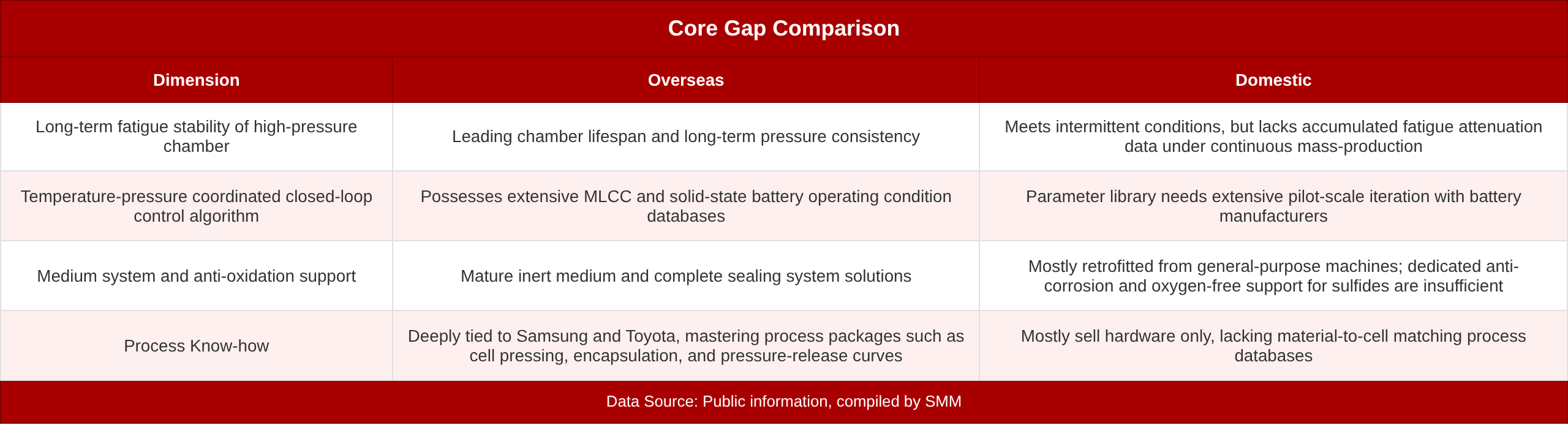
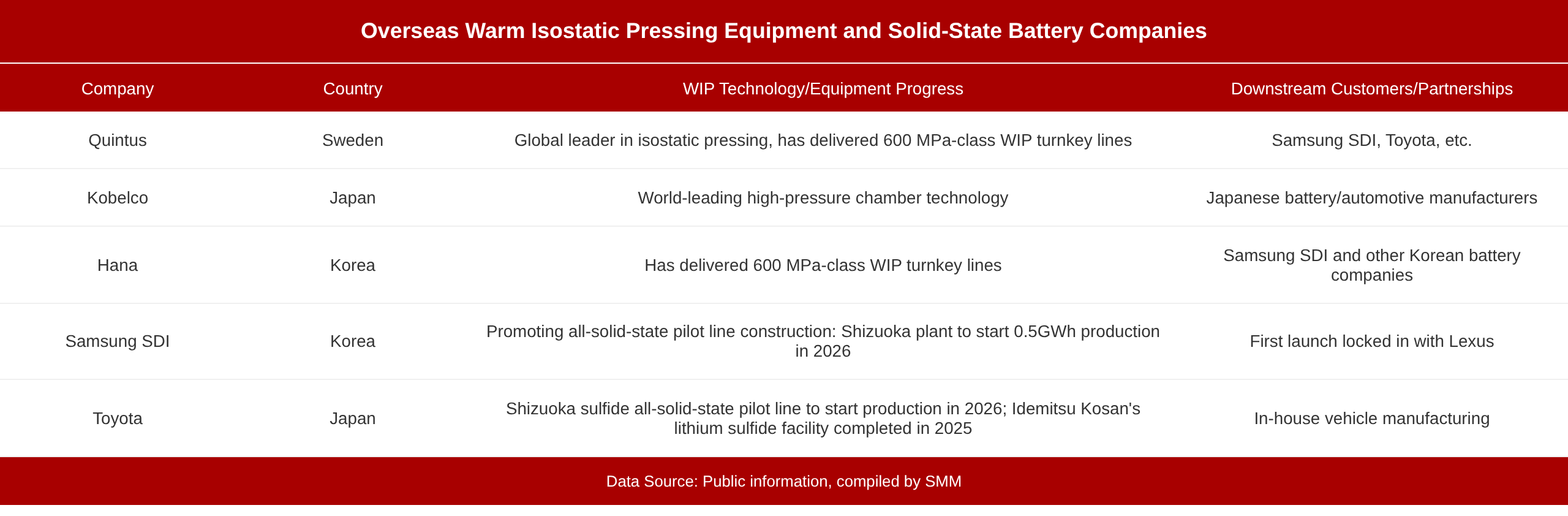
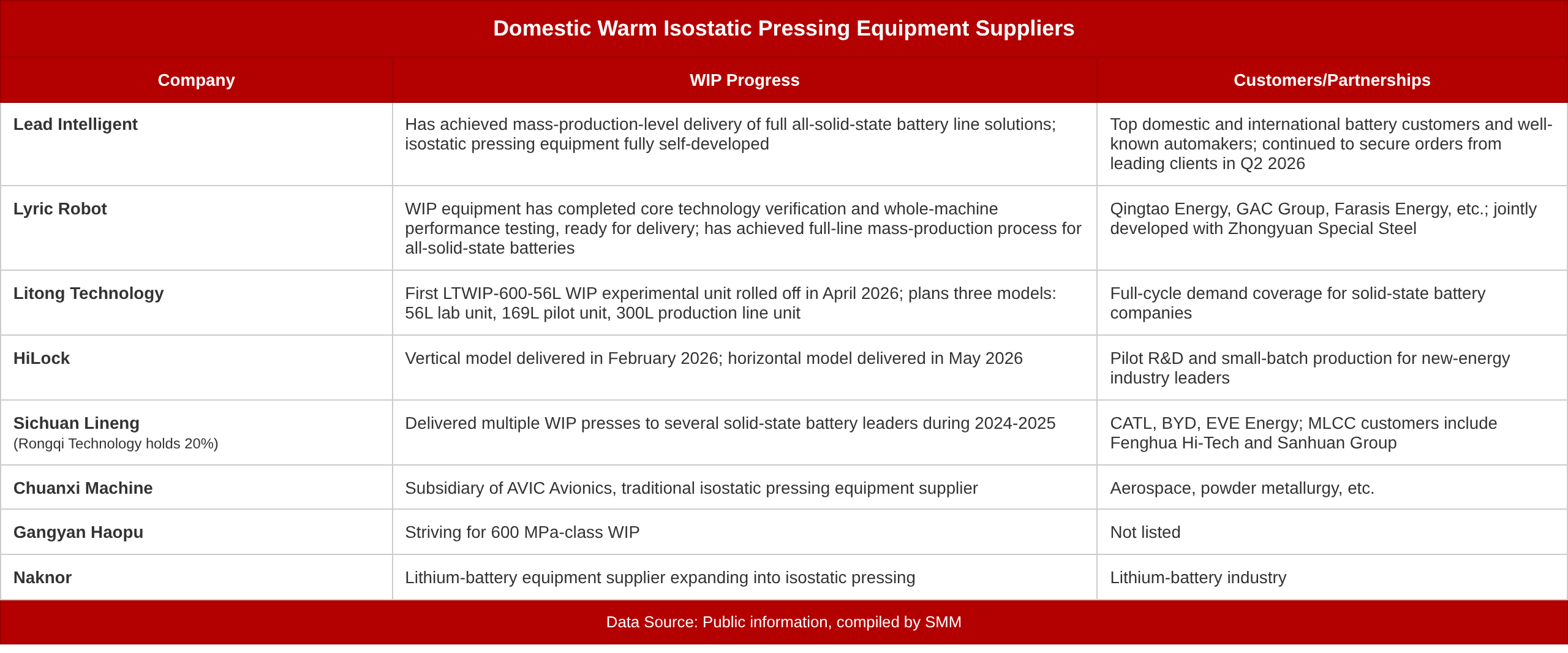
In terms of price, domestic models cost about 55%–70% of imported ones, with significantly shorter delivery cycles and advantages in local after-sales service. Leading overseas companies include Sweden's Quintus and South Korea's Hana, which have delivered 600 MPa-class warm isostatic pressing whole lines; domestic players such as Chuanxi Machine, Lead Intelligent Equipment, and Lyric are actively positioning themselves.
Three key barriers for domestic equipment suppliers entering the solid-state track (from most difficult to easy)
Process co-development capability (highest barrier):
Cannot just sell standalone machines; must jointly explore battery cell canning, warm pressing curves, and anti-misalignment processes with battery enterprises; lacking an electrochemistry and mechanics cross-process database, they can only be reduced to pure hardware suppliers.
Long-term stable mass production verification of 600 MPa-class warm isostatic pressing machines: Military hot isostatic pressing ≠ lithium battery warm isostatic pressing; military tends to high temperature, while lithium battery involves medium temperature and high pressure with repeated cycling conditions; the technical lineage is not fully interchangeable.
Whole-line automation integration capability: bare cell transfer, vacuum packaging, isostatic pressing, flaw detection, and inspection are seamlessly connected; a single machine may be strong but cannot be embedded into a solid-state production line, so the order ceiling is very low.
Four, Equipment supplier positioning: Whole-line capability > binding with top-tier customers > standalone machine performance
4.1 First Core: Whole-line integration and process solution (highest weight). In the future, battery factories will not purchase standalone machines in isolation. Lead Intelligent Equipment has achieved mass production level delivery of all-solid-state battery whole-line solutions, with core equipment covering electrode preparation, electrolyte membrane preparation, isostatic pressing densification, and post-process inspection across all process steps. Lyric has linked up the entire all-solid-state battery full-line mass production process, possessing equipment adaptation capabilities for all systems of sulphide, oxide, polymer, and halide. Manufacturers that only make isostatic pressing standalone machines are easily packaged and replaced by whole-line equipment suppliers.
4.2 Second Core: Deeply bind with top-tier battery/automaker customers, co-establish joint labs. The warm isostatic pressing process is highly customized; once a customer has validated its exclusive process package, the cost of switching equipment suppliers is extremely high; for leading players like CATL, Toyota, and Samsung, the verification cycle is 2–3 years, forming a strong customer barrier.
4.3 Third Core: Standalone machine hardware performance. Standalone performance is an entry ticket, but not the decisive factor.
Five, Industry Pace: Pilot equipment procurement window has arrived.
5.1 Demand Scale Estimation (Sulphide Route)
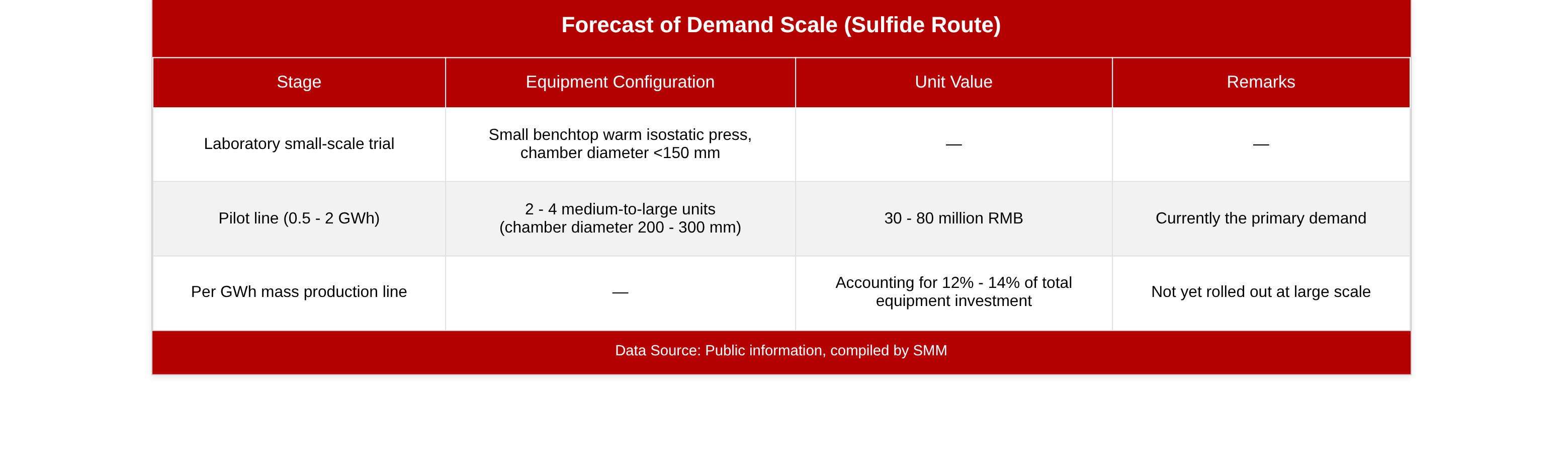
Isostatic presses account for about 13% of the total value of solid-state battery equipment, and the market size for isostatic presses is expected to exceed 6 billion yuan by 2030. The global market size for solid-state battery equipment is expected to reach 12 billion yuan in 2026.
5.2 Pace Discrepancies in and Outside China
Outside China (Primarily Japan and South Korea):Samsung SDI and Toyota are back-calculating equipment procurement based on mass production targets. Toyota will launch its solid-state battery production line in 2026, and Samsung SDI's Shizuoka plant will start production at 0.5 GWh in 2026. Procurement characteristics: Prioritising imported equipment from Quintus and Hana; highly planned orders with long-cycle validation locked in at one go; preference for horizontal large-cavity models.
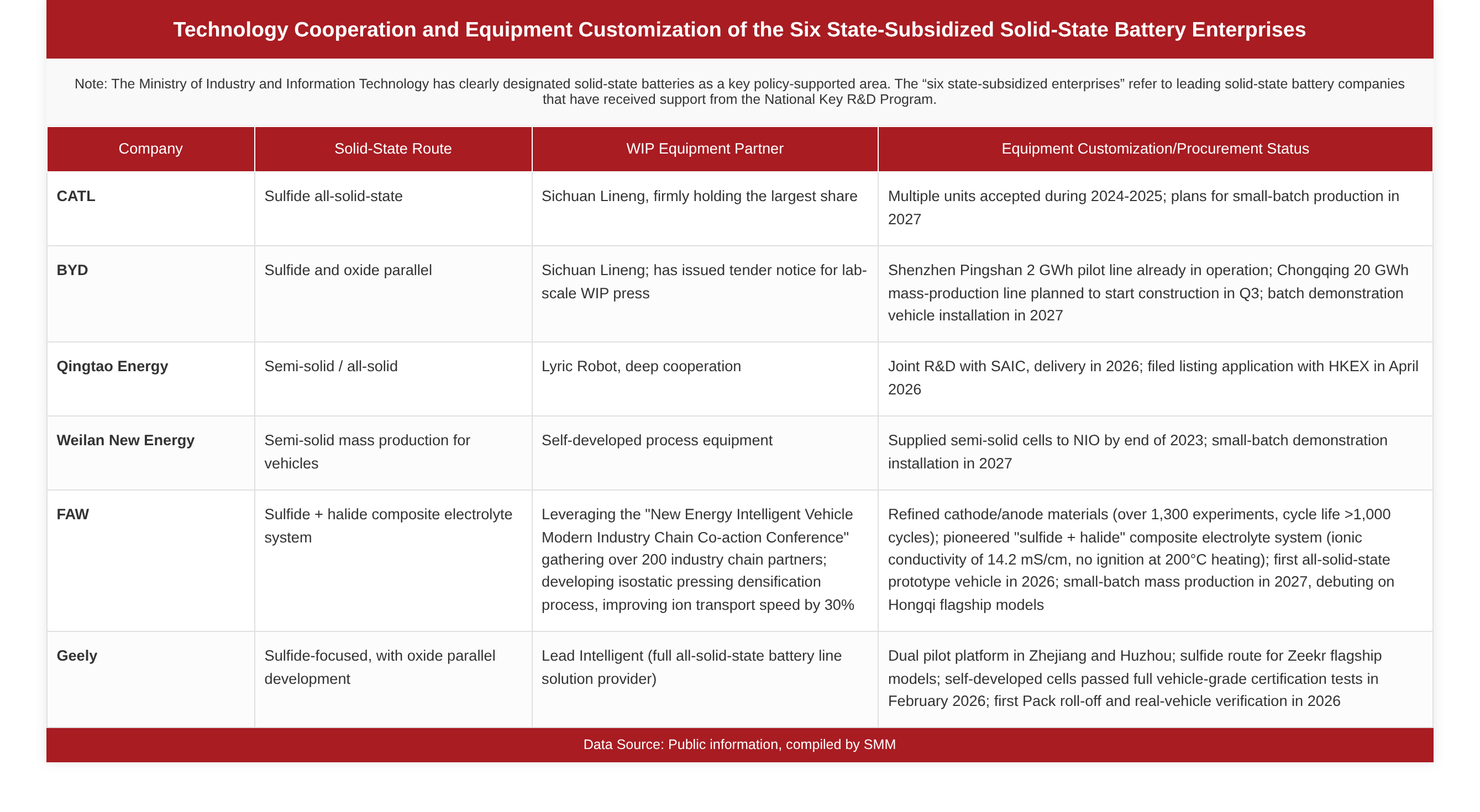
China:The technology routes are more fragmented (sulphide/oxide in parallel); procurement is more flexible, with extensive adoption of "domestic equipment first for pilot-scale verification"; iteration speed is faster. 2026–2027 represents the peak of pilot-scale equipment procurement. Over ten top-tier players, including CATL, BYD, WELION New Energy, Qingtao, Yaoning, and Gotion High-tech, are building or expanding pilot lines.
6. Mass Production Timeline Expectations: "Very Unlikely" to Reach a Million Units Before 2030
Zeng Yuqun rated the current technological maturity of all-solid-state batteries at TRL 4 (on a 9-level scale), meaning only foundational lab principle tests have been completed. Speaking at the 2026 Dalian Summer Davos Forum, he stated: "If we are talking about level 1 to 9, we are currently only at level 4; level 9 is where mass production becomes feasible."
Mass Production Timeline Expectations
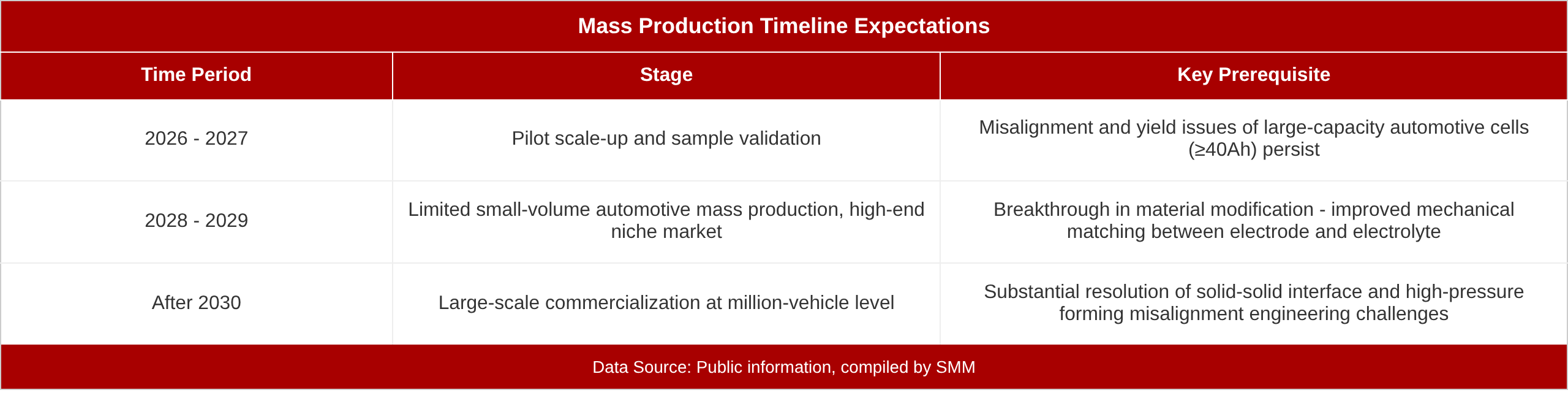
Zeng Yuqun explicitly stated that achieving mass installation of all-solid-state batteries in a million-unit scale before 2030 is "very unlikely." He advocates viewing technological breakthroughs as "event-driven" rather than "time-driven" – commercialisation can only be realised once key scientific and engineering problems are resolved.
Key Risk Scenario: If the industry sees the emergence of new process routes that do not require ultra-high-pressure warm isostatic pressing (such as low-pressure adapted solid-state systems, in-situ curing, and other solutions), the current investment logic for high-value Warm Isostatic Pressing equipment will be restructured.
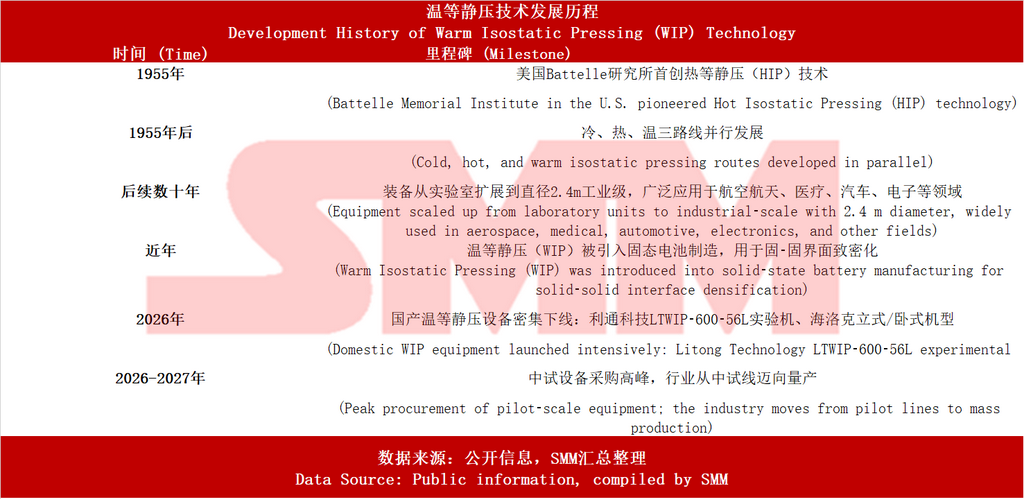
7. Development History of Warm Isostatic Pressing Technology
Global Development History of Warm Isostatic Pressing Technology
8. Overview of Key Enterprises' Technologies and Clients in and Outside China
8.1 Overseas Warm Isostatic Pressing Equipment and Solid-State Battery Enterprises
8.2 China-Based Warm Isostatic Pressing Equipment Manufacturers
8.3 Technology Cooperation and Equipment Customisation Among Six Major State-Funded Solid-State Battery Enterprises
Note: The Ministry of Industry and Information Technology has clearly identified solid-state batteries as a key policy support direction; the "Six Major State-Funded Enterprises" refers to the top-tier solid-state battery players that have received support from the National Key R&D Programmes.
9. Conclusion
The root cause of material misalignment in warm isostatic pressing is the mechanical mismatch of multi-layer materials, with the priority for solutions being: material modification > process optimisation > equipment upgrades. The hardware gap for domestic equipment continues to narrow, but the deficiencies lie in process databases and turnkey solutions. The industry is currently in a procurement window period for pilot-scale equipment, and China's iteration pace is faster than outside China. The long-term success of equipment manufacturers depends on turnkey solutions and deep collaboration with top-tier clients, with standalone machine performance serving merely as an entry threshold. Constrained by misalignment bottlenecks, achieving million-unit-scale all-solid-state vehicle installations before 2030 is extremely challenging—as Zeng Yuqun put it, this is an "event-driven" rather than a "time-driven" breakthrough.
Note: If you have any additions regarding the details mentioned in this article or wish to follow solid-state battery developments, please feel free to contact us via the methods below:
Tel: 021-20707860 (or add WeChat: 13585549799) Yang Chaoxing, thank you!
Related Reading