From the historical profit trend of cold-rolled and hot-rolled steel, the spot profit of cold-rolled products was higher than that of blast furnace HRC in most cycles. However, from the end of 2025 to H1 2026, the profit centers of both cold-rolled and HRC shifted downward simultaneously, and the gap between their profit curves continued to narrow. The traditional processing premium of cold-rolled over HRC contracted significantly. At present, the spot profits of both cold-rolled and HRC are moving sideways around the break-even line, and overall industry profitability has declined markedly. On the one hand, raw material costs have shown strong resilience, supporting the bottom of finished steel prices. On the other hand, downstream end-use demand has continued to weaken since the start of this year, making it harder to support cold-rolled prices. Meanwhile, steel mills have taken more HRC orders than cold-rolled orders this year, and firm HRC prices have continuously squeezed the processing income of cold-rolled steel, steadily narrowing the profit gap between the two.
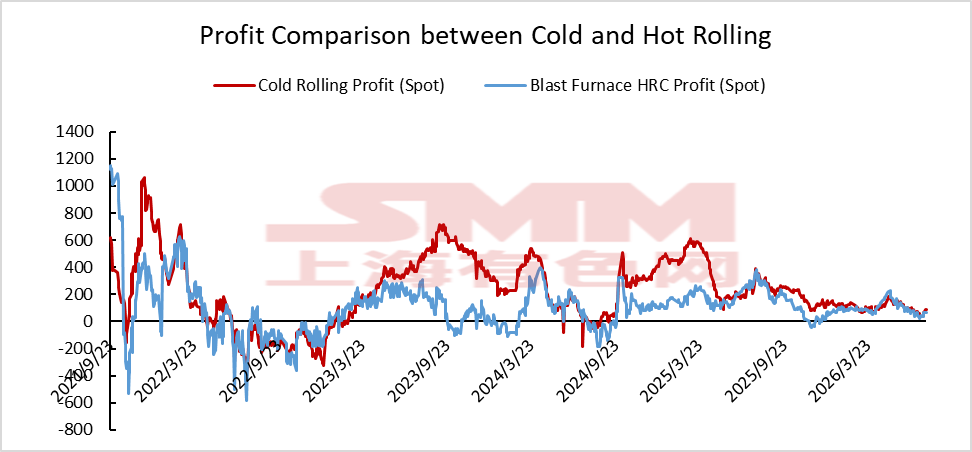
Looking ahead to H2 2026, cold-rolled and HRC profits are likely to consolidate on a subdued note overall. Cold-rolled steel is still expected to retain a modest processing premium, but it will be difficult to see a repeat of the significant profit rises from 2023 to 2024. On the supply side, blast furnaces face expectations of seasonal maintenance, which can periodically shore up HRC supply. In the persistently low-profit environment for cold-rolled steel, some mill production lines are willing to voluntarily reduce output, potentially providing some support for cold-rolled processing fees. Demand will become the core variable driving profits. In H2, traditional manufacturing typically sees a seasonal recovery during the "September-October peak season," and downstream automobile and home appliance industries are expected to sprint toward their full-year production plans, providing some demand support.
However, the extent of the recovery in downstream end-use demand this round remains uncertain. In the short term, absent stronger policy support to stabilize growth, the recovery pace of downstream demand is likely to be gradual, and cold-rolled and HRC profits will most likely continue to consolidate near the break-even line. On the raw material front, iron ore has seen no particular trend and is broadly fluctuating in line with steel. The second round of coke price reductions has been implemented, weakening cost support and leaving room for cold-rolled and HRC profit recovery. At the same time, if downstream users show strong willingness to stockpile for the peak season starting in late August, with orders being released continuously, demand support may lead to a phased recovery in cold-rolled profits and a renewed widening of the price spread between cold-rolled and HRC. If the manufacturing recovery falls short of expectations, profits of both cold-rolled and HRC will come under pressure simultaneously. Going forward, close attention should be paid to auto production and sales data, downstream order booking, and raw material price movements, and one should stay vigilant against the risk of profits falling short of expectations if the peak season fails to materialize.
![[Brief Commentary on China's Iron Ore] Iron ore concentrate prices in west Liaoning may remain in the doldrums and consolidate.](https://imgqn.smm.cn/usercenter/fvyjO20251217171715.jpg)
![[Indian and Indonesian Steelmakers Plan $350 Million Stainless Slab Mill]](https://imgqn.smm.cn/usercenter/JdqON20251217171718.png)
![[SMM Steel] Alang Ship-Breaking Scrap Prices Hold Firm on Tight Supply](https://imgqn.smm.cn/usercenter/zbJUC20251217171718.jpg)