According to foreign media reports, Zimbabwe's state-owned enterprise Mutapa Energy Resources recently announced that its Sandawana lithium mine project has confirmed 39.9 million mt of JORC-compliant lithium resources, of which 28.7 million mt are proven resources, accounting for about 72% of the total.
It is reported that the resources confirmed at the Sandawana lithium mine project cover only about 30% of the roughly 3,800-hectare mining lease area. The project's first-phase exploration lasted 11 months, completing 103,000 meters of drilling and 33,000 sample assays, with a cumulative investment of $24 million.
According to Mutapa Energy Resources CEO Rukweza Innocent, the remaining 70% of Blocks B and C have not yet been explored. The company is conducting geochemical and geophysical analyses on them, with preliminary results expected to be released soon.
It is worth noting that the report also mentioned that Mutapa Energy Resources has currently mined about 2 million mt of ore and is constructing a beneficiation plant with an annual processing capacity of 3 million mt. The next phase plans to invest $6 million to carry out 23,500 meters of drilling, and the third phase will invest another $12 million to complete 70,000 meters of drilling, with the goal of increasing the resource tonnage in Block A from 39.9 million mt to 90 million mt.
Furthermore, Zimbabwean Vice President Chiwenga recently stated that the proven reserves at the Sandawana lithium mine project currently stand at about 39 million mt, while the total potential lithium resources of the entire mining lease area could be as high as 600 million mt.
In addition to lithium resources, the project has also discovered tantalum and niobium resources with commercial development potential.
Public information shows that Zimbabwe is the world's second-largest supplier of hard-rock lithium ore and the fourth-largest lithium ore producer.
According to USGS data, Zimbabwe's lithium resource production in 2025 was about 28,000 mt in metal content, accounting for 8% of global total production.
It is worth mentioning that Zimbabwe has always been one of the core sources of China's lithium concentrate imports.
According to data from the Lithium Branch of the China Nonferrous Metals Industry Association (hereinafter referred to as the Lithium Branch), China is the only country in the world where the production of basic lithium chemicals such as lithium carbonate, lithium hydroxide, and lithium chloride exceeds 1 million mt, but its lithium concentrates mainly rely on imports. In 2025, China's imports of lithium concentrates surged significantly, with trade value reaching 31.93 billion yuan.
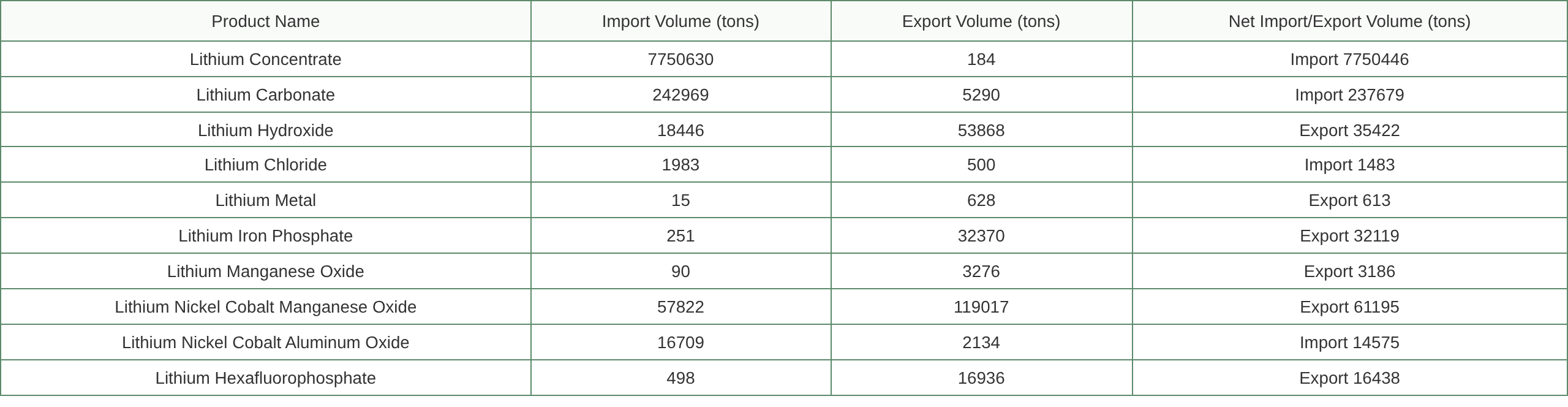
2025 Lithium Product Import and Export Situation Image source: Lithium Branch
Data from the Lithium Branch shows that in 2025, China imported approximately 7.751 million mt of lithium concentrates, up approximately 39.4% YoY, of which 1.204 million mt were imported from Zimbabwe, accounting for 15.5% of total imports. Zimbabwe is China's second-largest source of spodumene imports.
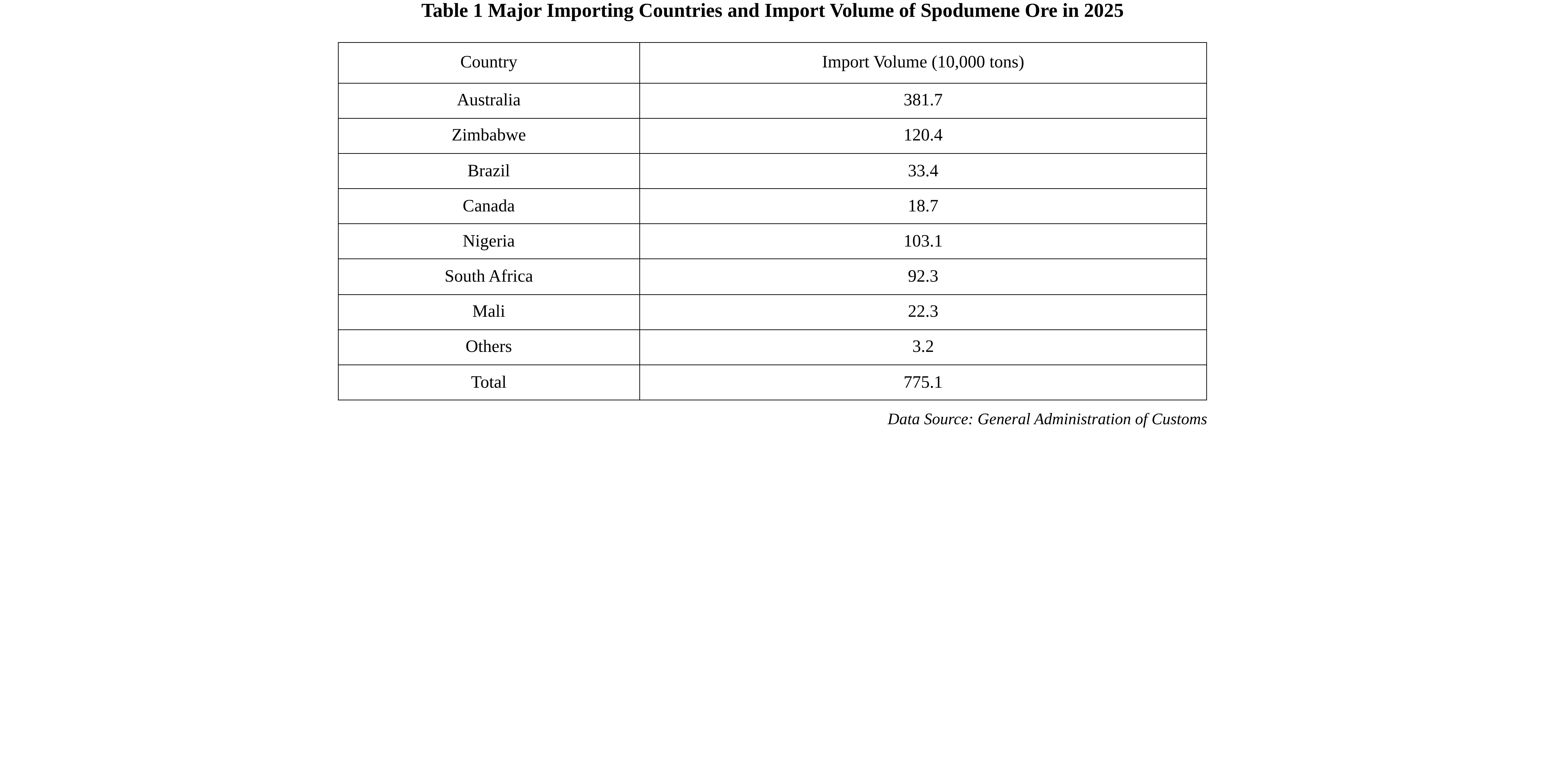
Battery Network observes that in recent years, Zimbabwe has been continuously tightening its lithium ore export policies.
As one of Africa's largest lithium producers, Zimbabwe suspended lithium ore exports in 2022, allowing only lithium concentrates exports, thereby compelling enterprises to engage in primary mineral processing.
In 2023, Zimbabwe officially added lithium to its strategic resources list, raising the threshold for lithium ore exports through measures such as export taxes.
In 2025, the Zimbabwean government further proposed a 5% export tax on lithium concentrates and simultaneously decided to ban lithium concentrates exports from 2027 onward, allowing only higher value-added lithium sulfate exports. The association of Chinese-invested miners in Zimbabwe had previously applied for a deferral of the lithium concentrates export tax to the end of 2027, which the government rejected.
On February 25, 2026, Zimbabwe's Ministry of Mines declared the early full enforcement of the concentrates export ban originally scheduled for implementation in 2027.
On May 22, Zimbabwe further classified 14 minerals, including lithium, nickel, and cobalt, as "critical minerals," establishing the state's principle of exercising a mandatory minimum shareholding through special purpose vehicles. In the same month, another African lithium ore resource nation, the Democratic Republic of the Congo, also added lithium to its strategic minerals list, raising the tax rate to 10%.
On June 24, Zimbabwe's Finance Minister Mthuli Ncube explicitly stated that despite the industry's collective request for an extension, the government will not postpone the lithium concentrates export ban, which is originally to take effect in January 2027. Companies unable to build their own processing plants can be encouraged to sign processing trade agreements with supplied materials with firms possessing processing capabilities.
Frequent policy disruptions in resource-rich countries have become a key force driving fluctuations in lithium prices.
SMM data shows that in H1 2026, China's lithium carbonate production presented a pattern of "initial decline followed by a steady production ramp-up." After adjusting for the maintenance disruption in February, monthly output gradually climbed, with a cumulative output of approximately 622,000 mt. The average lithium carbonate price range during H1 was 149,600–177,000 yuan/mt, with notable volatility.
Entering late July, China's lithium carbonate prices gradually stabilized near 145,000 yuan/mt. On July 27, the average price of lithium carbonate rose by 1,000 yuan in a single day, closing at 146,500 yuan/mt.
Behind the price stabilization, the upstream industry chain's profit recovery is more visually evident: among the 15 lithium mine and lithium chemicals publicly listed firms tracked by Battery Network, 14 are expected to report profits in H1 2026, a profitability rate as high as 93%. Of these, nine saw a significant earnings climb, five successfully turned losses into profits, while only Jiangxi Special Electric Motor experienced an expanded loss. Using the median of projected net profits as the statistical benchmark, these 15 publicly listed firms posted a combined net profit of 27.323 billion yuan for H1, with 11 of them exceeding 1 billion yuan each. The growth of the four companies—Tianqi Lithium, Canmax, Sinomine Resource Group, and YOUNGY—all exceeded the tenfold mark. Among them, the midpoint of Tianqi Lithium's estimated net profit recorded a staggering YoY surge of 4,105.63%; if calculated based on the upper end of the estimate, the growth could reach as high as 4,934.91%, achieving a nearly 50-fold leap.
![H1 Battery Materials Import & Export Data Released, Lithium Carbonate Imports Surge Over 50%, How About Other Segments? [SMM Special Topic]](https://imgqn.smm.cn/usercenter/JmyWy20251217171729.png)
![[SMM Flash] Russia Lifts Rail Transit Ban on Kazakh Sulfur Exports](https://imgqn.smm.cn/usercenter/gCNEi20251217171715.jpeg)