SMM, July 28:
In metals markets:
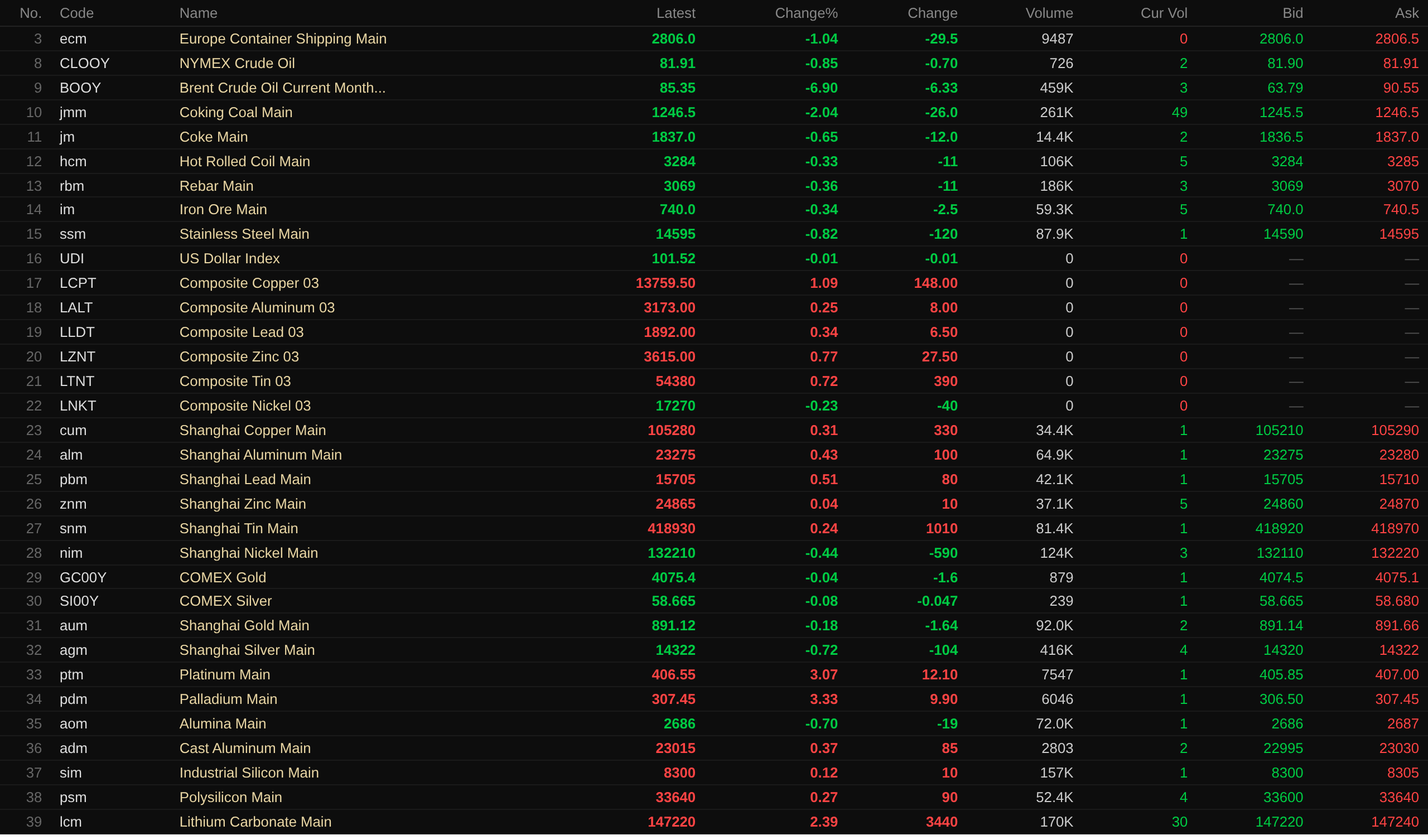
Base metals generally rose in overnight trading both domestically and overseas, with only LME nickel and SHFE nickel both declining—LME nickel fell 0.23%, SHFE nickel fell 0.44%. LME copper led the gains with a 1.09% increase, while LME zinc and LME tin both rose over 0.7%—LME zinc gained 0.77% and LME tin gained 0.72%. Other metals rose within 1%. Alumina main contract fell 0.7%, while cast aluminum main contract rose 0.37%.
Ferrous metals generally fell overnight, with stainless steel down 0.82%, HRC, rebar, and iron ore all down over 0.3%—HRC fell 0.33%, rebar fell 0.36%, and iron ore fell 0.34%. In coking coal and coke, coking coal fell 2.04%, while coke fell 0.65%.
In precious metals overnight, COMEX gold rose 0.19%, while COMEX silver fell 0.36%. Domestically, SHFE gold fell 0.18% and SHFE silver fell 0.72%.
Overnight closing prices as of 6:44 AM July 28:
Macro Front
China:
[NBS: Profits of China's Industrial Enterprises Above Designated Size Rose 18.7% in Jan–Jun; Electronics-Related Sectors Saw Rapid Profit Growth ] On July 27, the National Bureau of Statistics (NBS) released data showing that in H1, against the backdrop of stable industrial production growth and a continued rebound in industrial product prices, the operating revenue of industrial enterprises above designated size rose 6.5% YoY, accelerating 1.5 percentage points from Q1. The faster revenue growth drove profits of industrial enterprises above designated size up 18.7% YoY, accelerating 3.2 percentage points from Q1. By the three major categories, profits in mining and manufacturing rose 33.5% and 20.1%, respectively, accelerating 17.3 ppt and 1.0 ppt from Q1; profits in electricity, heat, gas, and water production and supply fell 4.2%. In June, profits of industrial enterprises above designated size nationwide rose 15.1% YoY. In H1, profits of raw material manufacturing enterprises above designated size surged 71.7% YoY, boosting the overall industrial profit growth by 8.8 ppt. By sector, driven by factors such as favorable demand for non-ferrous metals like copper and aluminum, profits in the non-ferrous sector jumped 99.4%, boosting overall industrial profit growth by 4.7 ppt. Propelled by rising prices of petroleum-related products, the petroleum processing sector turned from a loss to a profit YoY, while profits in the chemical sector grew 67.8%.
US Dollar:
The US dollar index rose 0.08% overnight to 101.53. Citadel Securities expects the US Fed to raise interest rates this week—a surprise move that would reinforce Chairman Kevin Warsh's credibility in the fight against inflation. In a report, Frank Flight, the firm's head of macro strategy, wrote that a 25-bp hike on Wednesday would cement Warsh's repeated commitment to restoring price stability while signaling that policymakers no longer rely on signaling every policy move in advance. "Markets may again be underestimating the degree of the Fed's hawkish shift." This week's hike would "decisively end the era of forward guidance" while underscoring the Fed's independence.
US President Trump on Monday commented on the Fed, saying that Chairman Warsh is very good but he has to deal with the committee's issues. He believes Warsh will do the right thing and knows what Warsh wants. On interest rates, Trump said rates should be lower and the US should have the lowest rates in the world. He also mentioned that costs are falling rapidly. (Jin10)
Citi traders are betting that the Fed will hold rates steady this week, even though the swaps market assigns over a one-third probability to a 25-bp hike.
Citi’s global head of short-term rates trading, Akshay Singal, said the bank is taking on July FOMC meeting contracts based on “high conviction”—positions that will pay off if the central bank stays on hold. Currently, the swaps market sees a nearly 40% probability of a 25-bp hike this week. This comes after escalating Middle East tensions triggered wild swings in oil prices and US Treasury yields, fueling inflation worries. “We remain strongly forecasting that the Fed will hold rates steady,” Singal told Bloomberg News. He added that Fed Chairman Kevin Warsh “has made it very clear that he wants the market to focus on the data, and the data tell us there’s no need for the Fed to hike now.” Singal said Warsh’s opposition to forward guidance has also added to market uncertainty. “The market is currently lacking clear guidance,” Singal said. “We expect a healthy and robust debate, but ultimately rates will be left unchanged.” (Wall Street CN)
According to CME FedWatch: The probability of the Fed keeping rates unchanged in July is 63.7%, while the probability of a cumulative 25-bp hike is 36.3%. By September, the probability of rates staying on hold is 18.5%, the probability of a cumulative 25-bp hike is 55.7%, and the probability of a cumulative 50-bp hike is 25.8%. (Jin10)
Other Currencies:
Capital Economics economist Neil Shearing said in a report that while markets have priced in slightly more than 50 bp of rate hikes from the Fed, BOE, and ECB by mid-2027, policy paths could diverge next year. If the Iran war ends, energy prices will retreat and domestic economic fundamentals will become the main driver of monetary policy. However, underlying inflation pressures in the UK and eurozone are weaker. The situation in the US is different, and fiscal policy also remains relatively loose. Shearing said it is becoming increasingly difficult to justify the tightening expectations priced in for the ECB and BOE, though the Fed may resume tightening before long. (Jin10)
According to people familiar with the matter, the Swiss National Bank plans to keep its key interest rate at zero until the end of 2027 before potentially starting to hike. This view is based mainly on current inflation forecasts and assumes no major new shocks. They noted that the recent softening of the Swiss franc against the euro and the interest rate differential between Switzerland and the eurozone are also factors shaping this expectation. The people said that if the economic outlook faces fresh shocks, implementing negative rates remains an option, but they stressed that this is not the current baseline scenario. They added that zero rates have not seriously hurt the profitability of the Swiss banking sector. The SNB kept rates unchanged at its June meeting and expects to keep them on hold until the end of next year. (Jin10)
Macro Front:
Today, data releases include the US ADP employment change for the week ending July 11, the May FHFA House Price Index MoM, the May S&P/Case-Shiller 20-City Composite Home Price Index YoY (NSA), the July Conference Board Consumer Confidence Index, and the July Richmond Fed Manufacturing Index.
In addition, RBA Governor Bullock will speak, and Israeli Prime Minister Netanyahu will meet with US President Trump.
Crude Oil:
Both oil benchmarks plunged overnight, with WTI falling 8.29% and Brent falling 6.9%. The Middle East geopolitical risks that had been driving the relentless surge in oil prices showed clear signs of cooling. US President Trump confirmed that he would suspend a new round of strikes against Iran, leaving a window for diplomatic negotiations, and the market rapidly unwound the “war premium” previously priced in. Market analysis suggests that the sharp sell-off was not driven by a sudden deterioration in demand but rather a concentrated release of the risk premium that had accumulated rapidly due to Strait of Hormuz transit risks and escalating US-Iran military tensions. However, several institutions also warned that the current situation remains far from genuine de-escalation, and oil prices could still rebound sharply if military action escalates again. (Wall Street CN)
Although market sentiment has improved markedly, analysts generally believe it is still too early to say that Middle East risks have passed. The Wall Street Journal noted that the US suspension of military action has increased the likelihood of a diplomatic resolution to the crisis and boosted market expectations that shipping through the Strait of Hormuz will eventually normalize. However, key variables including Red Sea shipping security, attacks by Yemen’s Houthi rebels, the Iran nuclear issue, and the future passage conditions in the Strait of Hormuz remain unresolved, meaning international oil prices will remain highly sensitive to geopolitical developments. Reuters also pointed out that the market’s focus this week will remain on whether US-Iran contacts can achieve substantive progress. If negotiations fail and military action re-escalates, the risk premium just released from the energy market could quickly return to oil prices. (Wall Street CN)
US President Trump said on Monday that the US has collected more than $13 billion from Venezuelan crude oil sales since US forces abducted former Venezuelan President Nicolás Maduro in a cross-border operation. “Venezuela has brought us $13 billion? I think it’s more than that,” Trump told reporters aboard Air Force One en route to Michigan to visit a General Motors plant. “We’ve more than made back the cost of that war many times over.” Trump claimed the money was used to keep Venezuela running. “We’re making a lot of money—billions and billions of dollars from Venezuela.” (Financial Times)
![[SMM Flash News] Adani Wins INR 85 Billion Transmission Project for India's Green Hydrogen Hub](https://imgqn.smm.cn/usercenter/YKilH20251217171735.jpg)
![[SMM Flash News] Iberdrola Secures EUR 29 Million EIB Loan for 40-MW Wind Farm in Spain](https://imgqn.smm.cn/usercenter/nQsOk20251217171736.jpg)
![[SMM Flash News] France Awards EUR 778 Million to Support 161.4 MW of Low-Carbon Hydrogen Projects](https://imgqn.smm.cn/usercenter/gePcx20251217171735.jpg)