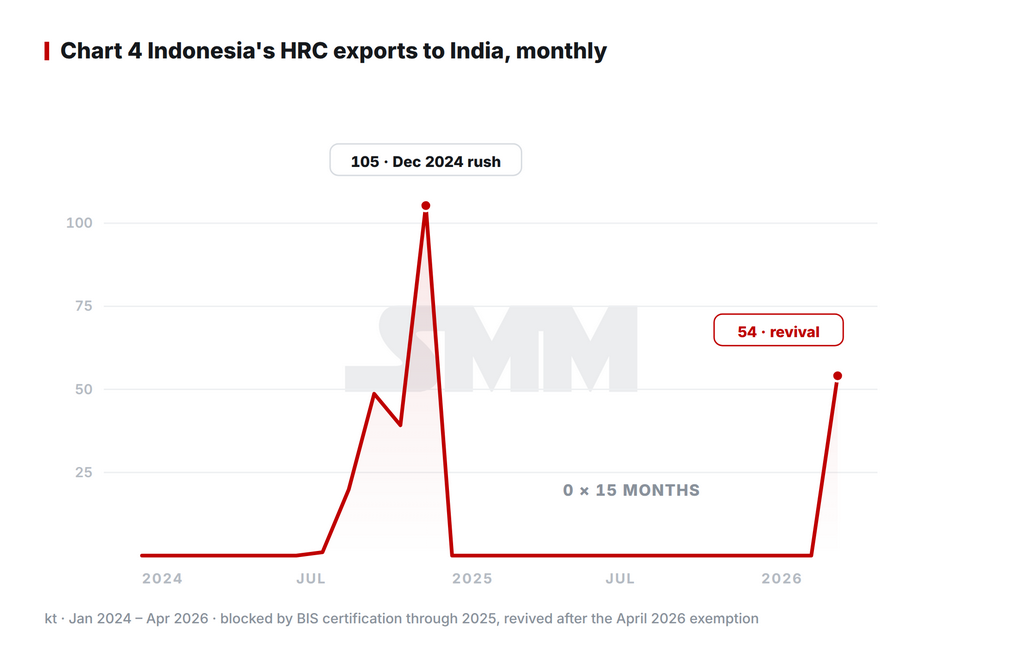
One number in Indonesia's April 2026 customs data deserves a pause: 54,000 mt of stainless hot-rolled coil shipped to India. In a monthly export book of 380,000 mt it looks unremarkable, until you check the history. From January 2025 to March 2026, that trade lane recorded fifteen consecutive months of zero. What killed it was not price or demand but India's BIS certification regime; what revived it overnight was another piece of paper from New Delhi, which suspended the entire quality-control order in late April and left the window open for shipments until October 26.
The world's largest stainless steel exporter now has its trade flows written by customs paperwork rather than market prices. That is the first key to understanding Indonesian stainless steel.
A champion that stopped growing
Start with the long view. Mirrored customs data covering HS 7218–7223 shows Indonesian exports peaked at 4.86 million mt in 2021 and have never taken another step up: 4.75 million mt in 2022, 4.21 million in 2023, then 4.77 million in both 2024 and 2025, two years that match almost to the tonne. Since mid-2024, every rolling 12-month total has sat inside a band of 4.62–4.84 million mt, a full range of just 4.5%. Over the same window, China's rolling export total swung four times as much.
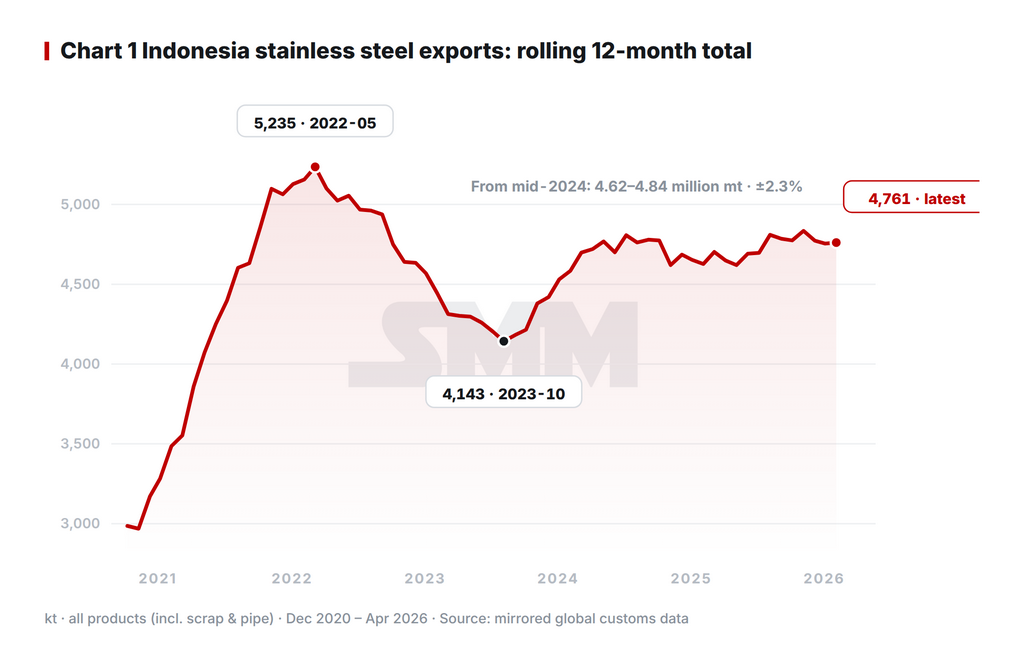
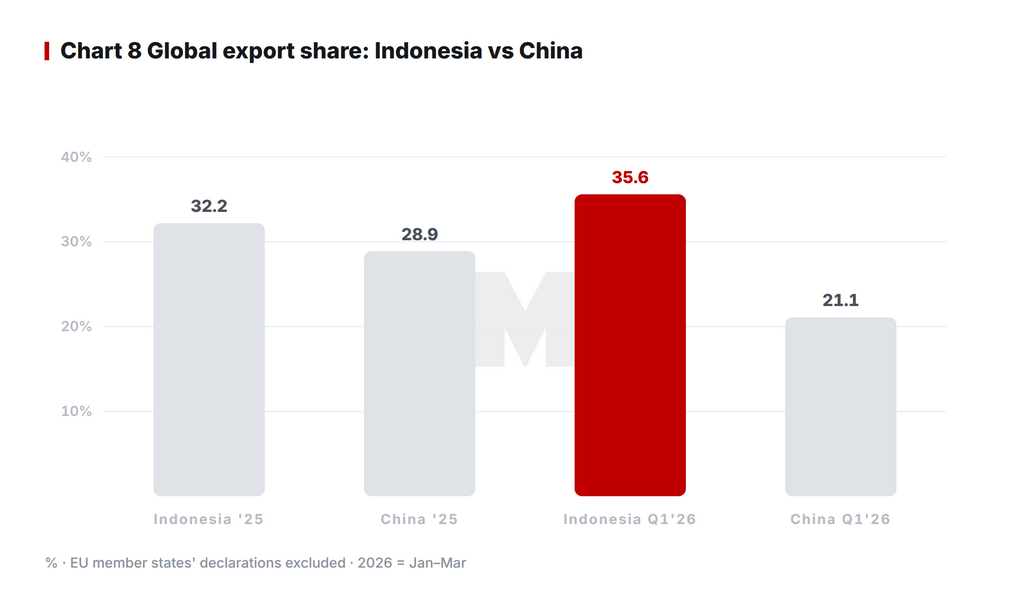
Yet Indonesia's standing has only risen. On the same product scope it exported 4.70 million mt in 2025 against China's 4.21 million, its fifth consecutive year as the world's largest exporter, holding around 32% of global exports excluding intra-EU trade. In the first quarter of 2026 that share jumped to 36% while China's slipped to 21%.
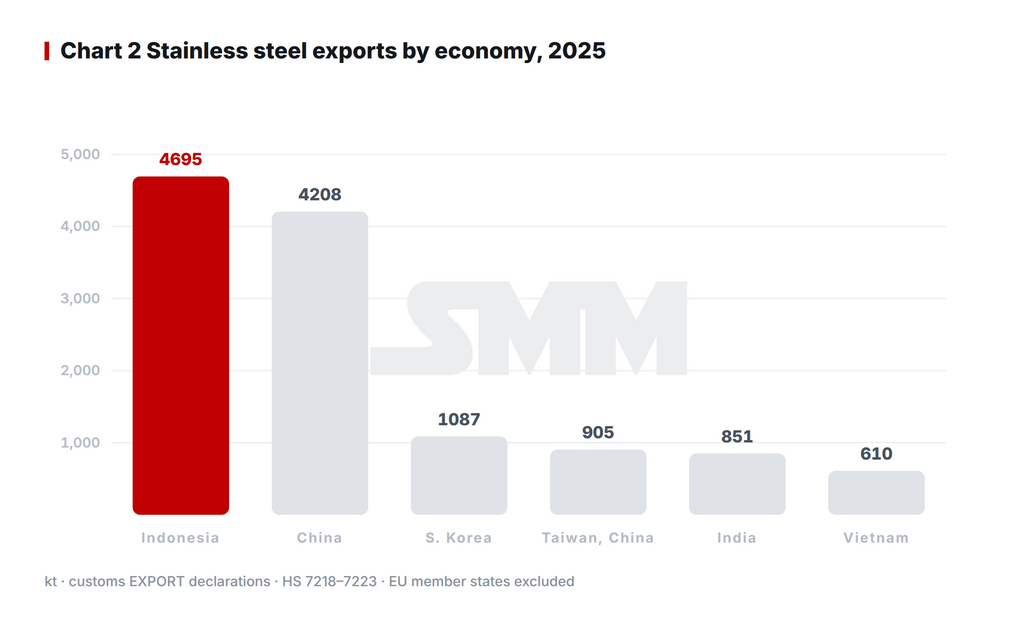
On the surface these facts sit awkwardly together: a five-year world champion whose volumes have flatlined, and which faces new duties, certifications or quotas in almost every major market. Put them inside a framework of capacity and trade barriers, however, and the contradiction dissolves. Volumes are flat because capacity is full: Indonesia's stainless melting capacity is concentrated in two industrial parks, at Morowali and Kendari, totalling a little over five million mt, with essentially no additions after 2021. Exports stayed at full stretch despite the walls because Indonesia kept doing one thing well: rerouting. For five years, what changed was not the tonnage but the direction the coils sailed after leaving port.
China: exports shaped like a duty schedule
The first rerouting is China. In 2021, 52% of Indonesia's exports, 2.51 million mt, went to China. By 2025 that was down to 1.19 million mt and a 25% share.
The product mix tells you why. China levies a 20.2% anti-dumping duty on Indonesian slab and hot-rolled coil, renewed for five years in July 2025, but cold-rolled coil carries no duty. Indonesia's China-bound trade has grown into the exact shape of that duty schedule: slab shipments collapsed from 507,000 mt in 2024 to 148,000 mt in 2025, while duty-free cold-rolled sailed through at a steady 888,000 mt, roughly 70,000–80,000 mt a month.
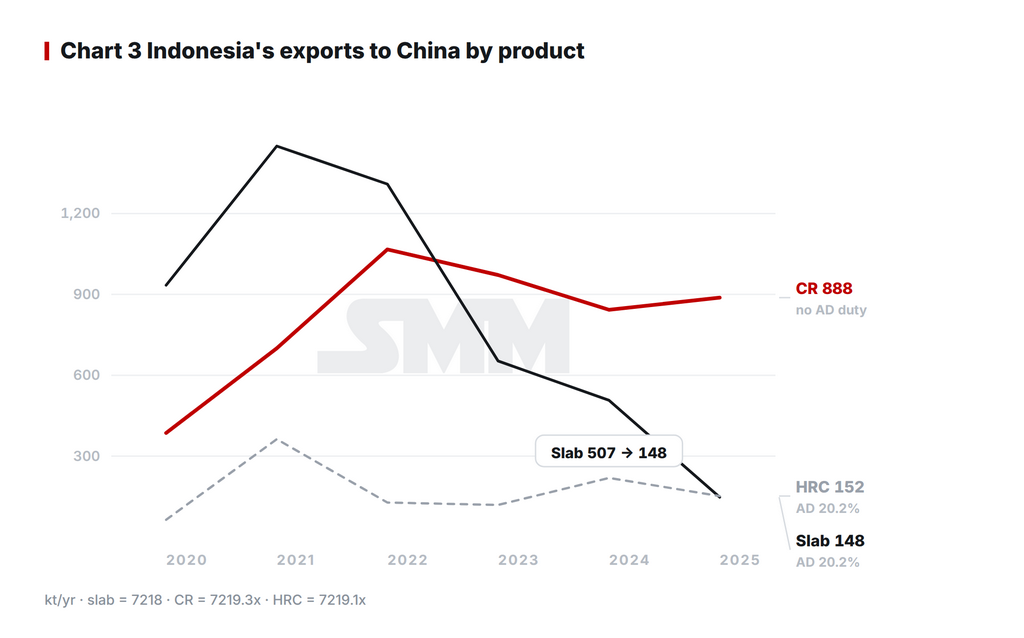
Look one level deeper and the shrinking headline is not a loosening of the China–Indonesia industrial bond, rather the opposite. China's imports of Nickel Pig Iron (NPI), the stainless feedstock smelted in Indonesia, rose about 30% year on year in the first half of 2025, running at more than eight million mt a year. Smelting and rolling have settled in Indonesia; the China trade has quietly shifted from selling finished steel to selling raw material. Where the finished product goes depends on who pays and whose door is open, and China's door has a 20.2% sign hanging on it.
India: a market switched on and off by paperwork
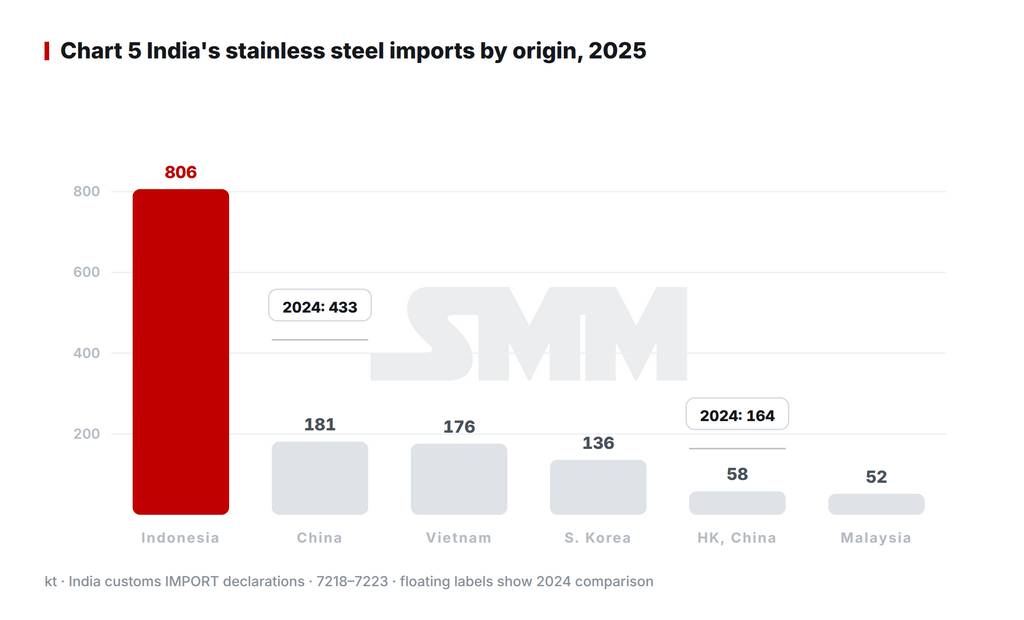
India picked up what China put down. From a 4% share in 2021, India took 18% of Indonesia's exports in 2024 and 800,000 mt in 2025, making it the third-largest destination after China and Taiwan, China. The backbone of the trade is not finished coil but slab: 722,000 mt in 2025, an average of 60,000 mt a month, feeding India's own rolling mills.
What makes India unusual is that the tap is controlled by neither buyer nor seller. BIS certification is nominally a quality regime; in practice it has re-sorted India's import mix. On India's own customs declarations, imports from China fell from 433,000 mt in 2024 to 181,000 mt in 2025, transshipment via Hong Kong, China was cut by two-thirds, while Indonesia rose to 806,000 mt, taking 48% of India's imports. The fifteen-month zero and overnight revival in HRC described above is simply the most dramatic scene of that re-sorting: a 105,000-mt rush shipment in December 2024 ahead of enforcement, fifteen blank months, then an instant restart once the exemption window opened. Demand never went anywhere. Only the valve moved.
The reopened valve is now running hard. India's stainless imports in April 2026 jumped 65% year on year, Chinese shipments to India hit a 20-month high in May, and India's smaller mills have petitioned to reinstate the certification order, with a ministry hearing held on July 9. The catch is that a door opened by paperwork can be closed by paperwork. India's anti-dumping investigation into 300- and 400-series cold-rolled from China, Indonesia and Vietnam completed exporter sampling in June, and the exemption window expires on October 26 with no promise of renewal. For Indonesia, India is both the fastest-growing market and the most policy-dependent one. Those are two sides of the same coin.
The re-rolling system, and Europe's slab-shaped hole
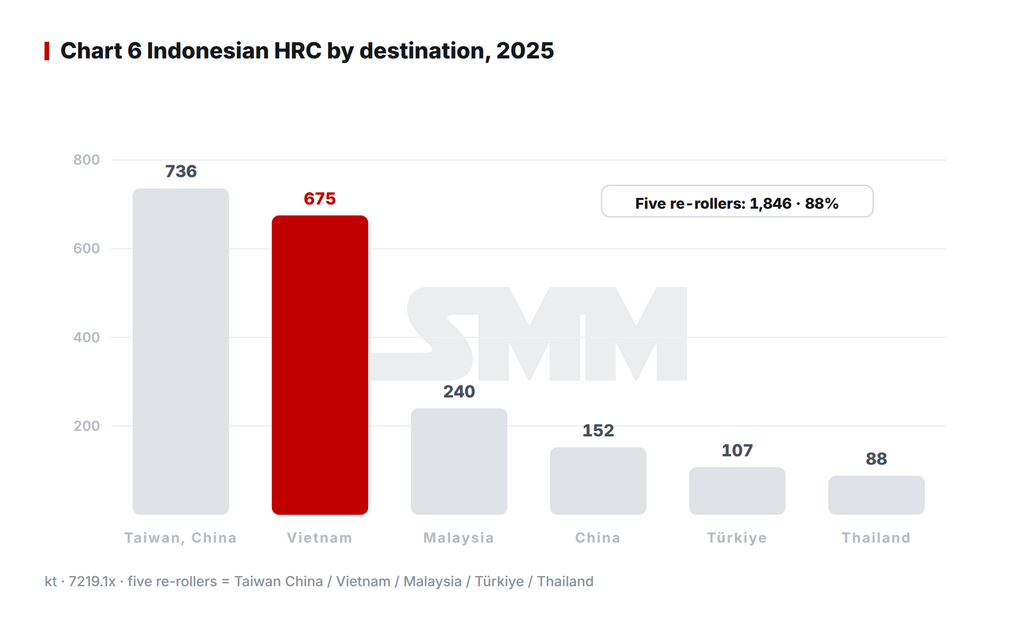
The purest expression of Indonesia's export model is the re-rolling network. Of the 2.09 million mt of hot-rolled coil Indonesia exported in 2025, 88% went to five places: Taiwan, China; Vietnam; Malaysia; Türkiye; and Thailand. They buy the coil not to use it but to roll it into cold-rolled and sell it onward. Vietnam is the starkest case: its own stainless exports swelled from 110,000 mt in 2020 to 610,000 mt in 2025, with cold-rolled up sevenfold. Vietnam has effectively become a shadow Indonesia.
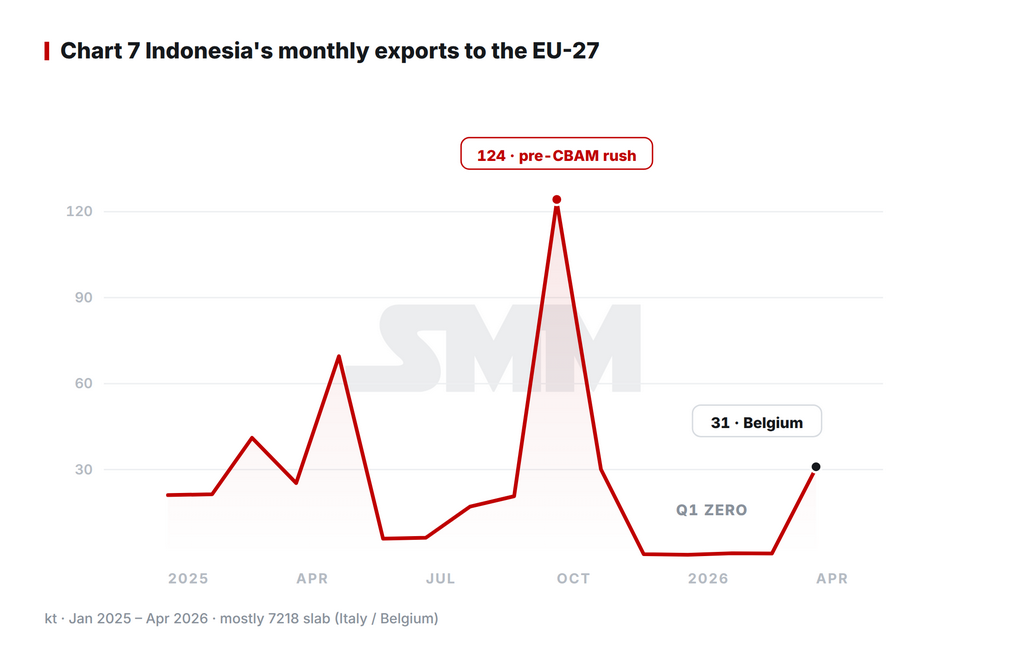
Europe forced this system into being. The EU's combined anti-dumping and countervailing duties, about 30.7% for the largest Indonesian producer on cold-rolled and 17.3% on hot-rolled, closed the front door for finished coil years ago. But the duties cover flat-rolled products only; semi-finished slab passes free, a hole left in the wall. Indonesian slab accordingly sailed to Italy: 333,000 mt in 2025, including a single-month spike of 124,000 mt to the EU in October as buyers stockpiled ahead of the Carbon Border Adjustment Mechanism (CBAM) entering its paid phase in January 2026. Then the flow stopped, near zero in the first quarter of 2026, before Belgium restarted with 30,000 mt of slab in April.
The EU's new steel import regime, in force since July 1, gives Indonesia exactly one stainless quota line: 35,843 mt of hot-rolled, the largest single-country allocation in that category. Its cold-rolled quota is zero, because allocations were based on 2022–24 trade, years when Indonesian cold-rolled was already shut out by duties and never entered the denominator. Against annual exports of 4.77 million mt, Indonesia's duty-free space in Europe amounts to less than 0.8% of its output. So much for Brussels' generosity.
The real regime change comes on October 1, when the EU begins requiring melt-and-pour origin declarations: importers must state where the steel was first melted and cast, not merely where the coil last shipped from. That provision is not aimed at Indonesia's modest direct EU sales. It is aimed at the 88%: once cold-rolled from Taiwan, China, Vietnam or Türkiye is traced to Indonesian steel, the economics of every conduit must be recalculated. The data already shows early stress, with shipments to Taiwan, China down 26% in the first four months of 2026 and Taiwan's own cold-rolled exports contracting by more than a fifth in 2025. South Korea has imposed duties on Vietnamese cold-rolled, Thailand likewise, and Japan has provisional duties on cold-rolled from Taiwan, China. The walls are no longer being built one at a time; they are closing into a ring. The only wall that fell this year was Malaysia's, where duties on Indonesian cold-rolled lapsed in April because the sole local petitioner had stopped producing and nobody was left to ask for renewal.
2026: the rival slows, costs rise, new capacity lands
Seen from mid-2026, Indonesia's position comes down to three sentences.
First, its biggest competitor has slowed. China introduced export licensing for stainless products on January 1 to bring order to export flows, and first-quarter exports fell 35% year on year. Indonesia opened no new production line, yet its global share rose from 32% to 36% and the gap over China widened to 15 percentage points. To be clear, that shift came from China's own policy rhythm, not from anything Jakarta did right.
Second, Indonesia's own cost floor is rising. The 2026 mining quota (RKAB) for nickel ore has been cut to roughly 260 million wet mt from 379 million approved in 2025; the benchmark ore price formula was revised in April, lifting the price-correction coefficient from 17% to 30%; and mining royalties now run at 14–19% on a progressive scale. Smelters consumed only 46% of their ore quota in the first half, so the true squeeze has not yet arrived, but every policy lever is pushing the same way: making Indonesian nickel and steel more expensive. Indonesian export offers for 304 cold-rolled climbed from around $1,700/mt FOB to $2,197.5/mt between December and April, part market, part the echo of those policies.
Third, the flatline is about to break. A 1.2 million-mt line started up in March, a further 2 million-mt joint-venture project is under construction, and Indonesian capacity is projected to approach 9 million mt in 2027. Five years of capacity ceiling produced five years of flat exports; once the ceiling lifts, where does the extra million-plus tonnes go? Duties to China, quotas and traceability to Europe, certification and an anti-dumping case hanging over India, a 50% Section 232 tariff to the United States. Every direction has a wall. When the moment comes, Indonesia can either squeeze through the cracks on price or follow China's route of building a domestic market, and with Indonesia's current manufacturing base, the second road is too far to help soon.
Jakarta's own hand is also reaching further. A May regulation routes ferronickel exports through a state-owned channel from 2027, with stainless steel not on the list for now. Recent policy history suggests "for now" should not be over-insured.
Five dated gates before December
The EU's cold-rolled anti-dumping measure expires on November 19, and European industry must file for an expiry review by August 19; without a filing, the 30.7% wall lapses on its own. Brazil's final anti-dumping ruling on hot-rolled is due November 25, after a preliminary dumping margin of 25.3% for Indonesia and a hearing held July 23. India's cold-rolled case could reach a preliminary ruling at any time, with the certification window closing October 26. The EU's melt-and-pour implementing rules are due by August 31 and will decide how hard the traceability regime bites. And Indonesia's RKAB revision window closed at end-July with officials signalling no blanket increase, only case-by-case exceptions for ore-short smelters, a decision that sets the cost floor for the whole nickel chain. Five gates, all inside the next four months.
Outlook
Reread the past five years and Indonesian stainless steel is a history of rerouting: when China taxed, exports to China turned into cold-rolled; when India certified, slab fed its mills instead; when Europe imposed duties, the trade went through the slab-sized hole; when front doors shut, the coils detoured through rolling mills in third places. Every time a wall went up, the steel changed direction, and the plants never missed a shipment. That adaptability is built into this industry's bones.
But melt-and-pour marks a change in the nature of the game. The old barriers stopped goods, and goods can change category or change port. Traceability-era barriers verify origins, and origin is fixed the moment the steel is cast; every subsequent reroute leads back to the same source. As the craft of rerouting loses its value, what goes on trial is the model itself: capacity in Indonesia, capital from China, customers everywhere. That triangle thrived in a world of tariffs. In a world of origin checks, every side of it is exposed.
Nobody is taking the number-one spot away for now. But in 2027, when nine million mt of capacity meets a ring of walls that ask where the steel was born, five years of sideways calm may turn out to have been the best ending this industry could get.
Written by Bruce Chew
Nickel & Stainless Steel Analyst, Shanghai Metals Market
Email: bruce.chew@metal.com
Tel: +601167087088