SMM, July 26:
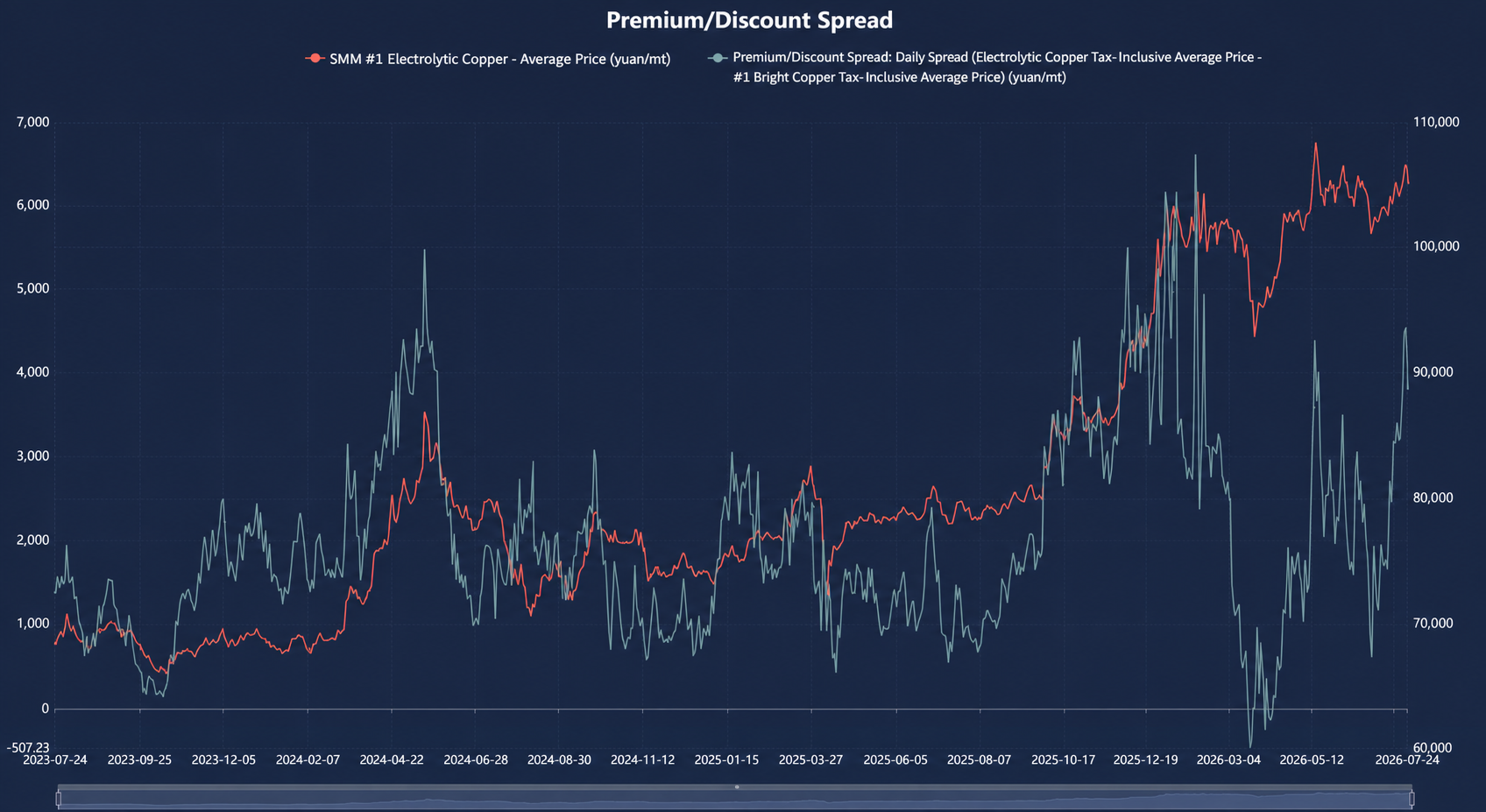
This week (July 20-23), the copper scrap market operated under a triple framework of low copper cathode inventories and high premiums, ongoing compliance constraints from reverse invoicing, and a deepening high-temperature off-season. The SHFE copper 11:30 closing price surged from 104,180 yuan/mt to 106,340 yuan/mt before pulling back slightly to 106,170 yuan/mt at the week's end, with a full-week increase exceeding 2,000 yuan/mt. Driven by the one-sided rise in copper cathode and the scrap's resilience in holding prices firm, the price spread between copper cathode and copper scrap widened steadily from 3,218 yuan/mt to 4,545 yuan/mt, briefly touching a weekly high above 4,800 yuan/mt. The inherent price resilience of copper scrap was the core supply-side feature this week. The supply side continued the structurally tight pattern seen since 2026, with the fundamental constraint remaining the reverse invoicing policy: regulatory inspections intensified in Jiangxi, Hubei, and other regions; production in Jiangxi came to a halt after quotas were exhausted; enterprises in Hubei grew concerned due to retroactive checks linked to reverse invoicing; and invoicing quotas in areas like Shuyang, Jiangsu remained restricted. Available compliant and deductible copper scrap stayed persistently tight. Following the abolition of local non-compliant tax rebates under Document No. 770 at the end of 2025, small and medium-sized copper scrap traders reliant on subsidies continued to exit the market, leading to a significant contraction in overall available supply compared to the same period in previous years. Mainstream copper scrap invoice tax rates have surpassed 10%, rising to 12% in some regions, further pushing up enterprises' raw material procurement costs. Supported by this, supplier selling pace closely tracked copper price fluctuations: at the start of the week, as copper prices rose, the sales sentiment index climbed from 2.47 to 2.53, willingness to sell gradually increased, and market supply of available cargoes grew somewhat. Mid-week, after copper prices surged above 106,000 yuan/mt, the sales sentiment index hit a monthly high of 2.66; suppliers actively priced and sold cargoes, with some even taking on market short positions, leading to a marked increase in market supply. However, constrained by weak off-season orders in the downstream scrap-using sector and low acceptance of high-priced raw materials, these shipments did not translate into actual production restocking. The majority of cargoes were purchased by secondary copper rod enterprises under a hedging logic of "buying raw materials and shorting futures." At the week's end, futures consolidated at highs; suppliers maintained sales at elevated prices, but purchasing willingness on the procurement side pulled back, and market transactions turned thin. Regional divergence persisted. In south China, due to compliance costs and slow capital turnover, bare bright copper purchase prices were 400-600 yuan/mt lower than in the north, sustaining the anomalous structure of different prices for the same material. Traders continued to maintain low-inventory strategies with rapid turnover, while the problem of payment cycles stretching beyond two weeks remained unresolved, further restricting the elastic release of supply. The overseas copper scrap market remained weak in both supply and demand; as LME copper moved sideways, the overseas bare bright copper discount rate was stable at 98.5%-99%, and while the deduction on imported copper scrap pulled back slightly, there was no significant growth, leaving overseas supply supplementation limited.
The demand side showed a stark divergence of "robust hedging, sluggish physical demand."Although secondary copper rod enterprises had theoretical economic viability because the price difference between copper cathode rod and secondary copper rod widened to above 1,800 yuan/mt, SMM data showed that the operating rate of secondary copper rod producers rose slightly by 0.91 percentage points WoW to 18.29%. The average price difference between copper cathode rod and secondary copper rod widened by 328 yuan/mt to 1,580 yuan/mt, and the average gross profit on sales increased by 568 yuan/mt to 1,218 yuan/mt. However, enterprises saw few new orders, and with relatively sufficient early-stage raw material inventories (weekly raw material inventories increased by 730 mt WoW to 2,730 mt), purchases were mainly for arbitrage and hedging against futures, while actual restocking for production was minimal. Mid-week, when copper prices surged, orders for secondary copper rods did see a significant WoW surge in volume, but this was triggered by an arbitrage window rather than driven by end-user orders. At the end of the week, after copper prices consolidated at highs, rod enterprises' fear of high prices, combined with ample raw material inventories, led to a pullback in purchase willingness. Scrap-derived copper anode producers, constrained by reverse invoicing quotas, also operated at comparatively low rates, and their copper scrap purchases were largely limited to bargain hunting for immediate needs. The end-user wire and cable and enamelled wire sectors were pressured by both high copper cathode premiums and high absolute copper prices. Fear of high prices grew, and new orders became even weaker in the off-season. State Grid infrastructure orders provided only slight bottom support. Growth in retail and property-related wiring was insufficient. The home appliance sector saw shrinking production schedules for refrigerators and air conditioners. Orders for two-wheelers fell WoW. Finished product inventory days of enamelled wire enterprises rose to 9.34 days, providing extremely limited boost to copper scrap consumption.
Overall, the core contradiction in the copper scrap market this week has shifted from “copper price level” to “who captures the spread dividend”—the roughly 4,500 yuan/mt-grade refined-scrap price spread brought by the price surge was essentially captured by arbitrage capital. The operation of secondary copper rod enterprises buying raw materials and shorting futures supported copper scrap circulation but did not translate into physical consumption. Compliance invoice constraints superimposed on the high-temperature off-season left scrap utilization enterprises with very low acceptance of copper prices above 104,000 yuan and high premiums. Even with active selling by suppliers, the demand side responded only with arbitrage hedging and just-in-time buying. Subsequently, if the refined-scrap price spread can stabilize above 1,500 yuan/mt, the implementation rules for reverse invoicing become more explicit, and quotas in some regions ease at the margin, this may stimulate some restocking demand. Otherwise, under the combination of low copper cathode inventories, high premiums, and downstream fear of high prices, the copper scrap market will persist in a weak equilibrium pattern of “suppliers selling and rod enterprises buying for hedging when copper rises, and both sides turning cautious when copper stays at highs.” The true recovery in physical consumption still needs to wait for a pullback in copper prices or a substantial improvement in end-user orders.