SMM July 24 News:
I. Aluminum Billet Inventory Turns from Destocking to Buildup, Destocking Logic Has Changed
According to SMM statistics, on July 23, aluminum billet social inventory in major Chinese consumption areas recorded 121,000 mt, up 1,000 mt from last Monday and up 6,500 mt from last Thursday, marking two consecutive weeks of inventory buildup. In a comparison with corresponding periods, the current inventory stood 24,500 mt lower than the same period in 2025, 10,200 mt lower than 2024, but 45,900 mt higher than 2023. Although the absolute inventory level remains below the same periods of the past two years, the destocking logic has clearly shifted—from rapid destocking in June to a transition from destocking to buildup in July, with support for processing fees weakening accordingly.
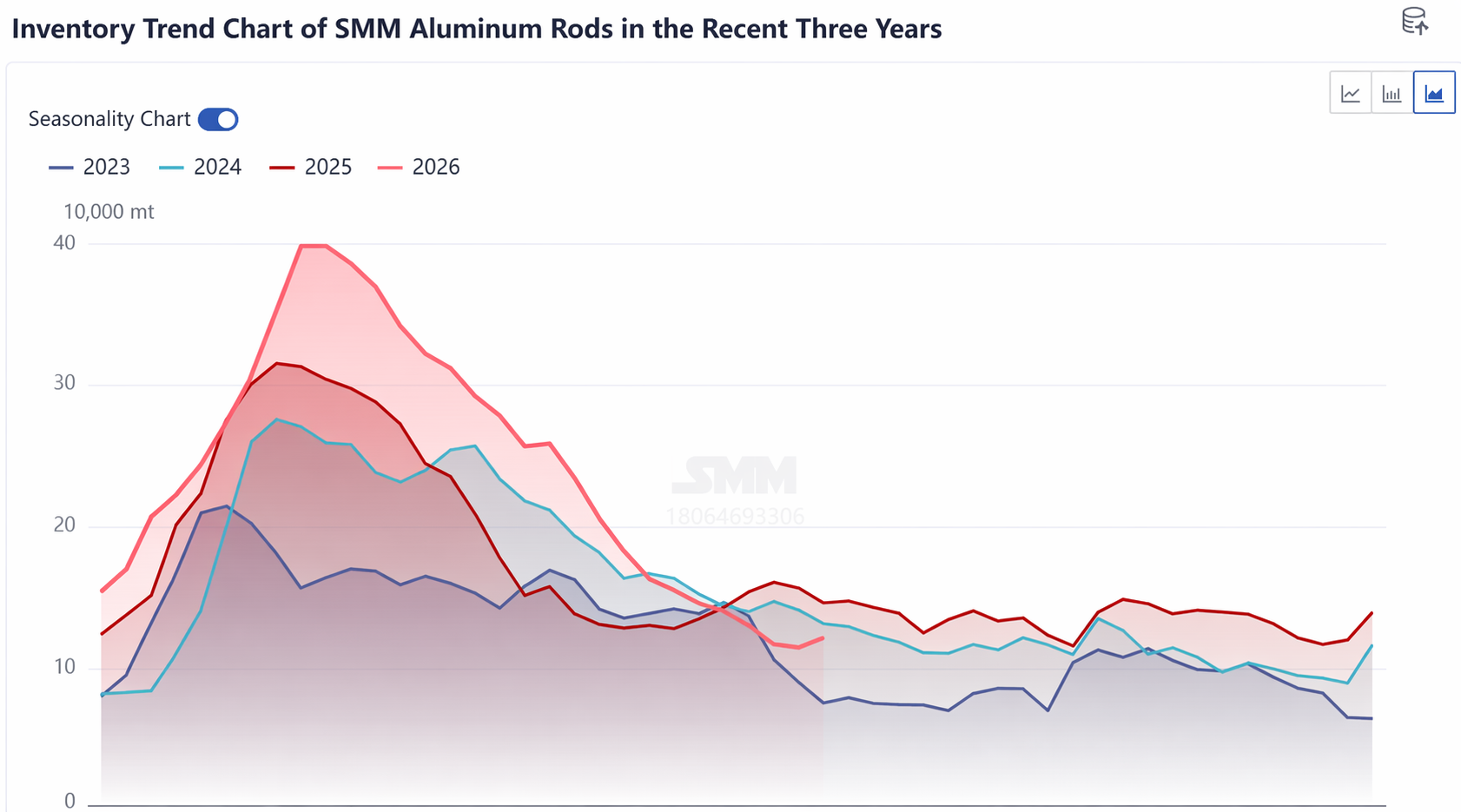
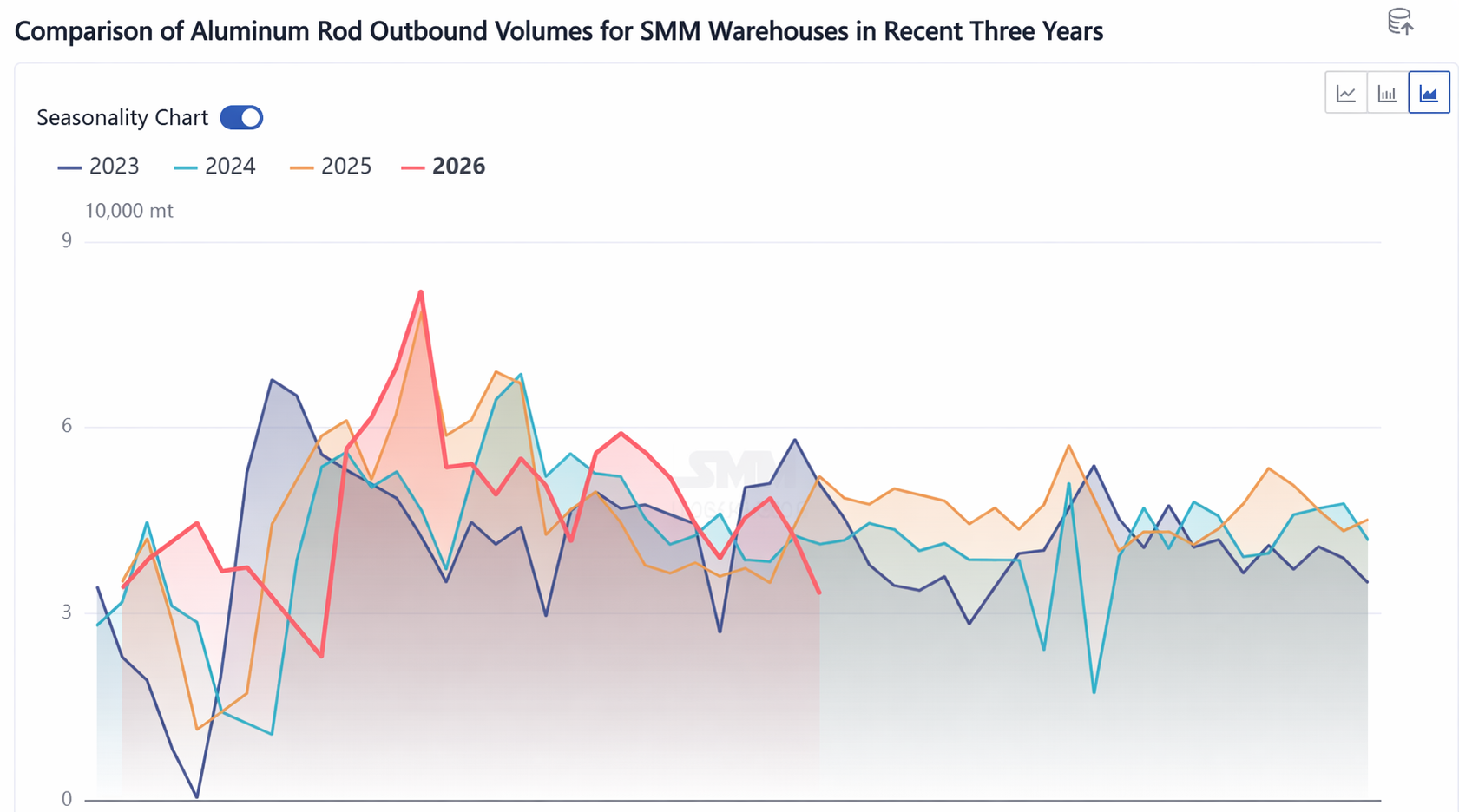
From the warehouse withdrawal data, China's aluminum billet warehouse withdrawals during July 14-20 recorded 33,000 mt, down 9,100 mt WoW and 19,000 mt YoY. The sharp contraction in warehouse withdrawals directly reflects a marginal cooling in downstream purchasing sentiment, with a notable decline in market trading activity. From a regional perspective, arrivals in Foshan continued to increase, with inventory building up to a high of 53,000 mt for the period, becoming the main contributor to this round of buildup; while in Wuxi, some cargo transfers led to reduced arrivals, although partly offset by downstream purchases, the area still saw inventory buildup of 1,000 mt. Under the combined influence of supply and demand, the supporting effect of the low inventory environment on processing fees is gradually weakening.
II. Processing Fees Generally Decline, Regional Divergence Significant
During the week, the center of aluminum prices consolidated and remained relatively stable, with the SMM A00 spot aluminum price edging up to 23,260 yuan/mt from 23,170 yuan/mt last Thursday. Under the combined pressure of stable slightly higher aluminum prices and continuously increasing arrivals in South China, aluminum billet processing fees generally declined across regions.
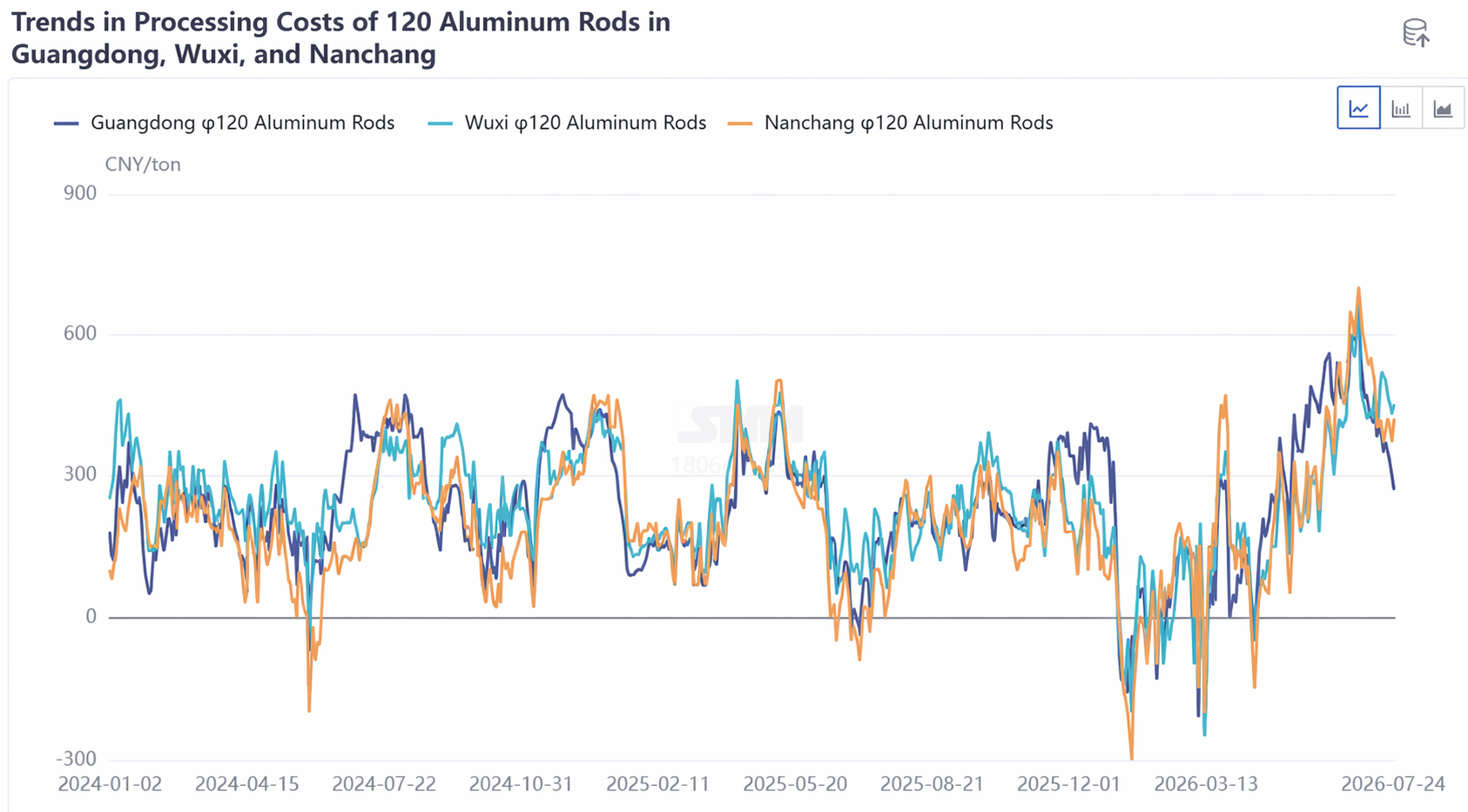
Observing the φ120 processing fee trends in the three regions, South China has undoubtedly become the hardest hit in this round of processing fee pullback. Currently, China's aluminum billet production cost line is in the range of 250-300 yuan/mt, varying with regional factor cost differences. As of July 23, the φ120 processing fee in Foshan has fallen to 300 yuan/mt, right at the upper edge of the cost line, squeezing corporate profits close to the break-even point. In Wuxi, due to tight supply of small billets, the decline in φ90 was relatively limited, indicating that structural tightness in specifications still provides some support for processing fees; however, φ120 also fell by 90 yuan/mt, reflecting increasing pressure from large billet supply. Nanchang saw relatively smaller declines, reflecting relatively stable local supply-demand pace.
Heading into the weekend, as of July 24, the average price of φ120 in Foshan had fallen to 270 yuan/mt, breaking below the lower bound of the 250–300 yuan/mt cost line range. Downstream wait-and-see sentiment remained unchanged, with procurement demand weak and significant price suppression tracking market movements. As it was the last day of the monthly long-term contract settlement, because the spot price was substantially higher than the monthly average price, some suppliers had huge room to sell, with no shortage of those selling off at sharply lower prices. Although some suppliers, actually selling at a loss, chose to hold prices firm and not sell, this could not prevent processing fees from declining further.
III. Demand side: Extrusion operating rate pulls back, off-season characteristics deepen
The fundamental driver behind the continuous decline in processing fees was marginal weakening on the demand side. According to an SMM survey, this week, China’s aluminum extrusion weekly operating rate recorded 52.9%, down 0.4 percentage points WoW, continuing the sluggish off-season pattern. Looking at sub-sectors, construction extrusion was continuously dragged down by the deepening off-season and weakness in the property sector, with end-use demand weakening further; downstream clients became more cautious in purchasing, mainly relying on rigid demand and urgent orders. New orders declined, significantly dragging down the overall operating rate.
Industrial extrusion showed some resilience. Some sampled enterprises, benefiting from ample orders on hand in the energy storage segment, maintained relatively full production schedules; for PV frames, top-tier players’ production schedules remained broadly stable, and downstream module makers’ production schedules in Q3 are expected to be slightly higher than in Q2, which will provide a floor for frame demand. However, SMM believes that the marginal support from industrial extrusion is not enough to fully offset the off-season weakness of construction extrusion, and decent processing margins do not imply simultaneous expansion in end-use consumption. Whether warehouse withdrawals can be sustained still needs verification. Overall, downstream procurement remained dominated by rigid demand, with moderate spot order market trading sentiment, providing limited support for processing fees.
IV. Supply side: Increasing arrivals combined with production enthusiasm put further pressure on processing fees
From the supply side, the continuous increase in arrivals in South China was the direct trigger for this round of rapid pullback in processing fees. Foshan’s inventory accumulated to a phase high of 53,000 mt, reflecting that, stimulated by previously high processing fees, billet plants accelerated their shipment pace while local demand failed to keep up, resulting in regional supply surplus. Additionally, while processing fees in Wuxi, Nanchang, and other areas were relatively resistant to declines, overall production enthusiasm for aluminum billets nationwide remained at a high level. Once processing fees fell below the cost line, enterprises might make marginal adjustments through production cuts and maintenance, but the pace of supply release in the short term was still faster than the pace of demand recovery.
5. Can Processing Fees Hold Firm?
Based on the current supply-demand pattern, whether domestic aluminum billet processing fees can hold firm near the cost line depends on the following key variables:
Downward pressures remain:First, inventories have built up for two consecutive weeks, warehouse withdrawals have contracted sharply WoW, and the off-season characteristics of demand have not yet ended. Second, the pace of arrivals in Foshan has slightly accelerated, and the relatively loose supply in South China is unlikely to fundamentally reverse in the short term. Third, terminal orders for construction extrusions remain weak, pushing for lower prices has become the norm among downstream buyers, and processing fees lack upward driving force from demand. Fourth, even though processing fees have fallen to the cost-line range of 250-300 yuan/mt, billet plants have limited willingness to cut production in the short term, and the pace of supply-side exit remains slow.
Phased support still exists:First, the current absolute inventory level remains lower than the same period in 2024 and 2025, and overall inventory pressure has not completely spiraled out of control. Once the pace of arrivals slows or demand shows marginal recovery, the destocking rationale is expected to re-emerge. Second, supply of small-diameter billets in Wuxi and other regions remains tight, and structural shortage of certain specifications is providing a floor for local processing fees. Third, orders in new energy sub-sectors within industrial extrusions, such as energy storage and PV, still show resilience, which can partially offset the off-season for construction extrusions. Fourth, if aluminum prices experience a phased retreat, it may spur downstream restocking at lower prices, thereby driving a recovery in processing fees.
SMM view:In the short term, aluminum billet processing fees have entered a channel of phased pressure. The processing fees for mainstream specifications such as φ120 in Foshan have retreated from earlier highs to the production cost range of 250-300 yuan/mt, with some low-priced cargoes even dipping below the lower bound of the cost line. There is limited room for further sharp declines due to cost constraints, yet momentum to hold prices firm and rebound is also insufficient. For next week, processing fees across regions are expected to maintain a diverging pattern. In South China, there is still downside room under supply-demand pressure, and some low-priced cargoes may continue to trade below the cost line. In Wuxi, supported by tight supply of small-diameter billets, processing fees are relatively resilient to declines, but larger billets also face adjustment pressure. Overall, processing fees are likely to consolidate on a subdued note near the cost line. A meaningful stabilization and rebound will require signals of renewed destocking, a recovery in warehouse withdrawals, and material improvement in end-user orders.
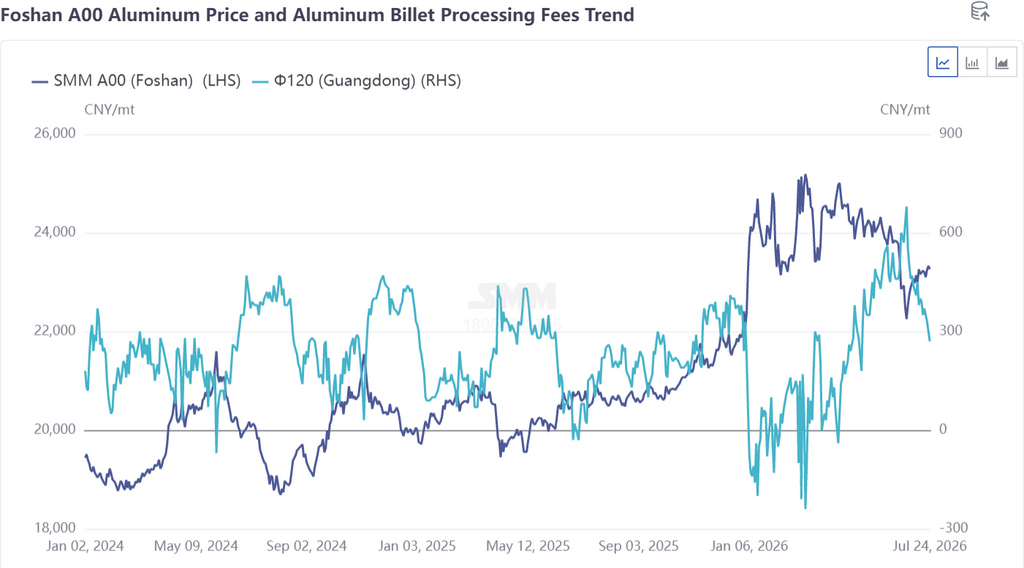
Conclusion:Currently, aluminum billet processing fees have retreated to near the production cost line of 250-300 yuan/mt. The average price for φ120 in Foshan fell to 270 yuan/mt on July 24, with some low-priced cargoes breaking below the cost line. In theory, cost constraints limit further downside room, but against a backdrop of weak off-season demand, the shift from destocking to inventory buildup, and increased circulation in South China, it is rather difficult for processing fees to hold firm. In the short term, it may consolidate on a subdued note, with focus on the pace of arrivals and digestion in South China, the strength of downstream purchases, and the marginal changes in orders for industrial extrusions.
Data source: SMM