1. Overall Imports in H1
According to the latest data from the General Administration of Customs, China imported 210,900 mt in physical content of copper scrap and shredded copper scrap in June 2026, up 10.43% MoM and up 15.11% YoY. Imports from January to June 2026 totaled 1.2415 million mt in physical content, up 8.39% YoY. (HS code: 74040000)
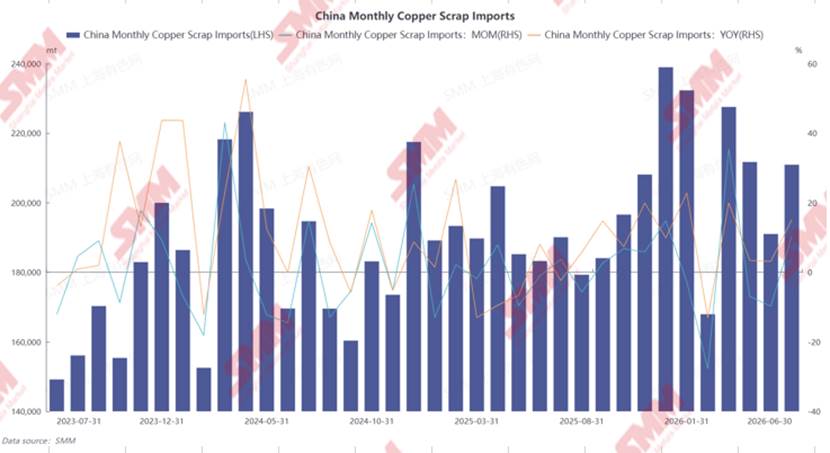
In terms of monthly pace, copper scrap imports in H1 showed a pattern of "starting high then adjusting, a volume spike in March, contraction in April-May, and stabilization and recovery in June." Imports in both January and March exceeded 220,000 mt in physical content. January imports reached 232,300 mt, the highest single month in H1, down 2.78% MoM but up 22.82% YoY. March imports stood at 227,600 mt, up 35.5% MoM and up 19.94% YoY. Impacted by tightening overseas supply and other factors, imports pulled back consecutively in April and May, with May falling to a period low of 191,000 mt. June then rebounded 10.43% MoM to 210,900 mt, staging a recovery.
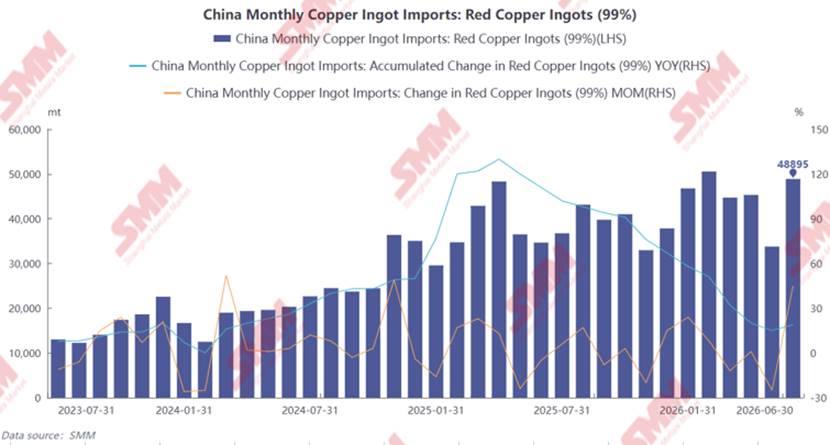
In addition, imports of copper scrap ingot (scrap refined copper ingot, HS code: 74031900) also performed strongly. Imports of copper scrap ingot reached 48,900 mt in June, up 45% MoM and up 41% YoY. Cumulative imports from January to June totaled 270,100 mt, up 19% YoY, indicating that more copper scrap is entering the domestic smelting sector in processed form.
2. Import Source Structure: Asia's Dominance Continues to Strengthen
The import source structure of copper scrap in H1 continued the pattern of "one dominant leader, multiple strong players, and diversified sources" seen since 2025, with Japan and Thailand firmly holding the top two supplier positions.
Looking at June data alone, Thailand ranked first with 37,300 mt, up 41.41% MoM and up 42.29% YoY. Japan followed with 36,100 mt, up 27.24% MoM and also up 42.29% YoY. South Korea, Spain, and Taiwan, China ranked third to fifth with 13,500 mt, 10,800 mt, and 9,000 mt, respectively. H1 data shows that Thailand ranked first with 200,500 mt in physical content, up 55.33% YoY cumulatively; Japan followed with cumulative imports of 198,000 mt in physical content in January-June, up 38% YoY cumulatively.
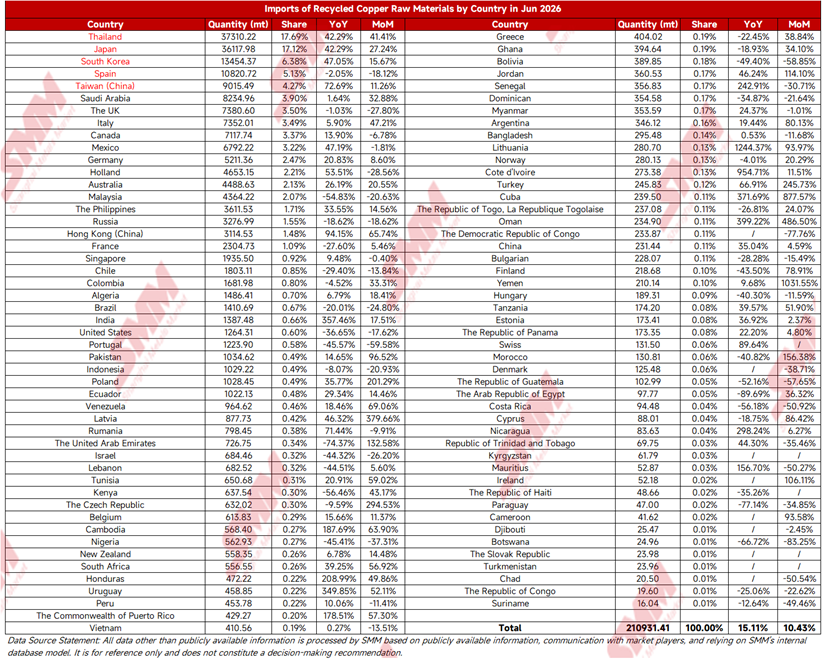
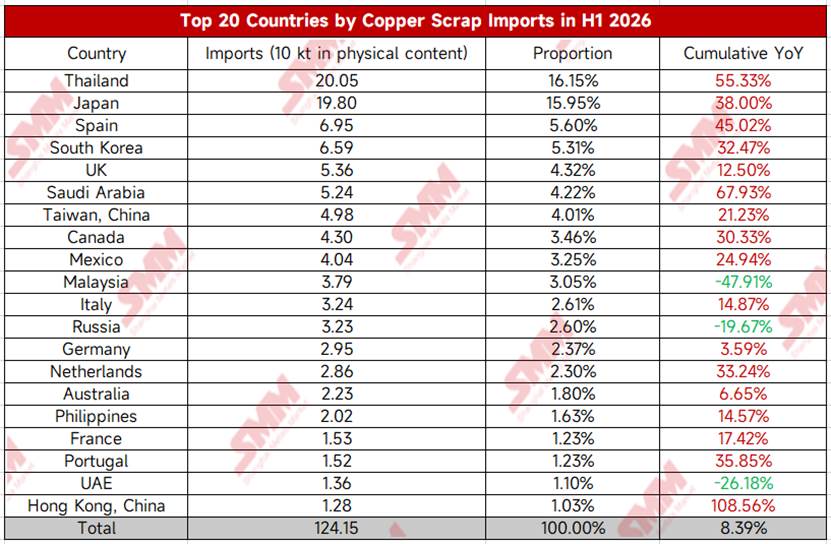
Notably, imports of copper scrap from the US continued to shrink, with only 1,300 mt in June, down 36.65% YoY, extending the contraction trend amid US-China trade frictions since 2025. Meanwhile, supply share from Asian countries and regions such as Thailand, Japan, and South Korea increased significantly, further consolidating Asia's leading position in import sources. In addition, shipments from European and Middle Eastern sources including Spain, Saudi Arabia, the UK, and Italy remained steady, diversifying the import source layout.
III. Key Drivers of Import Growth
In H1, copper scrap imports maintained steady growth. SMM believes this was driven mainly by the following factors:
First, the structural shortage of tax-included copper scrap in China persisted. Against the backdrop of the "reverse invoicing" policy, the circulation of tax-included copper scrap remained tight. Downstream compliant enterprises had rigid demand for imported copper scrap with tax invoices to meet production and tax requirements. Even if import profit margins narrowed, enterprises still needed to maintain a basic level of import procurement.
Second, the ongoing tightness in copper concentrates pushed up replacement demand for copper scrap from smelters. In 2026, global copper concentrate TC remained in negative territory, forcing enterprises to actively seek copper scrap, copper anode, and other materials as supplements. The proportion of copper scrap flowing from the processing sector to the smelting sector increased.
Third, the import profit window opened periodically. In February-March, the import P&L of copper scrap was mostly in positive territory, providing commercial feasibility for importers. This, combined with concentrated shipments from key suppliers Japan and Thailand, drove the import surge in March.
IV. Major Bottlenecks Limiting Import Volume Growth
Although H1 copper scrap imports achieved positive YoY growth, they posted consecutive pullbacks in April-May, reflecting several constraints:
First, available supply outside China contracted temporarily. In May, Japan's exports to China fell 16.99% MoM and Thailand's 24.69% MoM, as the recycling sector in major overseas supplying countries entered the off-season, reducing available exportable supply—the underlying reason for the decline in total imports.
Second, narrowed import profit margins dampened traders' willingness to purchase proactively. From April to May, LME copper prices continued to consolidate at highs, overseas suppliers strongly held prices firm, the bare bright copper quotation coefficient stayed high, and import profits were squeezed compared to February-March, dampening purchasing sentiment among domestic traders.
Third, the marginal stimulus of high copper prices on copper scrap supply weakened. SMM believes that copper prices can alter the pace of copper scrap release, but cannot significantly increase actual available supply in the short term. After sustained high copper prices from Q4 2025 to Q2 2026, previously accumulated social inventory has been gradually digested, and the stimulus effect of copper prices on supply is showing marginal weakening.
Looking ahead to H2 2026, copper scrap imports face a mix of bullish and bearish factors, and import volumes are expected to continue to consolidate at highs.
Positive Factors Supporting Imports:
First, the shortfall in domestic tax-included copper scrap is unlikely to ease in the short term. Invoice issues have yet to materially improve, domestic trade tax-included prices continue to stay high, and downstream enterprises' rigid demand for imported tax-included copper scrap will always provide a floor for import volumes.
Second, the tightness in copper concentrates persists, and the smelting sector's replacement demand for copper scrap will continue to increase.
Third, the overseas recycling sector will gradually enter its peak season in H2, and available exportable supply is expected to improve marginally compared to the off-season in May-June. Combined with continued incremental release from certain emerging sectors, the probability of a sharp plunge in total imports is low.
Constraints Suppressing Imports:
First, import profits are expected to remain in a thin-margin range. Overseas suppliers' willingness to hold prices firm remains strong, the bare bright copper quotation coefficient stays high, and traders' willingness to purchase proactively on a large scale remains weak.
Second, the diversion of local demand intensifies. As copper scrap smelting and processing capacity improves in the US, Europe, India, and parts of Southeast Asia, more and more copper scrap is directly absorbed by local markets, keeping available supply for export markets under continuous pressure. Additionally, geopolitical and transportation risks persist. Uncertainty in the Middle East could continue to disrupt shipping lane stability, increasing working capital burdens and contract performance risks for traders.
Overall, SMM expects H2 2026 copper scrap imports to take on a pattern of "supported at the bottom, confronted with headwinds at the top." The structural shortage of tax-paid copper scrap within China forms a solid foundation for import volumes. However, factors such as tight supply of available material outside China, limited import profitability, and intensifying global resource competition will constrain significant growth in imports. Over a longer horizon, as China advances its "dual carbon" policies, improves its domestic recycling system, and deepens the "domestic circulation" strategy, the supply structure of copper scrap is shifting from an "import-dependent" model toward one where "domestic supply plays the lead, supplemented by imports." In the near term, though, imported copper scrap remains irreplaceable as a critical channel for bridging the domestic shortfall of compliant material.

![China's Sulphuric Acid Market Continues to Hit Bottom, Weak Demand Drags Down the Price Center [SMM Sulphuric Acid Weekly Review]](https://imgqn.smm.cn/usercenter/YhgvU20251217171725.jpg)
![As Contract Rollover Approaches, Wait-and-See Sentiment Rises; Market Trading Remains Subdued [SMM North China Spot Copper]](https://imgqn.smm.cn/usercenter/TlzAr20251217171709.jpg)