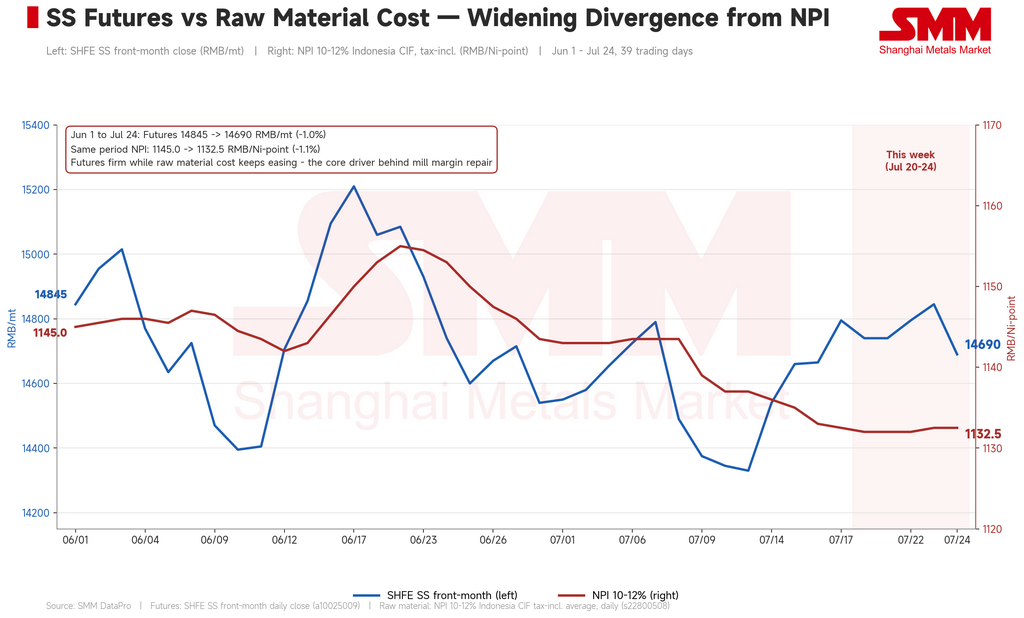
China's stainless steel futures held onto most of the prior week's rally but lost momentum into the close. The benchmark contract opened at RMB 14,740/mt (approximately $2,176/mt) on July 20, touched a weekly high of RMB 14,845/mt (about $2,192/mt) on Wednesday, then pulled back to settle at RMB 14,690/mt (about $2,168/mt) on Friday — down RMB 105/mt (roughly $15/mt), or 0.71%, from the prior Friday's close of RMB 14,795/mt (about $2,184/mt). The pattern was "up then down," but the contract stayed within the elevated range established by the previous week's bounce rather than reversing it.
Middle East escalation dominated the risk narrative
Geopolitics, not fundamentals, drove most of the week's price action. Iran said it struck US targets in Kuwait, Bahrain, and Jordan, and its Revolutionary Guard claimed to have killed "large numbers" of US personnel in Syria; Washington confirmed two US soldiers killed and one missing in an attack in Jordan, plus a separate fatality in Iraq while disposing of an unexploded Iranian drone. Iranian state media claimed traffic through the Strait of Hormuz had fallen to zero, and Houthi forces separately declared a maritime blockade against Saudi Arabia. Several tankers were attacked or rerouted in the Red Sea and Black Sea, and Kazakhstan briefly suspended oil exports via the Black Sea route. Israeli media reported that a 10-day ceasefire proposal originated from Tehran, underscoring a week that swung between escalation and diplomacy. OPEC+ was reported to be weighing a roughly 188,000 barrel-per-day increase to September output quotas at its August 2 meeting, while the European Central Bank held rates steady but left room for a September hike.
Trade and policy signals added to the mix
Washington moved to replace its expiring global tariff regime with a flat 10–12.5% duty on imports from 60 economies, and separately imposed a 50% tariff on select Canadian goods (energy, potash, fish, and critical minerals excluded). In China, refined and diesel fuel prices rose by RMB 300/mt and RMB 290/mt respectively (about $44 and $43) effective July 18, adding to logistics costs. On the policy support side, China's foreign exchange regulator said it would expedite a new round of Qualified Domestic Institutional Investor quotas and roll out further cross-border investment facilitation measures, and the Commerce Ministry confirmed China and the US are soliciting feedback on a tariff-reduction arrangement to be implemented soon. Chinese equities rallied sharply, with the STAR 50 index posting its biggest single-day gain of the year, and stamp duty revenue from securities trading rose 97.3% year-on-year in the first half. Separately, the ongoing dispute over British Steel's nationalization drew a response from China's foreign ministry, which said it was monitoring the situation closely and would take steps to protect Chinese interests if needed — a reminder that overseas steel-asset disputes remain a live issue for Chinese producers.
Spot demand released early, then stalled against the seasonal wall
The futures rebound restored some market confidence, and spot transactions were concentrated in the early part of the week as buyers absorbed lower-priced material with reasonably steady rigid demand. But the market remains deep in its traditional low season: overall effective downstream demand stayed limited, and buyers showed little appetite for higher-priced material once spot quotes moved up. As a result, spot prices traded in a narrow range for the week, with gains lagging well behind the futures move.
Inventories swung toward a build as delayed cargo arrived
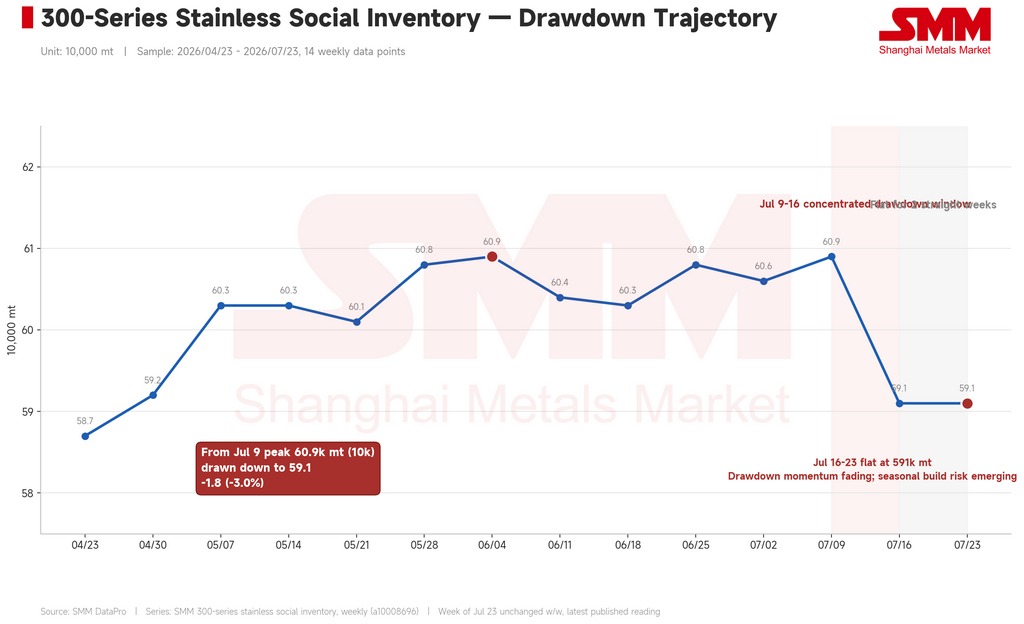
The inventory picture weakened over the week. Typhoon-related logistics disruptions that had been holding back deliveries eased, allowing a backlog of previously delayed material to reach ports and enter warehouses. Combined with mills maintaining normal shipment schedules and ample material reaching the market, supply began to outpace what soft seasonal demand could absorb — early signs of a build in social inventories. SMM's official weekly stainless inventory print had not yet updated at the time of writing; the most recent published figure, as of July 16, remained flat at 591,000 mt.
Raw material costs held steady; mill margins stayed intact
Trading in raw materials was thin and cautious this week, with a tug-of-war between bulls and bears. Chinese mills kept up steady pressure on Nickel Pig Iron (NPI) purchase prices, and with buying interest weak, NPI held largely flat around RMB 1,132/nickel point (about $167/nickel point) — showing no clear directional move. Scrap stainless steel, by contrast, edged higher in step with the stronger futures market. High-carbon ferrochrome's weekly average had not yet been updated for this period; the most recent published reading, for the week ending July 17, was RMB 8,090/50mt basis ton (about $1,194). With the spread between finished product and raw material prices roughly stable, mill smelting margins held steady week-on-week.
Outlook
The week captured a market pulled in two directions: geopolitical risk premium and tight nickel ore supply expectations kept futures elevated, while soft seasonal demand and a rebound in cargo arrivals pushed inventories back toward a build. That combination — firm futures, soft spot, rising stock — is the clearest signal yet that the futures-led rally may be running ahead of underlying demand. Three things are worth watching into next week: whether Middle East tensions cool and shipping through the Strait of Hormuz meaningfully normalizes, since that will shape both risk sentiment and cost expectations; whether the emerging inventory build extends, which could cap further upside in futures; and how quickly the recent refined-product price increase feeds through into logistics and production costs. For now, market participants should treat the geopolitical premium as a source of headline volatility rather than a fundamental floor, and wait for confirmation of an inventory drawdown before adding to positions on dips.