
Two pricing systems are pulling China’s nickel feedstock market in opposite directions
China’s nickel feedstock market has produced an unusual price divergence over the past two months.
In theory, higher-grade ferronickel should be more resilient. It contains more nickel, generally carries fewer impurity constraints and can be more efficient for stainless steel mills to use. Yet FeNi has fallen much more sharply than nickel pig iron, or NPI.
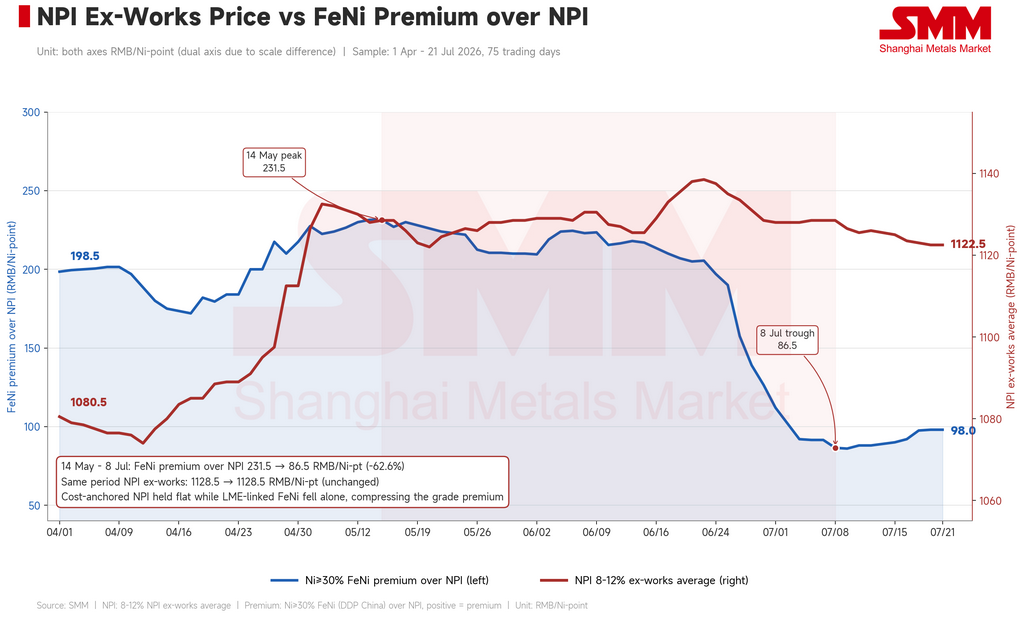
The premium of FeNi containing at least 30% nickel over 8–12% NPI fell from RMB 231.5 per nickel point in mid-May to RMB 86.5 on July 8—a contraction of 62.6% in eight weeks. It has since recovered slightly to around RMB 98.
NPI, meanwhile, barely moved. SMM’s average ex-works price remained within a narrow range of RMB 1,122–1,138 per nickel point, a fluctuation of less than 2%, even as benchmark nickel prices declined.
The explanation is not that FeNi has lost its technical advantages. Rather, the two products are being pulled by different pricing systems.
NPI is largely priced as a physical spot commodity in China, where tight availability has allowed sellers to resist lower offers. FeNi is more closely linked to international nickel prices, often through formulas based on lagged monthly averages. At the same time, cheaper refined nickel has begun to displace some FeNi demand at the margin.
Together, these forces have sharply reduced the premium that mills are willing to pay for FeNi.
First, what is a “nickel point”?
Nickel feedstocks contain different percentages of nickel, so comparing their prices by gross tonne can be misleading. The Chinese market therefore commonly quotes NPI and FeNi in renminbi per nickel point.
One nickel point represents one percentage point of nickel contained in one tonne of material. If NPI containing 10% nickel is priced at RMB 1,120 per nickel point, its approximate gross value is RMB 11,200 per tonne.
This convention makes it possible to compare materials of different grades on a contained-nickel basis.
It also means that the FeNi premium is not simply payment for “more nickel.” Nickel content has already been accounted for. The premium represents the additional value that mills assign to FeNi’s higher grade and handling advantages.
Compared with NPI, FeNi generally requires less physical material to deliver the same amount of nickel. It may also provide better control over carbon and other impurities, improve blending and furnace efficiency, and offer more consistent quality.
It is this premium per unit of contained nickel—not the value of the nickel itself—that has been compressed.
There is one further qualification. The observed spread compares FeNi delivered duty paid into China with NPI quoted on an ex-works basis. It therefore includes differences in freight, port charges and delivery location.
These factors affect the absolute level of the spread. But because logistics costs were relatively stable, they cannot explain a 63% contraction in eight weeks.
Similar products, different pricing anchors
Both NPI and FeNi are used as nickel-bearing feedstocks in stainless steel production. Their applications overlap, but their short-term pricing anchors are different.
NPI behaves primarily like a domestic physical commodity. Its price is influenced by available spot supply, stainless steel demand, ore costs, inventories and the cash cost of marginal producers.
FeNi is more commonly sold under formulas linked to LME nickel. Traditional supply is often settled against a lagged monthly average rather than the latest spot price.
As a result, a decline in nickel prices gradually feeds into FeNi contract values. NPI does not necessarily follow if China’s physical market remains tight.
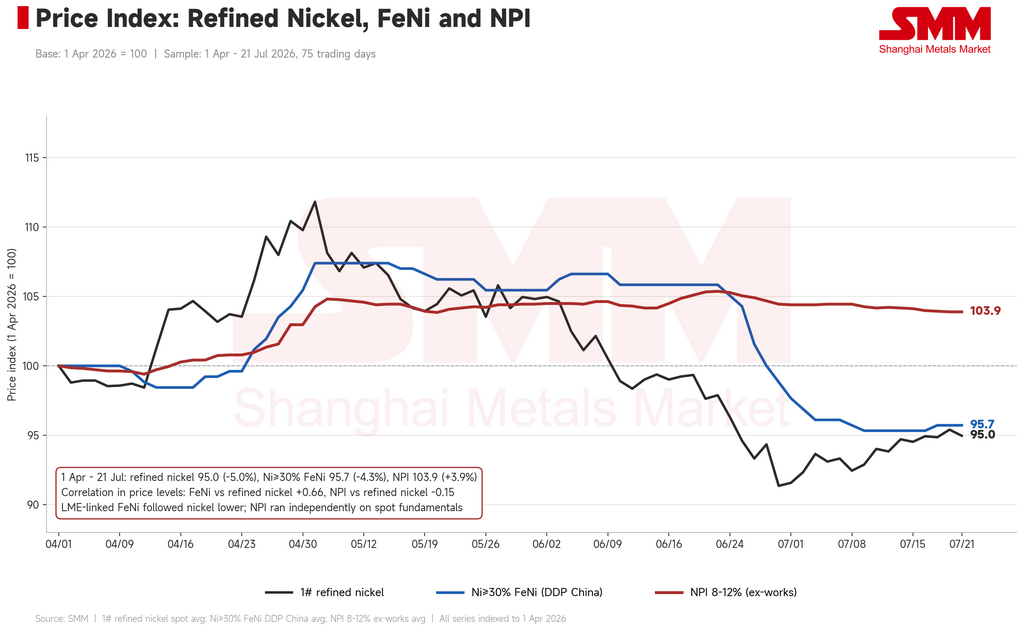
The data support this distinction. From April 1 to July 21, FeNi’s contemporaneous correlation with China’s refined nickel price was 0.66, compared with minus 0.15 for NPI.
The relationship became stronger when a lag was introduced. FeNi’s correlation with the previous 20 trading days’ average refined nickel price rose to 0.94, consistent with monthly-average formula pricing.
SMM’s No. 1 refined nickel price is used here as a comparable domestic proxy. It is influenced not only by the LME but also by exchange rates and Chinese physical premiums, so the relationship should not be interpreted as a direct one-for-one correlation with the LME.
The broader mechanism is nevertheless clear:
FeNi is mainly anchored to nickel prices; NPI is mainly anchored to physical availability.
When nickel prices fall quickly while NPI remains tight, the two price curves separate. FeNi declines, NPI holds firm and the premium between them contracts.
Why did NPI refuse to fall?
NPI’s support initially came from production costs. It later shifted to inventories.
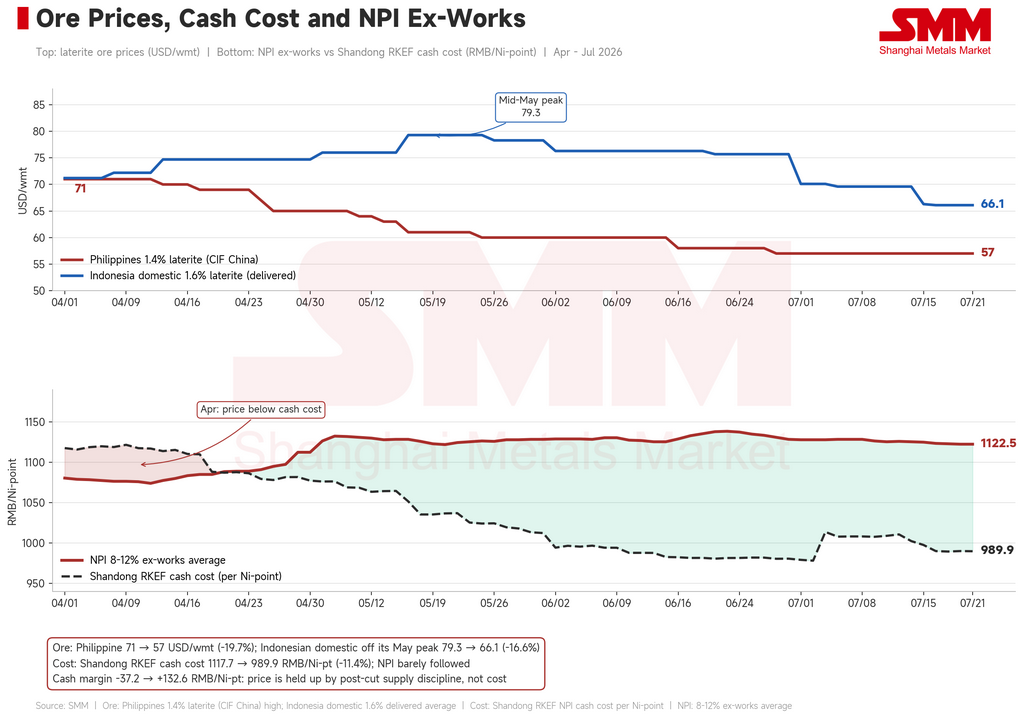
In early April, the average ex-works NPI price stood at RMB 1,080.5 per nickel point. That was around RMB 37 below the estimated cash cost of RMB 1,117.7 for a Shandong rotary kiln-electric furnace, or RKEF, operation using imported ore.
This cost is not representative of all Indonesian supply. It serves as a reference for marginal Chinese capacity serving the domestic market.
With some producers operating below cash cost, further downside appeared difficult to sustain. NPI subsequently recovered from RMB 1,074 on April 13 to RMB 1,132.5 in early May.
The recovery was not driven by an immediate production cut. Chinese high-grade NPI output was broadly stable at 19,400 nickel tonnes in March and 19,300 tonnes in April. Refined nickel prices also rose 13.6%, from RMB 135,000 to RMB 153,350 per tonne, helping lift sentiment across the nickel complex.
After May, however, the cost picture changed.
Production costs fell, but NPI did not
Philippine laterite ore containing 1.4% nickel fell from $71 per wet metric tonne, CIF China, in early April to $57 on July 21, a decline of 19.7%.
The delivered price of Indonesian domestic ore containing 1.6% nickel also fell, from a mid-May peak of $79.3 per wet metric tonne to $66.1, a decline of 16.6%.
Lower ore prices reduced the estimated Shandong RKEF cash cost from RMB 1,117.7 to RMB 989.9 per nickel point, an 11.4% decline in four months.
NPI prices barely responded.
The implied cash margin consequently swung from a loss of approximately RMB 37 to a profit of around RMB 133 per nickel point.
If high production costs were still the main reason for NPI’s resilience, prices should have weakened as costs fell. Their failure to do so indicates that another form of support had taken over.
The real constraint was freely available inventory
China’s total NPI inventory does not tell the whole story. Its location matters.
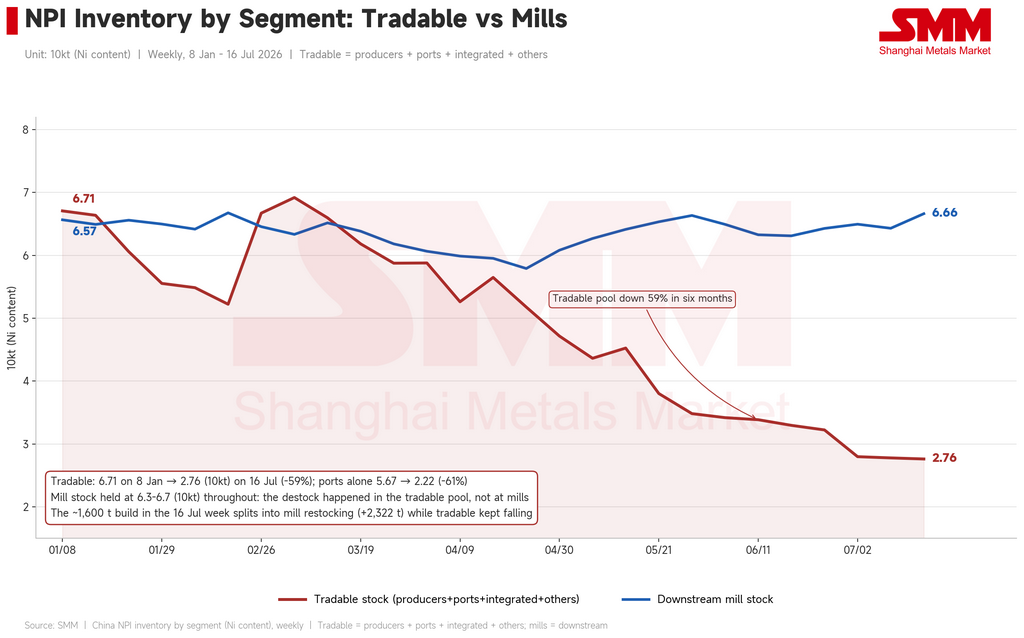
From early January to July 16, stocks held by downstream stainless steel mills remained broadly stable at 63,000–67,000 nickel tonnes.
Over the same period, inventories in more accessible parts of the supply chain—including producer stocks, ports, integrated operations and other market channels—fell from 67,100 to 27,600 nickel tonnes, a decline of 59%.
Port inventories alone dropped by 61%, from 56,700 to 22,200 nickel tonnes.
This means mills were not simply running down their internal feedstock reserves. The amount of material available for immediate purchase in the market had genuinely contracted.
Freely available stocks fell from roughly half of total inventory at the beginning of the year to only 29%.
Imports weakened at the same time. China imported 81,400 tonnes of NPI in June, down 17% from May and 35% from the same month in 2025. It was the lowest monthly volume of the year.
That gave holders of physical material considerable pricing power, even as their production costs declined.
NPI’s asymmetric performance—rising with the nickel market in April but refusing to fall with it from May to July—is typical of a market in which tradable spot material is scarce.
Why did China’s NPI imports decline?
Part of the answer lies in a change in Indonesia’s product mix.
Indonesia is the most important external source of NPI for the Chinese market. But some flexible Indonesian RKEF lines have been switching from NPI to high-grade nickel matte, an intermediate product used further along the battery supply chain.
Indonesian NPI production declined from 134,700 nickel tonnes in March to 127,500 tonnes in June, down approximately 7% year on year.
High-grade nickel matte output moved in the opposite direction. June production reached 28,700 nickel tonnes, an increase of approximately 126% from a year earlier.
Indonesia did not produce less nickel overall. It produced the nickel in a different form.
Combined NPI and high-grade matte production still increased by approximately 4.5% year on year. However, NPI’s share of that combined output fell from roughly 92% to 82%.
The shift therefore represented a structural diversion of nickel units away from NPI.
Economics determined the direction of the switch.
Some Indonesian RKEF lines can move between NPI and high-grade matte production. When the conversion margin for matte is favourable, producers have an incentive to divert NPI output into matte.
During the nickel price rebound from mid-April to mid-May, that conversion margin briefly turned positive. On May 13, producing high-grade matte rather than selling NPI directly offered an estimated advantage of RMB 2,936 per nickel tonne.
Flexible lines consequently favoured matte. After allowing for production and shipping time, the effect appeared in China’s June arrivals, which fell to their lowest level of the year.
The decline in imports was therefore more than a temporary shipping disruption. It reflected a change in Indonesia’s production economics.
The supply support for NPI is beginning to weaken
NPI remains supported by low available inventories, but the supply picture is changing on both sides of the market.
In China, profitable operations are already increasing production. Output rose from 19,300 nickel tonnes in April to 21,300 tonnes in May and 23,000 tonnes in June—an increase of roughly 19% in two months.
An estimated cash margin of more than RMB 130 per nickel point provides a direct incentive for further increases.
The economics of Indonesia’s product switch have also reversed.
As nickel prices declined while NPI remained firm, converting NPI into high-grade matte became increasingly unattractive. The relative margin turned negative in early June and fell to minus RMB 18,074 per nickel tonne on July 8. It remained close to minus RMB 12,500 in late July.
For flexible Indonesian producers, the incentive to switch capacity back towards NPI is now clear.
The effect will not be immediate. Production changes must be followed by processing, loading and shipping before additional material reaches China. But the probability of higher arrivals around August is increasing.
China’s total NPI inventory rose by approximately 1,600 nickel tonnes in the week to July 16. Most of that increase reflected mill restocking, however, while freely available inventory continued to decline. The physical shortage has not yet reversed.
The key signal will be a sustained recovery in producer and port inventories.
Once higher Chinese production and returning Indonesian supply begin to rebuild accessible stocks, sellers’ pricing power could weaken quickly. Because the estimated Chinese cost floor has fallen by more than RMB 120 per nickel point since April, NPI’s eventual downside could be considerably greater than a simple “price stays close to cost” assumption would suggest.
Why did FeNi fall more sharply?
The first reason is mechanical.
China’s refined nickel price fell from RMB 153,350 per tonne on May 6 to RMB 125,600 on July 1, a decline of approximately 18%, before recovering to RMB 130,250.
As lower nickel prices entered lagged settlement formulas, the average delivered FeNi price fell from RMB 1,380 per nickel point in mid-May to RMB 1,225 in mid-July, a decline of approximately 11%.
This explains why FeNi followed nickel lower. It does not fully explain why its premium over NPI fell from RMB 231.5 to less than RMB 90.
The additional pressure came from a change in the way some Chinese stainless steel mills sourced their marginal nickel units.
Cheaper refined nickel began to displace FeNi demand
Stainless steel mills combine several feedstocks to reach a target nickel content.
When the average grade of NPI declines, mills need to obtain more nickel from other sources. Those additional units may come from FeNi, refined nickel or other suitable feedstocks.
The average grade of Chinese high-grade NPI fell from 11.33% in January to 11.00% in late June, before recovering slightly to 11.11% in July.
This created a broader need for supplementary nickel, but the grade change itself did not trigger the recent adjustment in purchasing. Relative prices did.
NPI’s discount to refined nickel narrowed from RMB 380.5 per nickel point on April 27 to RMB 110.5 on June 30—a contraction of about 70%.
On the same contained-nickel basis, refined nickel’s premium over FeNi fell from approximately RMB 154 per nickel point in early May to around RMB 72 in late July.
For mills with flexible blending systems and no particular shortage of iron units, refined nickel became increasingly competitive.
It requires little physical volume, carries limited impurity constraints and is highly liquid. When the extra price required for these advantages fell by more than half, using refined nickel for marginal nickel additions began to make economic sense.
This does not mean refined nickel can replace FeNi at every mill.
Some mills need the iron units contained in FeNi. Others have limited blending flexibility or different furnace economics. Their decisions also depend on nickel recovery rates, the value assigned to iron, energy use and the full effective cost of adding nickel—not simply the quoted price per nickel point.
The substitution therefore occurs only at the margin.
But marginal buyers often determine the premium. When the mills previously willing to pay for FeNi’s convenience reduce their purchases, FeNi sellers lose bargaining power. That is enough to compress the premium for the broader market.
In some lower-grade or spot FeNi transactions, the price per contained nickel point has consequently approached or even fallen below that of NPI.
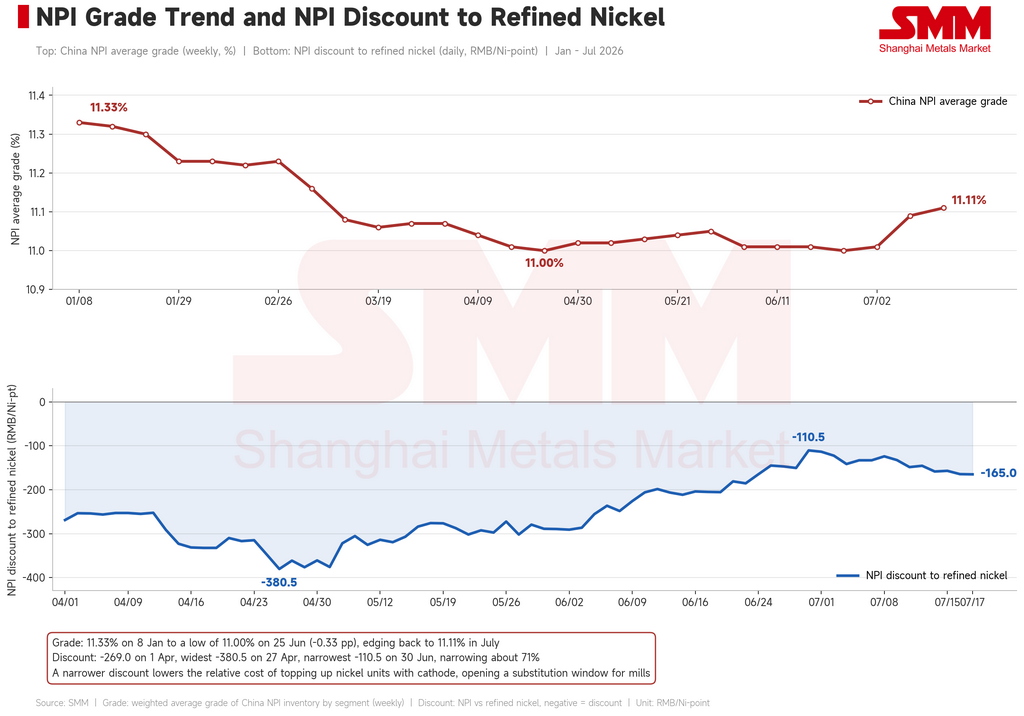
The substitution window was widest in late June. Since then, NPI’s discount to refined nickel has widened again to around RMB 165 per nickel point.
If that discount continues to expand, the economic advantage of using refined nickel will diminish, and some marginal demand may return to FeNi.
What could reverse the divergence?
Three variables will determine whether the FeNi–NPI spread normalises.
1. A recovery in freely available NPI inventories
Chinese NPI production has already increased by approximately 19% since April. In Indonesia, the economics of converting NPI into high-grade matte have turned deeply negative, creating an incentive to switch flexible capacity back towards NPI.
Allowing for shipping time, August could become an important window for higher Indonesian supply to reach China.
If producer and port inventories begin to rise on a sustained basis, NPI could adjust lower. The spread would then narrow from the NPI side.
2. A recovery in benchmark nickel prices
FeNi responds to nickel prices with a lag because of its monthly-average pricing formulas.
If LME nickel stabilises and recovers, stronger benchmark prices should gradually enter FeNi settlements. The FeNi premium could then improve roughly a month later, even if NPI remains unchanged.
3. The discount of NPI to refined nickel
This is the most direct indicator of mills’ marginal feedstock choice.
If NPI’s discount remains narrow, refined nickel substitution will remain attractive and the FeNi premium will struggle to recover.
If the discount widens, refined nickel will lose some of its economic advantage, reducing the pressure on FeNi demand.
Better material does not guarantee a fixed premium
FeNi has not lost its fundamental advantages.
Its higher grade still reduces physical input requirements, generally makes carbon and impurity control easier, and can improve blending and smelting efficiency.
But technical value and market premium are not the same thing.
NPI can remain expensive when immediately available supply is scarce, even if its production cost is falling. FeNi can lose its premium when benchmark nickel prices decline and mills gain a cheaper alternative for their marginal nickel requirements.
The current divergence is therefore not primarily a story about product quality. It is a repricing of convenience under two different pricing systems.
To judge whether the FeNi premium can recover, the market must look beyond FeNi’s grade and its own supply. The more important indicators are China’s freely available NPI inventory, lagged nickel averages and the relative cost of using refined nickel at the margin.
Grade determines how useful a feedstock is. The marginal buyer determines how much of that value can be converted into price.
Written by Bruce Chew
Nickel & Stainless Steel Analyst, Shanghai Metals Market
Email: bruce.chew@metal.com
Tel: +601167087088
![[SMM Nickel Flash] High-Grade NPI Prices Drop in China, Rise in Indonesia as Steel Mills Slow Procurement](https://imgqn.smm.cn/usercenter/yaAtG20251217171733.jpg)
![[SMM Analysis] Supply Recovery Expectations Rise, Market Sentiment Weakens, and Prices Come Under Pressure](https://imgqn.smm.cn/usercenter/LNpBh20251217171732.jpeg)