July 23, 2026 –
This week, the operating rate of leading Chinese aluminum downstream processors fell to 61.1%, down 0.2 percentage points WoW. The off-season effect deepened, putting broad-based pressure on various sectors. Aluminum plate/sheet and strip, aluminum wire and cable, and aluminum foil kept operating rates stable, providing bottom support, while primary aluminum alloy led the decline, and aluminum extrusion and secondary aluminum moved lower this week. The operating rate of primary aluminum alloy dipped 0.6 percentage points to 59.0%, as off-season order releases were insufficient and downstream purchase willingness was weak, with both supply and demand sides softening. Downward pressure remains in the short term. The operating rate of aluminum plate/sheet and strip held steady at 69.4%. Enterprises actively destocked, and June exports surging 44% YoY provided support. The weak pattern for general-purpose plate persisted, and the impact of the new national standard for can stock remains to be seen. The operating rate of aluminum wire and cable stayed flat at 63.6%. Exports entered a quiet period and the State Grid’s cargo pick-up pace was slow, both domestic and foreign demand being sluggish. The operating center is expected to shift further downward. The operating rate of aluminum extrusion dipped 0.4 percentage points to 52.9%. Demand from energy storage and PV frames provided marginal support, but construction extrusion was dragged by deepening off-season and sluggish real estate, remaining weak overall. The operating rate of aluminum foil held steady at 70.9%. Amid packaging off-season, capacity shifted to battery foil. June exports surged 23.8% YoY, and production schedules extended to September, limiting downside room. The operating rate of secondary aluminum declined 0.4 percentage points to 50.8%. Triple pressures from tight aluminum scrap, insufficient tax invoices, and high costs persisted, and the operating rate may still have room to dip. Overall, the deepening off-season effect kept downward pressure on industrial operating rates unabated. Export orders for aluminum plate/sheet and strip and aluminum foil provided phased bottom support, while other sectors will remain in the doldrums in the short term.
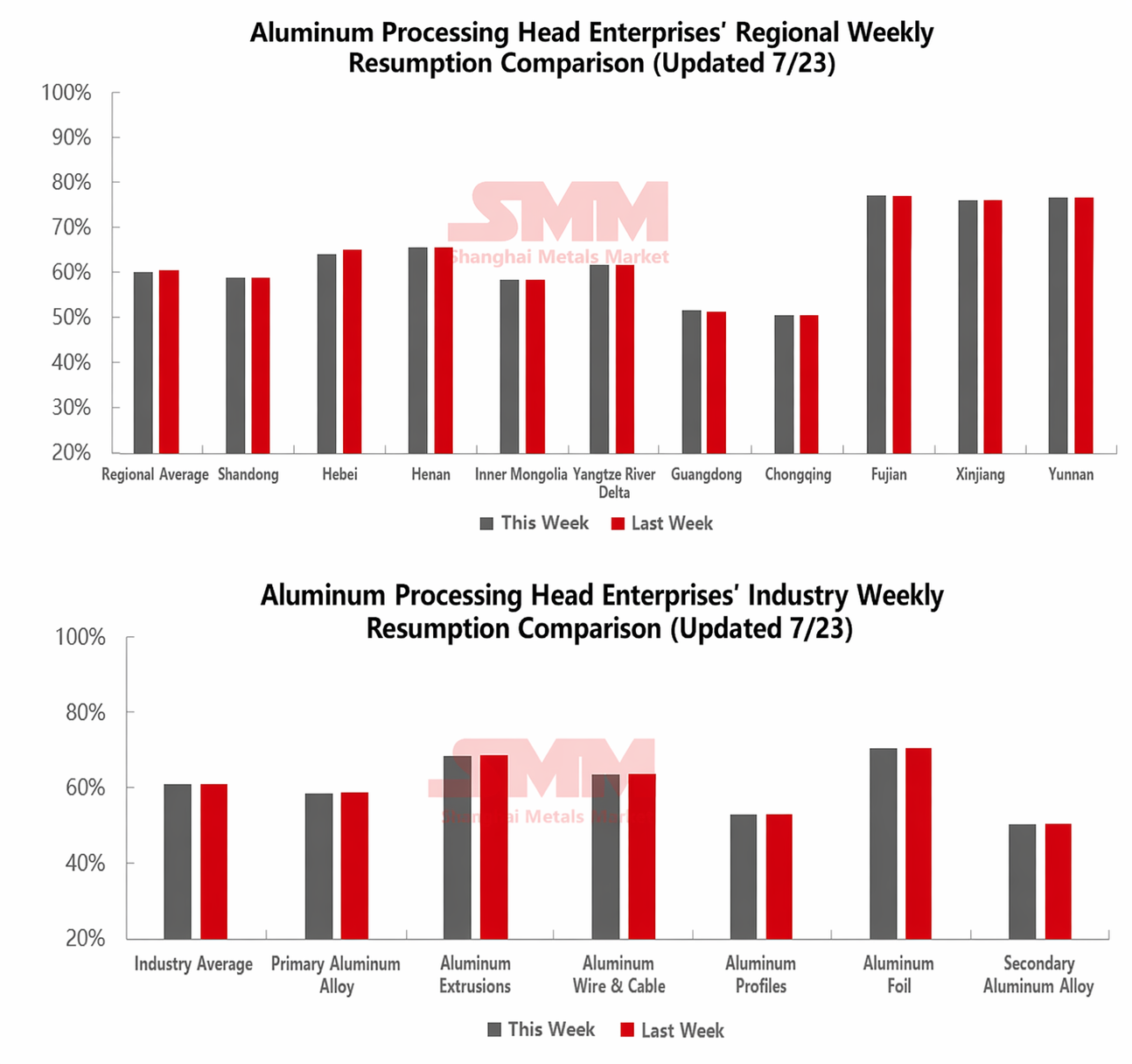
Primary aluminum alloy: This week, the operating rate of leading Chinese primary aluminum alloy producers stood at 59%, down 0.6 percentage points WoW, with the overall operating momentum slightly weakening. Supply side, affected by the off-season effect, downstream orders were generally poor, and enterprises adjusted production schedules appropriately based on actual orders, leading to a corresponding reduction in operating levels; no active production ramp-up plans were seen. Demand side, the market was in the consumption off-season, with a chilly procurement atmosphere. Downstream buyers and traders showed weak purchase willingness, and new order releases were insufficient, imposing certain pressure on operations. Overall, with both supply and demand softening, leading producers’ operating rates face downward pressure in the short term. The operating rate of primary aluminum alloy industry leaders is expected to pull back slightly next week, remaining in the doldrums overall.
Aluminum plate/sheet and strip: This week, the operating rate of leading aluminum plate/sheet and strip producers stayed stable at 69.4% WoW. On the enterprise operation level, although finished product inventories still hovered above warning levels, aluminum prices consolidated narrowly during the week, and enterprises actively destocked, with production pace tending stable. In terms of order structure, there were no further practical feedback on the new national standard for food-contact metal packaging cans. Can stock producers still received stockpiling orders as normal, and the actual impact remains to be observed. The export side showed strong resilience — according to customs statistics, June aluminum plate/sheet and strip exports stood at 354,000 mt, up 10.6% MoM and up 44% YoY. H1 cumulative exports reached 1.7894 million mt, up 18.7% YoY. Earlier received export orders are still being produced in an orderly manner. In the short term, export and energy storage orders form bottom support for aluminum plate/sheet and strip operating rates. However, with the off-season effect still unfolding, general-purpose plate continues to be weak, and the operating rate is expected to remain in the doldrums.
Aluminum wire and cable: This week, the operating rate of China’s aluminum wire and cable industry came in at 63.6%, flat WoW. The industry’s weak operating pattern remained unchanged during the week, as downward drivers persisted: the aluminum stranded wire export segment has largely entered a quiet period, with only a few manufacturers still in the final delivery stage for previously signed export orders; most enterprises had no new orders for pure aluminum stranded wire export business. Domestically, the State Grid’s cargo pick-up pace was slow, and the industry has entered the traditional off-season, with incremental domestic demand being very limited. Under the dual pressure of waning exports and sluggish domestic demand, the industry’s capacity utilization rate remained under pressure, and the overall operating rate stayed on a downward trajectory. In August–September, the domestic aluminum wire and cable industry is expected to enter the off-season cycle, and the operating center will shift further downward.
Aluminum extrusion: This week, the weekly operating rate of aluminum extrusion came in at 52.9%, down 0.4 percentage points WoW, continuing the off-season weak trend. The overall operating rate and orders for industrial extrusion stayed basically stable. Some enterprises in the sample benefited from abundant orders on hand in the energy storage sector, keeping production schedules relatively full and providing marginal support. For PV frames, leading frame producers maintained stable production schedules this week, continuing high operating levels. According to an SMM survey, downstream module makers’ Q3 production schedules are expected to be slightly higher than Q2, which will underpin frame demand. In the short term, the operating rate for PV frames is expected to remain largely stable. Construction extrusion, dragged by the deepening off-season and sluggish real estate, saw further weakening end-use demand. Downstream clients became more cautious, mainly engaging in just-in-time procurement for urgent orders, and new orders declined, weighing markedly on the overall operating rate. Overall, demand resilience from new energy sub-segments within industrial extrusion provides some support for the overall operating rate, partially offsetting the negative impact of off-season weakness in construction extrusion. In the short term, the aluminum extrusion operating rate is expected to remain weak.
Aluminum foil: This week, the operating rate of leading aluminum foil producers held steady at 70.9% WoW. On the enterprise operation level, amid packaging off-season weakness, some enterprises continued to shift double zero foil capacity to battery foil production, leaving effective packaging capacity in a tight balance. Processing fees showed no downward moves in the off-season environment. The export side was impressive: according to customs statistics, June aluminum foil exports stood at 131,000 mt, up 9.7% MoM and up 23.8% YoY. Current export order production schedules have been extended to September. After the price spread between Chinese and overseas markets narrowed, new orders received in October will be a key variable for observing the Q4 export turning point. Overall, while deep weakness in air-conditioner foil and the packaging off-season effect are the main drags keeping aluminum foil operating rates at low levels, with full export order schedules and steady battery foil demand underpinning operations, the downside room for aluminum foil operating rates is relatively limited.
Secondary aluminum: This week, the operating rate of leading secondary aluminum producers dipped 0.4 percentage points WoW to 50.8%, a low for recent years. Affected by tight compliant aluminum scrap supply, insufficient tax invoices, and the deepening consumption off-season, production enthusiasm was hit, production cuts continued, and operating rates extended their decline. On the raw material side, aluminum scrap circulation was tight, tax invoice policies showed no loosening, and the rise in primary aluminum drove up scrap aluminum prices, keeping procurement costs high. On the demand side, the off-season effect intensified, downstream order releases were limited, market transactions were sluggish, and new orders decreased. Enterprises mostly produced to order and made just-in-time procurement, with demand’s support for operating rates continuing to weaken. Overall, against a backdrop of tight aluminum scrap supply and high cost support, the industry’s low operating rate pattern is hard to improve significantly in the short term. If end-use demand remains weak and order recovery is slow, secondary aluminum enterprise operating rates will likely linger at low levels in the short term, with room for further decline.
(SMM Aluminum Team)
![[SMM Analysis] Southeast Asia Aluminum Scrap Rebounds as ADC12 Stays Under Pressure Amid Section 232 Focus](https://imgqn.smm.cn/production/admin/votes/imageslvDRc20240314085754.png)