SMM News, July 22:
According to customs data, China’s die-casting zinc alloy imports and exports in H1 2026 showed a pronounced divergence of “rising exports and falling imports.” Exports were exceptionally strong, while imports continued to shrink.
I. Exports: Up YoY, with Asia as the dominant market
In H1 2026, China’s die-casting zinc alloy exports delivered an impressive performance. Cumulative exports from January to June reached 7,082.34 mt, representing a cumulative YoY increase of as much as 137.68% versus the same period last year. From the monthly data, export momentum continued to strengthen: June exports reached 1,994.54 mt, up 11.46% MoM, and surged 220.59% YoY.
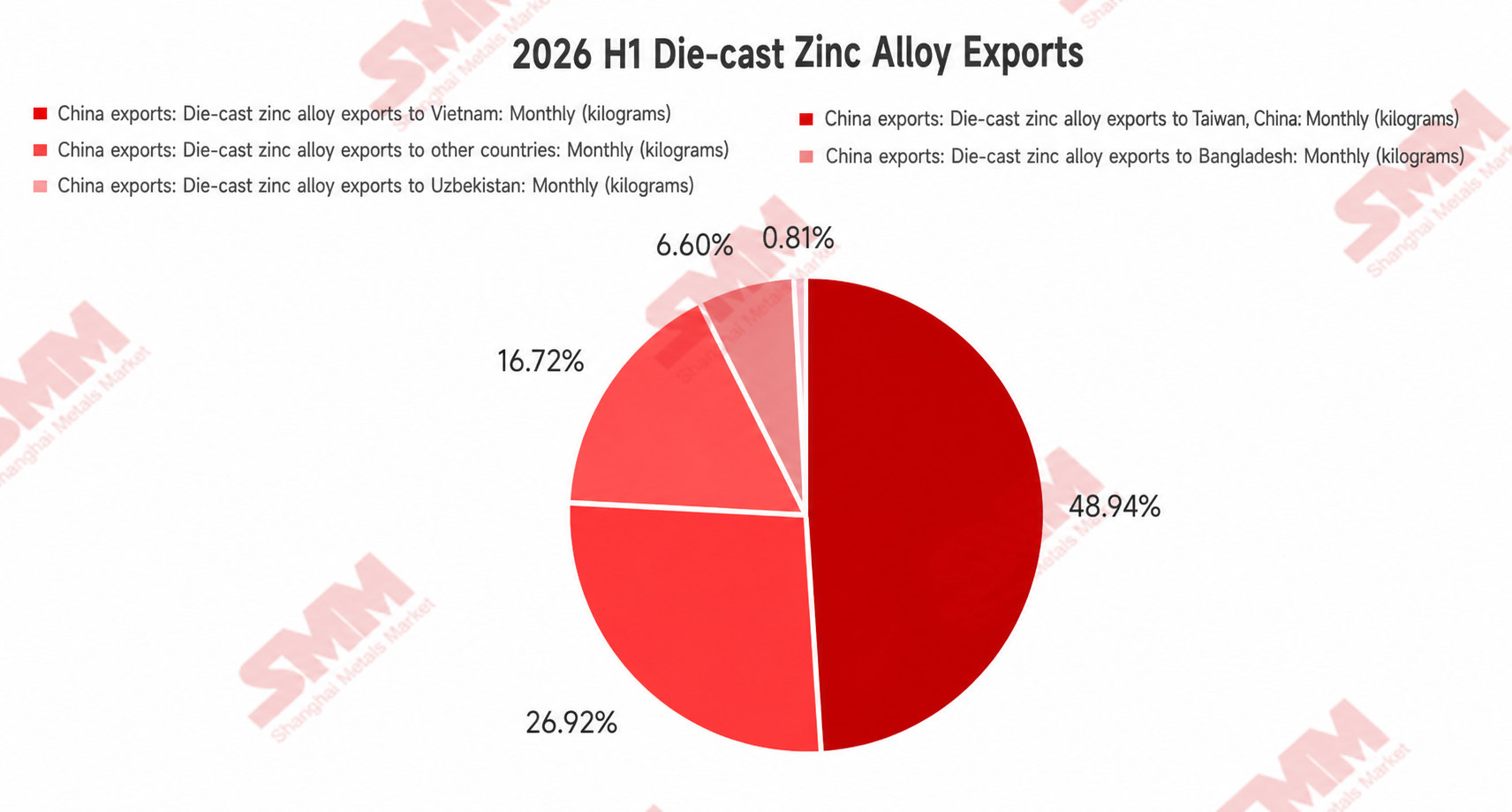
By export destination, market concentration was very high, with Asia accounting for over 70% of H1 exports. Vietnam was China’s largest export destination, with an H1 share as high as 48.94%; Taiwan, China ranked second at 16.72%; Uzbekistan, Bangladesh, and others also accounted for certain shares.
II. Imports: Weak demand, with the scale continuing to contract
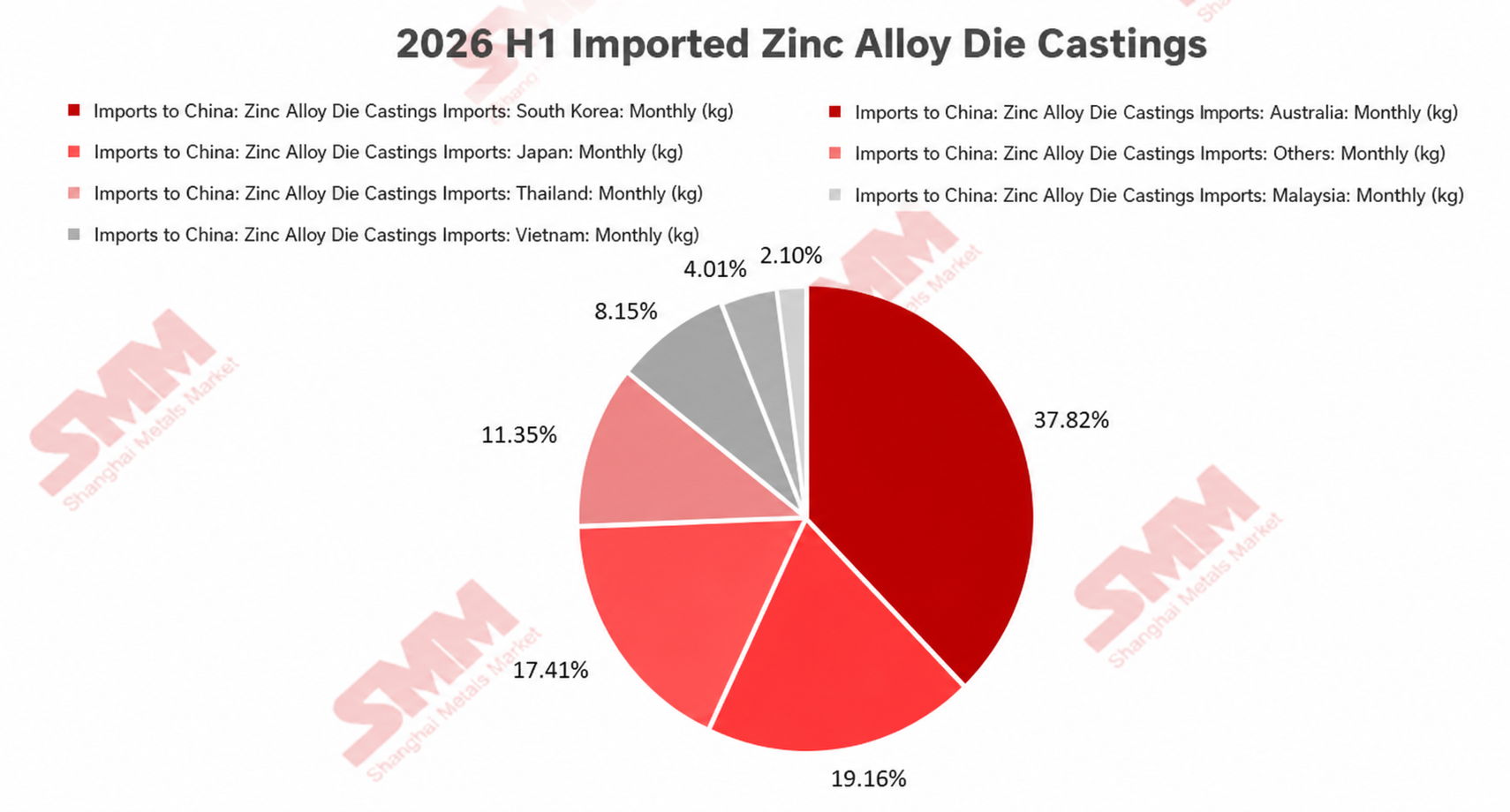
In sharp contrast to the export boom, the die-casting zinc alloy import market remained sluggish. From January to June 2026, China’s cumulative die-casting zinc alloy imports totaled 15,878.56 mt, down 32.93% YoY. In June, imports were 2,619.61 mt, edging down 0.12% MoM, with the YoY decline reaching 43.38%. Import sources were also highly concentrated, with South Korea, Australia, and Japan ranking among the top three, together accounting for over 74%.
As China’s die-casting zinc alloy capacity continued to release, China’s die-casting zinc alloy imports shrank. Meanwhile, domestic downstream consumption weakened YoY in H1, providing insufficient demand support.
Outlook for H2 imports and exports
Looking ahead to H2 2026, the “rising exports and falling imports” pattern is expected to continue with high probability, though several key variables warrant attention.
Exports: Expected to remain strong, but risks warrant vigilance
- Supportive factors: Recently, the SHFE/LME price ratio has remained at low levels, giving China’s die-casting zinc alloy a notable price competitiveness advantage in exports.
- Potential risks: The greatest uncertainties come from overseas trade policies and changes in the SHFE and LME price ratio.
Imports: Expected to remain weak, with a significant rebound unlikely
- Core logic: The contradiction of domestic alloy overcapacity is difficult to ease in the short term. Meanwhile, based on current understanding, the market is relatively cautious about the September-October peak season in H2. If domestic demand fails to deliver an above-expectations recovery in H2, demand for imported alloy will remain weak. Furthermore, the current unfavorable SHFE/LME price ratio environment also weighs on imports.
(The above information is derived from market data collection and comprehensive evaluation by the SMM research team. The information provided is for reference only. This article does not constitute direct advice for investment research decisions. Clients should make decisions prudently and not use this as a replacement for their own independent judgment. Any decisions made by clients are not related to SMM.)
![Secondary Zinc Oxide Pricing Coefficients Caught in a Tug-of-War [SMM Analysis]](https://imgqn.smm.cn/usercenter/XrnKf20251217171755.jpg)
![Low-Grade Zinc Oxide Payables Caught Between Rising and Falling, High Levels Expected to Persist [SMM Analysis]](https://imgqn.smm.cn/usercenter/TeRBO20251217171754.jpg)