According to data from China Customs, China's phosphoric acid exports showed a notable retreat after a rapid rise in Q2 2026, with exports surging to 40,200 mt in May before pulling back to 29,500 mt in June, down 26.5% MoM but still up YoY from June last year (up 3,500 mt). Resilient overseas demand from the new energy sector continued to expand, offsetting the short-term, pace-related pullback. Based on the policy pace for the full year and industry fundamentals, China's phosphoric acid trade is now exhibiting distinct characteristics of zero imports, pure exports, strong policy-driven fluctuations, and ongoing structural upgrades. Annual exports are impacted by both the policy to ensure agricultural material supply and the seasonal cycles in and outside China, resulting in an overall pattern of consolidating in regular cycles.
1. Significant Monthly Fluctuations in China's Phosphoric Acid Exports, Driven by Intertwined Policy and Seasonal Factors
According to SMM statistics, from October 2023 to June 2026, China's phosphoric acid exports displayed clear seasonal fluctuation patterns, with monthly export volumes consolidating dramatically between 15,000 mt and 48,300 mt, while imports remained near zero over the long term, indicating the strong self-sufficiency of China's phosphoric acid industry.
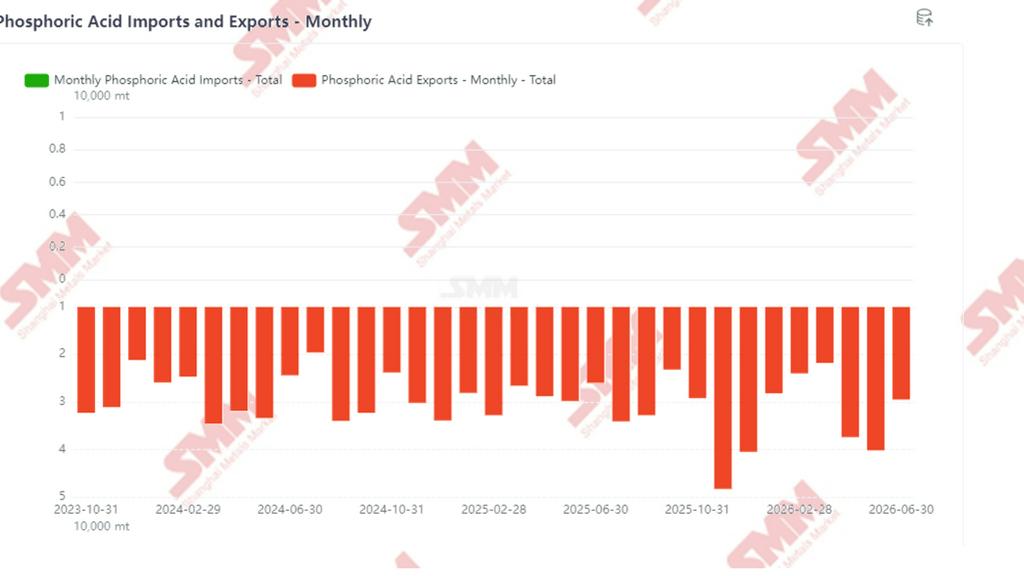
According to the SMM database, China's phosphoric acid exports follow a complete annual pace of "a dip during Chinese New Year, a spring rebound, a summer adjustment, and an autumn surge." Each year, during January-February, the Chinese New Year holiday weighs on enterprise operations and logistics, causing export volumes to pull back. From March to June, as the pressure to ensure supply during the spring plowing season eases and the market resumes operations in an orderly fashion, exports steadily rebound. July-August marks a period of adjustment, where exports pull back slightly into a mild range for the year, influenced by ongoing controls on phosphate fertiliser exports and weaker downstream operations during the rainy season in Southeast Asia. From September to December, the market fully enters the prime window for annual exports, with continued volume growth and repeated new annual highs. Exports hit 48,300 mt in November 2025, a peak within the statistical period. This was mainly due to concentrated overseas stockpiling ahead of Christmas and New Year holidays, the traditional peak season for external demand in November, the bottoming out and rebound of China's phosphoric acid prices from late October 2025, and a price spread advantage between Chinese and overseas markets that stimulated greater purchasing activity overseas, all driving up monthly export volumes.
This cyclical fluctuation is driven by a combination of policies and supply-demand factors in and outside China. To meet domestic agricultural supply requirements during the spring plowing and autumn fertiliser peak seasons, a special control on phosphate fertiliser exports is implemented from March 14 to August 31 each year. During this period, crude agricultural-grade phosphoric acid is banned for export, with only battery-grade and high-purity food-grade phosphoric acid allowed for compliant export, naturally capping total exports for H1. After controls are lifted on August 31, export potential for H2 significantly opens up, creating a fixed policy cycle of "restricted in H1, volume release in H2." This also resonates effectively with the rhythm of international market demand. The agricultural fertiliser demand cycle in Southeast Asia and the soybean planting season in South America are highly aligned with the window for China's rising phosphoric acid exports. Coupled with factors such as optimized efficiency in export statutory inspections and a widening price spread between Chinese and overseas markets after May 2025, this has further supported the continued rise in H2 exports in recent years.
2. Structural Upgrades: Continuous Optimization of Export Product Mix, New Energy High-End Trend Reshapes Trade Landscape
China's phosphoric acid export structure is undergoing continuous upgrades. The share of traditional crude agricultural-grade phosphoric acid exports has been declining year by year, while battery-grade purified phosphoric acid and high-end food-grade phosphoric acid have already become the mainstay of exports. The overall export landscape is gradually shifting from "low-end agricultural material exports" to "high-end new energy raw material exports." Especially during the annual export control period, high-purity phosphoric acid props up the industry's foreign trade fundamentals and serves as the core support for trade resilience. Behind this structural change is, on one hand, the continuous expansion of capacity for purified phosphoric acid and iron phosphate, steadily improving the supply capacity of high-end products. On the other hand, the gradual expansion of the overseas lithium battery and energy storage industries has driven a steady increase in rigid demand for high-end phosphoric acid. Coupled with the guidance of routine controls on agricultural material exports, industry capacity and trade resources continue to tilt towards high-value-added, high-end products, ultimately driving a comprehensive upgrade of the phosphoric acid export trade system.
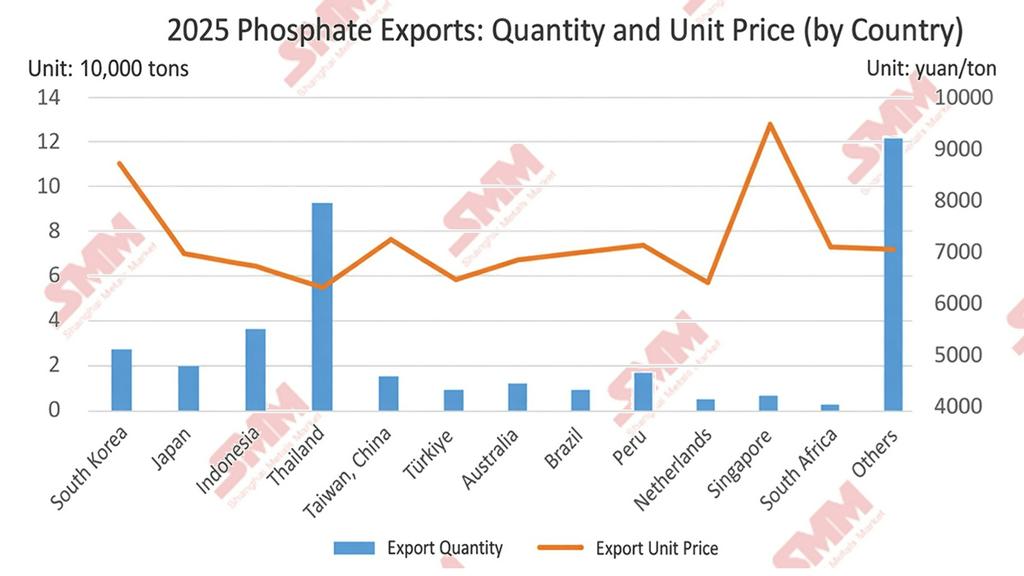
From the perspective of global export markets, Asia has always been the core base for China's phosphoric acid exports, with high market concentration, and top Southeast Asian countries have accounted for a major share of export volumes for many years. According to 2025 export data by destination, exports to Southeast Asian countries such as Thailand and Indonesia rank among the top globally. Leveraging the region's intensive agricultural cultivation, huge consumer demand from its large population, and geographical trade proximity, these countries continue to purchase large quantities of conventional agricultural- and industrial-grade phosphoric acid from China, firmly underpinning the overall export base. Exports to East Asian markets such as South Korea, Japan, and Taiwan, China, are smaller in scale, mainly driven by industrial and food processing demand, with import unit prices generally at a high level.
From 2023 to 2025, phosphoric acid imports from the Latin American market, represented by Brazil, increased significantly, and demand from multiple African countries expanded simultaneously. The expansion of large-scale agricultural development overseas and the establishment of local basic chemical facilities drove growth in raw material rigid demand, making these regions a highly promising emerging growth pole for China's phosphoric acid exports.
From a pricing perspective, price spread segmentation by country is very pronounced: the average import prices for Singapore and South Korea are significantly higher than those for agricultural, rigid-demand markets, confirming the premium advantage of high-end product exports. Agricultural powerhouses like Thailand and Indonesia primarily purchase basic-grade products, with export unit prices at the industry's mid-level. Overall, a tiered export landscape has formed: "Southeast Asia provides volume support with massive rigid demand, Latin America and Africa offer continuous incremental growth, and Europe, the US, and East Asia deliver high premiums with high-end products."
3. Outlook for 2026 Import/Export Trends and the Full Picture for the Phosphoric Acid Industry
Based on the H1 pace and considering the current policy cycle, overseas demand rhythm, and domestic spot fundamentals, the phosphoric acid industry will still be within the phosphate fertiliser export control window in July-August H2 2026. Crude agricultural-grade phosphoric acid exports will be restricted, creating a natural ceiling on total export volumes. Supported by the release of off-season restocking demand from overseas food and energy storage enterprises, phosphoric acid exports are expected to slightly recover from the June low, return to above the central level of 30,000 mt/month, and slightly offset the pressure from domestic agricultural off-season inventory buildup, solidifying the market floor with export resilience. In the corresponding spot market, domestic demand will be weak during the traditional agricultural off-season, but high raw material costs (sulfur, phosphate ore) and sustained losses at small and medium-sized wet process plants, leading to low operating rates and widespread output controls to support prices, will keep the wet process phosphoric acid market in a stalemate and consolidation pattern, weak but with no room for a deep, trend-driven decline.
From September to December, industry fundamentals and the foreign trade landscape are expected to significantly improve. The phosphate fertiliser export control policy officially expires on August 31. This, coupled with concentrated overseas agricultural material restocking in Q4, year-end capacity ramp-up at domestic LFP enterprises, and the concentrated delivery of long-term overseas lithium battery orders, will drive phosphoric acid exports into their peak period for the year. Monthly export volumes are expected to exceed 40,000 mt, hitting a new annual high, with the industry's overall export volume and trade surplus rising in tandem. This two-way volume release in domestic and external demand is expected to drive the industry into an upward inflection point. Not only will wet process phosphoric acid demand continue to recover, but thermal process phosphoric acid will also benefit from concentrated stockpiling in the food and electronic fine chemicals sectors and strengthen simultaneously, ushering in a peak season where both wet and thermal process markets thrive.
Over the medium and long term, the trend towards high-end products in China's phosphoric acid exports will become the norm. The export share of high-purity purified phosphoric acid will continue to rise, becoming the core source of growth for the industry's exports. Agricultural-grade phosphoric acid will fluctuate seasonally along with the annual policy cycle, forming a stable trade landscape where "high-end rigid demand stabilizes the base, while agricultural supplies provide elasticity through cycles," with the monthly export base firmly anchored at around 30,000 mt. The industry's fundamentals will also sustain this structural trend. On the supply side, rigid raw material costs, insufficient plant operating flexibility, and routine policy controls will keep industry supply tightening. On the demand side, steady growth in rigid export demand for high-end new energy applications and agricultural demand supporting the base will enable the phosphoric acid industry to officially enter a new development cycle of low volatility, strong resilience, and high premiums. The overall market will be more likely to rise than fall, and structural opportunities will become the market mainstream.
![[SMM Analysis] Million-Tonne Lithium Mine Project EIA Accepted, Pressing Fast-Forward on Snoway Development](https://imgqn.smm.cn/usercenter/MbKXH20251217171730.jpg)
![[SMM Analysis] China's Lithium Raw Material Imports Near 80kt LCE in June](https://imgqn.smm.cn/usercenter/ezoBg20251217171730.jpg)