SMM, March 25:
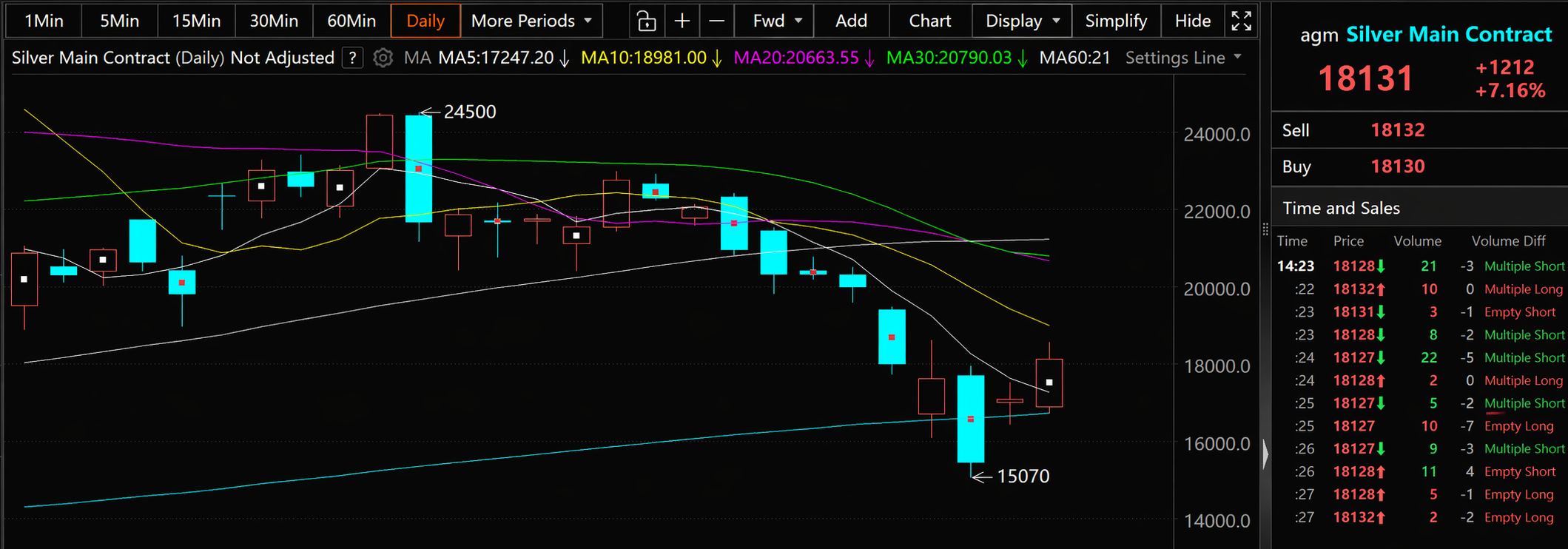
Falling oil prices eased inflation and rate hike concerns, as the US pushed to end the conflict with Iran, leading to some moderation in Middle East geopolitical tension expectations. Meanwhile, a senior executive at the World Gold Council (WGC) said on Tuesday that gold, as a hedge against de-dollarization and geopolitical risks, is expected to prompt central banks that have long been absent from the market to purchase the precious metal this year. At the same time, a weaker US dollar, coupled with fundamental supports such as valuation repair and tight silver supply, fueled a joint rally in precious metals futures and related equities. As of around 14:23 on March 25, COMEX gold rose 3.13% to $4,539.6/oz; the most-traded SHFE gold contract rose 3.71% to 1,015.54 yuan/g; COMEX silver rose 5.27% to $73.235/oz; the most-traded SHFE silver contract rose 7.19% to 18,136 yuan/kg; silver T+D rose 8.84% to 18,129 yuan/kg. In addition, the most-traded platinum contract rose 5.8% to 506.7 yuan/g, and the most-traded palladium contract rose 5.13% to 368.75 yuan/g.
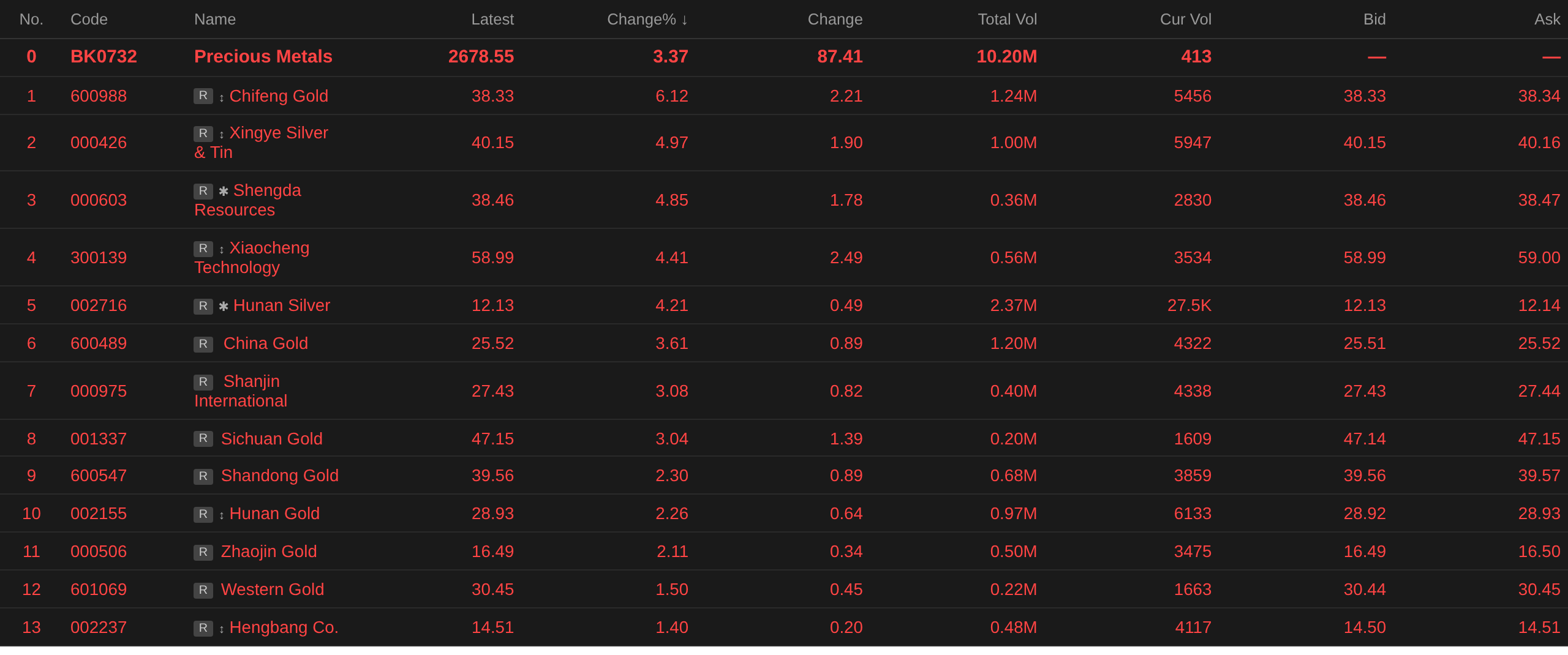
Precious metals stocks also strengthened following the futures rally. As of the close on March 25, the precious metals sector rose 3.37%. Among individual stocks: Chifeng Gold rose 6.12%, with Xingye Silver&Tin, Shengda Resources, Xiaocheng Technology, Hunan Silver, and Zhongjin Gold among the top gainers.

Spot Market
Platinum
On March 25, spot platinum was quoted at 499~503 yuan/g, with an average price of 501 yuan/g, up 5.92% from the previous trading day. Spot platinum was quoted at discounts of 6-8 yuan/g against the PT2606 contract, or at discounts of 2-4 yuan/g against the Sell 1 price on the SGE. Spot discounts widened slightly from the previous trading day. In terms of spot transactions, according to SMM, suppliers reported tight supply, with trading firms engaging in both spot and futures market actively inquiring, but mainstream quotation discounts did not widen significantly. The gap between intended and quoted prices was large, and actual transactions were limited. Some downstream enterprises made just-in-time procurement based on orders or adopted a wait-and-see stance. Overall spot market trading turned slightly lighter compared to yesterday.
Silver
On March 25, the SMM 1# silver ex-factory reference average price in the morning was 18,360 yuan/kg, up 1,800 yuan/kg from the previous trading day, an increase of 10.87%. It is understood that the spot-futures price spread between TD and the most-traded SHFE silver contract narrowed on the 25th. Some suppliers held back from selling and adopted a wait-and-see approach, while downstream broadly bargained and bought on dips. In the morning in Shanghai, mainstream quotations from holders of national standard silver ingots were at premiums of 100-150 yuan/kg against TD or premiums of 50-80 yuan/kg against the SHFE silver 2604 contract. Only a small volume was traded in early trading. As the spot-futures spread narrowed and silver prices surged, downstream willingness to purchase declined noticeably. Although suppliers held back from selling due to costs and other reasons, some sellers in the market cut prices to premiums of 0-20 yuan/kg against the 2604 contract to offload. Spot market quotations varied widely, with intense gaming between buyers and sellers. Downstream enterprises made small-scale dip-buying, and market trading turned thinner.
Voices from Various Parties
Regarding the outlook for precious metals, the views of some institutions are as follows:
On Monday local time, the UBS Global Wealth Management team released a report, further strengthening its bullish stance on gold. UBS analyst Wayne Gordon and his team stated that despite recent declines in gold prices, they believe investors should still hold gold as a defensive hedge. “We do not view this as a ‘Bernanke moment’ for gold—a major turning point—because we see significant differences between the current situation and the critical policy shifts of central banks decades ago, which suggests that fundamentals have not changed significantly, and we expect strong support for gold prices based on future macro developments,” he said. The analyst added that his team's view of gold as an effective portfolio hedge has not changed, and predicted that gold prices will soon start to rise again. UBS attributed gold's recent decline to several factors, such as weakening investor confidence in the US Fed's interest rate cuts and waning speculative momentum in the market. However, in Gordon's view, if history serves as a guide, negative views on gold's outlook may be premature.
Chaos Ternary Futures stated: The market's high-volatility trend continues alongside the changing conflict, and the five-day negotiation period may delay risks. However, before a real negotiation outcome emerges, market optimism is not enough to fully return. Moreover, the released negotiation agreements are all reiterations of previous ones and have yet to meet the conditions for an agreement with Iran; currently, Iran has not acknowledged them, so the risks remain unresolved. Precious metals trading continues to follow the conflict situation, and amid short-term high volatility, the long-term upward trend is maintained.
Minmetals Futures believes: The current geopolitical conflict has become the market's core focus, and gold price movements are significantly disturbed by news flow. As the US softens its stance, oil prices pull back slightly, easing concerns about further Fed rate hikes to some extent. If the geopolitical conflict eases subsequently, the pressure on the global economy from high energy prices and supply chain disruptions will gradually diminish, and the probability of central banks hiking interest rates will decline, allowing gold to regain upward momentum. However, at the same time, the inflation expectations brought by high oil prices have not yet eased, and the US Fed is unlikely to see data support for an inflation pullback in the near term. Combined with cautious statements from major central banks earlier, precious metals still face valuation pressure in the short term.
JP Morgan noted in a report: "Although the current gold price is still down about 17% from pre-conflict levels due to a stronger US dollar and widespread risk-off moves in the market, historically, such sharp declines often represent tactical buying opportunities. Moreover, the longer the conflict lasts, the more the bullish case for gold is reinforced. "
Renowned Wall Street economist, CEO of Euro Pacific Capital and Chief Global Strategist Peter Schiff believes that the current sell-off in gold is replaying the script of the 2008 global financial crisis and boldly predicts that gold will subsequently rebound to $11,400. Schiff’s bullish view on gold prices is based on historical comparisons with the global financial crisis. He wrote on social media platform X: “At the beginning of the 2008 global financial crisis, gold prices plunged 32%, roughly 40% of the preceding bull market’s gains. After bottoming out, gold prices surged 178% over the next three years.”
Ed Yardeni, a veteran of the precious metals market and president of Yardeni Research, recently stated that he still sticks to his forecast of gold reaching $10,000 by the end of this decade. However, he lowered his year-end target price from $6,000 to $5,000, a level still about 14% above current prices.
CITIC Securities pointed out that after previous Middle East conflicts, the medium-term trend of gold prices still depended on US dollar credit and liquidity factors. Looking ahead to the current conflict, the continuation of the two trends of looser liquidity and weakening US dollar credit is expected to further push up gold prices. Historically, valuation or stock price percentile advantages have strengthened the upside room for the gold sector, while the PE valuation levels of top-tier players have pulled back to a historical low of 15–20x. Meanwhile, considering that share price highs have been highly synchronized with gold price highs in recent years, we are bullish that new highs in gold prices will drive new highs in stock prices.
Justin Lin, Investment Strategist at Global X ETFs, said that his base-case expectation for gold remains $6,000 per ounce by year-end and called the current pullback “a very attractive entry point.” He noted: “This round of sell-off seems to be driven by multiple short-term factors, including increased sensitivity to rising interest rates, asset reallocation amid stock market weakness, and a degree of complacency in the market regarding the Iran conflict.” Lin particularly stressed that his bullish logic does not rely on war-related risk premiums. He said: “Our judgment is more based on the broader macro backdrop—persistent geopolitical uncertainty, continued gold purchases by central banks, and sustained inflows into Asian gold ETFs.” This structural demand, especially increased gold allocations by emerging-market central banks to diversify foreign exchange reserves, is expected to provide a bottom support for gold prices. Lin added that after this pullback, central banks are likely to ramp up gold purchases, helping to stabilize the market. (Cailian Press)
Rajat Bhattacharya, Senior Investment Strategist at Standard Chartered Bank, said: “We remain optimistic about gold’s long-term outlook, supported by strong demand from emerging-market central banks and investors’ need for asset diversification amid geopolitical risks.”Standard Chartered expects that after the current deleveraging phase ends, gold prices will rebound to around $5,375 per ounce in the next three months, and believes there is technical support at the $4,100 level.
The World Gold Council reported that in January 2026, global central banks’ cumulative disclosed net gold purchases reached 5 mt. Compared with the average monthly purchases of 27 mt in 2025, the purchasing momentum at the start of 2026 slowed somewhat. Affected by gold price fluctuations and holiday factors, some central banks may have paused their gold buying. However, with almost no signs of easing geopolitical tensions, it is likely to drive central banks to continue adding to their gold holdings in 2026 and beyond.
On March 16, Fitch Ratings raised its metal and mining price expectations, reflecting changes in supply-demand drivers for specific commodities. Among them: Gold: Gold prices were raised for the entire period, reflecting significant market price rises, with central banks making large purchases of gold to diversify their reserves and institutional and retail investors also increasing their allocations to gold. These holdings will fluctuate, but the macro drivers—geopolitical tensions, declining interest rates, and concerns about the long-term inflationary consequences of global trade fragmentation—are unlikely to ease in the short term. Platinum group metals: As substitutes for gold and silver, platinum group metals have garnered increasing attention from investors. Current prices are not supported by supply-demand dynamics. We assume that in the long term, prices will revert to levels supported by fundamentals. We have raised our mid-cycle expectations for platinum because its supply-demand fundamentals are stronger, it can substitute for gold in jewelry, and it benefits from broader end-use market exposure. Palladium and rhodium are highly concentrated in their applications in catalytic converters. Limited Russian mine production supports palladium prices.
The World Platinum Investment Council (WPIC) stated on March 4 that the global platinum market is expected to experience a supply deficit for the fourth consecutive year, with a deficit of 240,000 oz expected in 2026. The association had expected the market to be broadly balanced three months ago. Spot platinum prices, after surging 127% in 2025, have risen 2% so far this year, hitting a record high of $2,918.80 per ounce on January 26.
Recommended Reading:
►
►
►