According to data from China Customs:
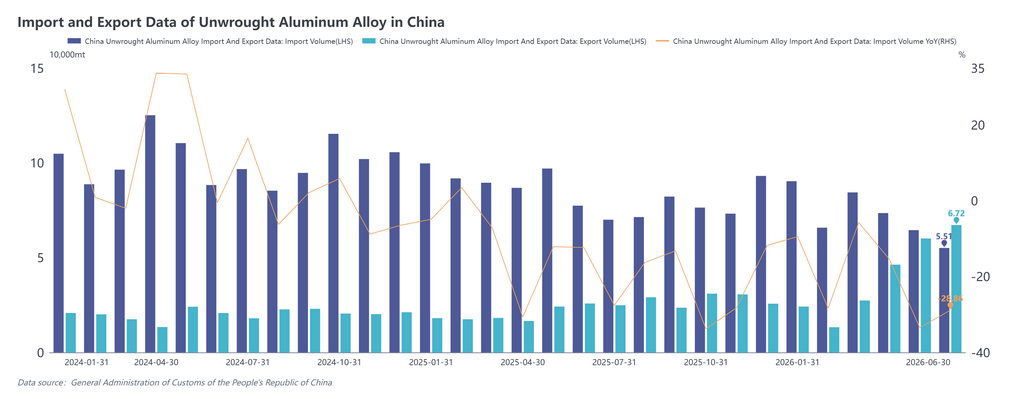
In June 2026, unwrought aluminum alloy imports were 55,100 mt, down 28.9% YoY and down 14.7% MoM. From January to June 2026, cumulative imports of unwrought aluminum alloy were 433,500 mt, down 20.0% YoY.
In June 2026, unwrought aluminum alloy exports were 67,200 mt, hitting a new monthly high, surging 160.6% YoY and up 11.7% MoM. From January to June 2026, cumulative exports of unwrought aluminum alloy were 238,500 mt, up 98.3% YoY.
Unwrought Aluminum Alloy Imports by Country, January-June 2026:
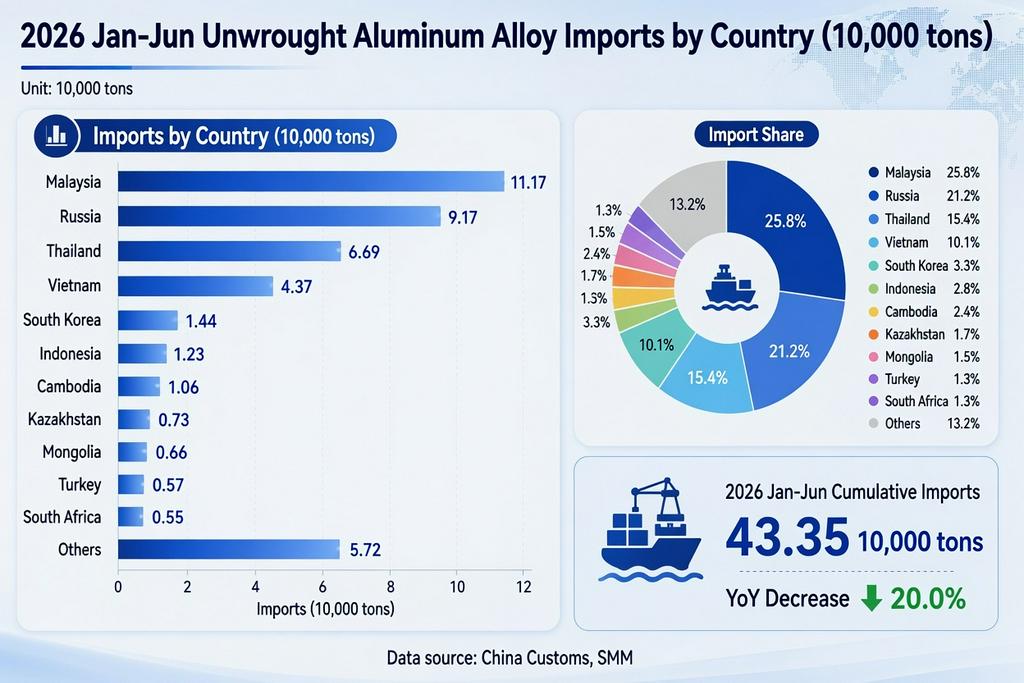
In terms of import sources, in H1 2026, China's unwrought aluminum alloy imports were highly concentrated. The top five source countries—Malaysia, Russia, Thailand, Vietnam, and South Korea—together accounted for 328,400 mt, or 75.8% of the total. Malaysia ranked first with 111,700 mt (25.8%), Russia followed with 91,700 mt (21.2%), Thailand and Vietnam accounted for 15.4% and 10.1%, respectively, and South Korea ranked fifth with 3.3%. By region, Southeast Asian countries (Malaysia, Thailand, Vietnam, Indonesia, Cambodia, the Philippines, Myanmar, and Laos) together accounted for approximately 254,000 mt, representing 58.6% of China's total imports, while Russia contributed 21.2%. Together these two accounted for nearly 80%, indicating that imports were heavily reliant on the two core areas of Southeast Asia and Russia. The remaining over 60 countries and regions supplied very little, with no single country exceeding 10,000 mt or 2% share, and the vast majority falling below 5,000 mt.
Unwrought Aluminum Alloy Exports by Country and Trade Mode, January–June 2026:
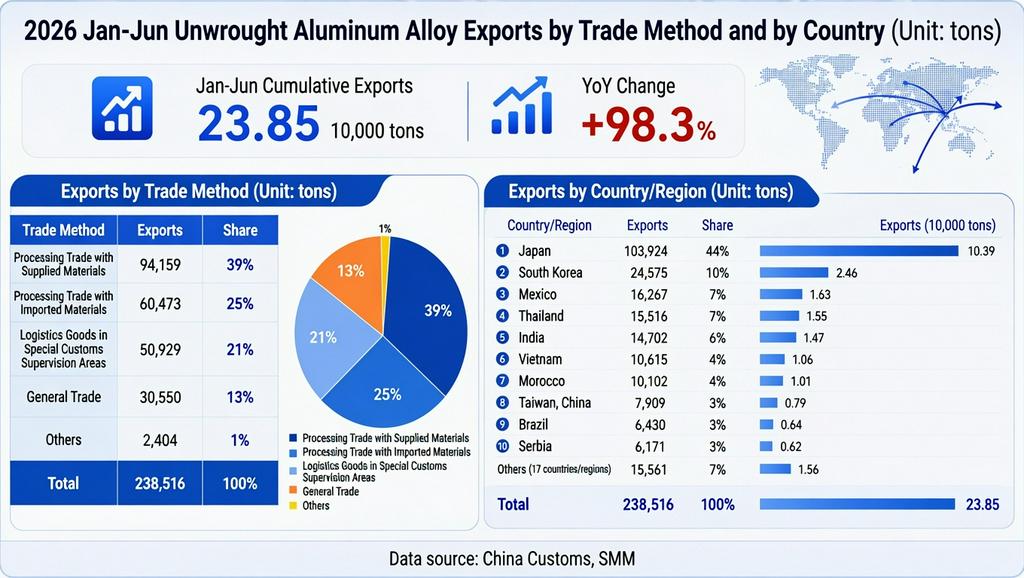
In H1 2026, China's unwrought aluminum alloy export structure underwent a notable shift compared to 2025, mainly in two dimensions: trade mode and export destination.
In terms of trade mode, exports in 2025 remained highly dependent on processing trade with supplied materials, which accounted for as much as 51%. In January–June 2026, the share of processing trade with supplied materials fell to 39%, processing trade with imported materials rose to 25%, and ordinary trade climbed rapidly from less than 1% to 13%, becoming a key driver of export growth.
By export destination, market concentration declined somewhat. In 2025, Japan accounted for 52% of China's total unwrought aluminum alloy exports, indicating high reliance on a single market. In January–June 2026, Japan's share pulled back to 44% but it remained the top export market. For other markets, South Korea's share rose from 4% to 10%, Thailand's from 2% to 7%, and Mexico emerged as the third-largest export destination. Exports to emerging markets such as Morocco and Serbia also expanded notably. Overall, export markets are shifting from the traditional East Asian region to North America, Southeast Asia, and North Africa.
Overall, in H1 2026, China's imports and exports of unwrought aluminum alloy exhibited a pattern of "shrinking imports and expanding exports".
Import side: import profit remained inverted, with imports down 20% YoY.
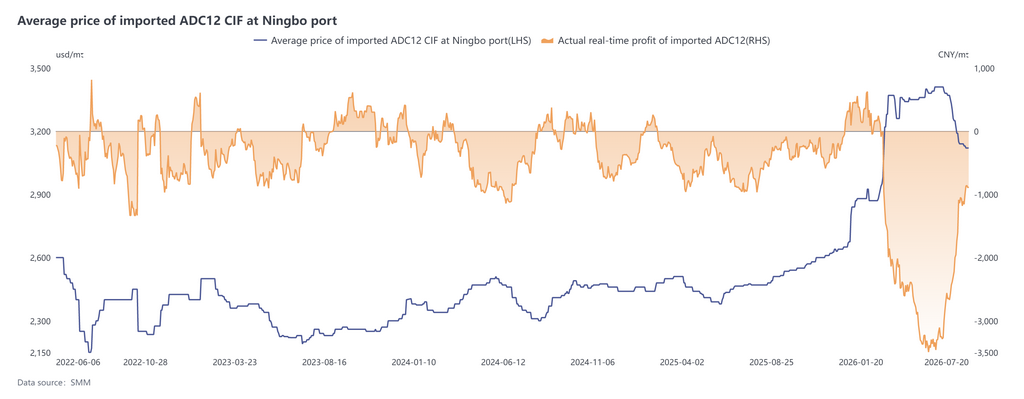
In H1, affected by high overseas raw material costs and persistently inverted import profit, cumulative imports of unwrought aluminum alloy reached 433,500 mt, down 20.0% YoY. In terms of prices, geopolitical tensions in the Middle East briefly pushed up LME aluminum prices, driving overseas ADC12 quotes to stay high, with import losses peaking at over 3,500 yuan/mt. Entering Q2, as overseas quotes pulled back and China's price center rose, import losses narrowed somewhat, but the import window never effectively opened, leaving import inflows constrained and volumes continually low. Entering July, overseas ADC12 quotes further pulled back to $3,050-3,160/mt, and the price spread between Chinese and overseas markets continued to improve. If overseas quotes remain weak subsequently, while China's prices stay relatively firm supported by factors such as tightness in tax invoices, the import profit window is expected to gradually open, at which point incremental imports will provide some supplement to the Chinese market.
Export side: the combined effect of the price spread advantage and tight overseas supply-demand dynamics pushed exports to a record high for the same period in recent years.
In H1, driven by tight overseas supply, growing international procurement demand, and the sustained release of the price spread advantage between Chinese and overseas markets, cumulative exports of unwrought aluminum alloy reached 238,500 mt, up 98.3% YoY, a record high for the same period in recent years. Looking ahead to H2, as overseas quotes pull back, the spread between Chinese and overseas markets narrows, and overseas supply gradually recovers, export profit margins have already been compressed compared to Q2. Exports are expected to remain at a relatively high level, but against the backdrop of a high base and a weakening price spread advantage, export growth will slow from H1.