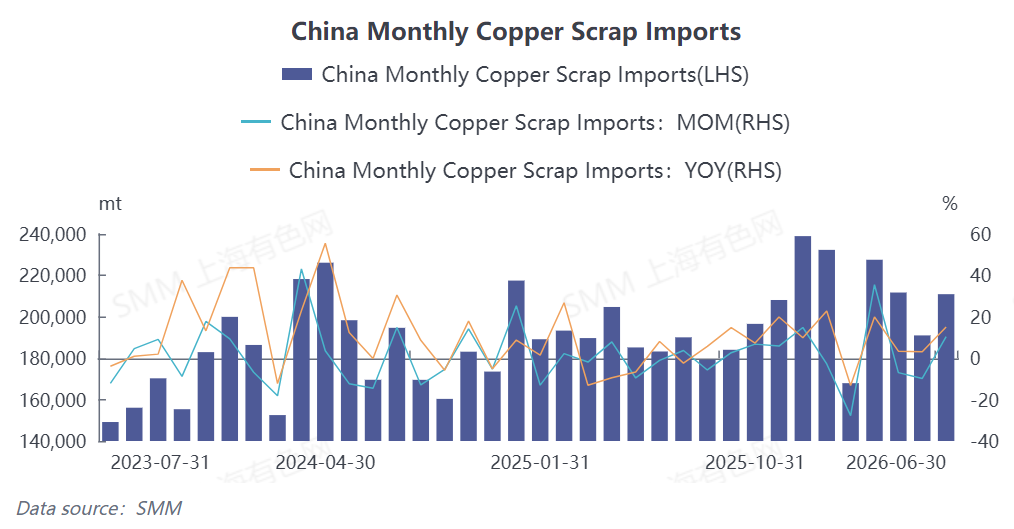
According to the latest data from the General Administration of Customs, in June 2026, China imported 210,900 mt in physical content of copper scrap and shredded copper scrap, up 10.43% MoM and up 15.11% YoY. In January-June 2026, cumulative imports reached 1.2415 million mt in physical content, up 8.39% YoY.
In June, the concentration of copper scrap import sources remained high, with Thailand, Japan, and South Korea continuing to hold the top three positions. Multiple countries achieved explosive growth in supplies, further broadening import channels.
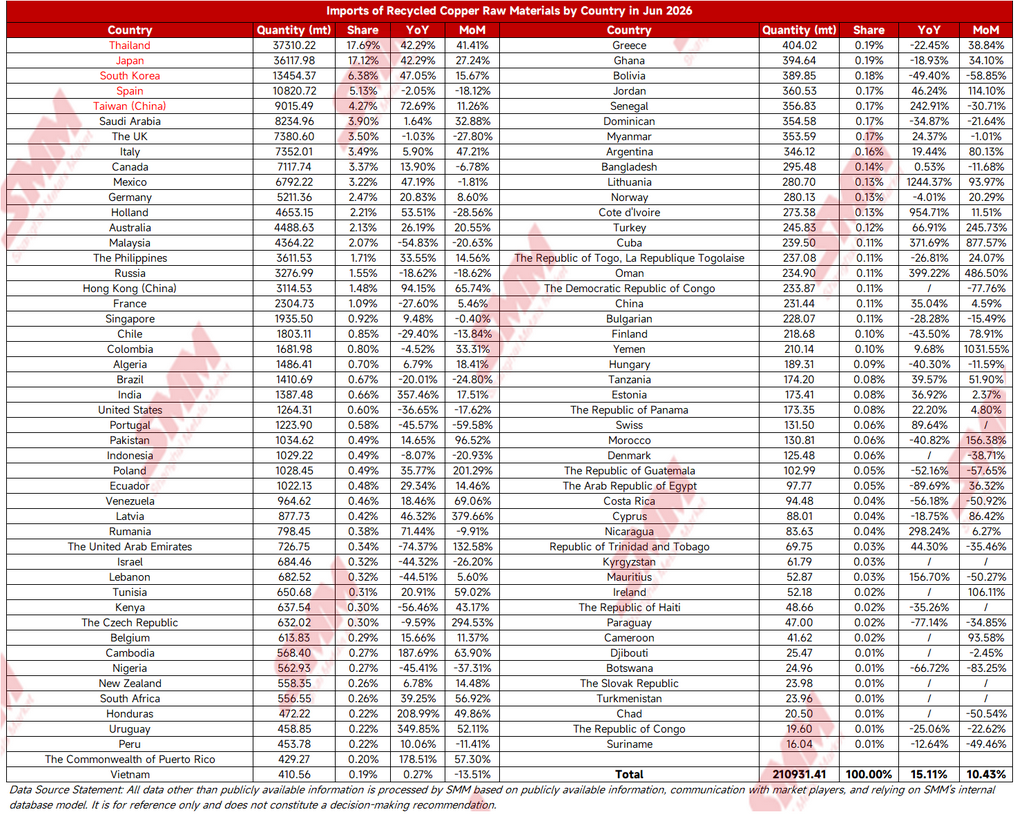
Thailand: In June, imports of copper scrap from Thailand totaled 37,300 mt in physical content, representing 17.69% of total imports, surging 42.29% YoY and up 41.41% MoM. Thailand’s supply recovered markedly in June, with YoY growth remaining high, continuously providing stable materials for China’s secondary copper market and serving as the core support for this month’s import growth.
Japan: In June, exports to China reached 36,100 mt in physical content, accounting for 17.12% of the total, up 42.29% YoY and up 27.24% MoM.
South Korea: In June, exports to China reached 13,500 mt in physical content, representing 6.38%, surging 47.05% YoY and up 15.67% MoM. It has sustained high YoY growth for several consecutive months, with stable incremental contributions.
Supply potential from Southeast Asian countries other than Thailand was released in a concentrated manner: in June, imports from Thailand, Malaysia, the Philippines, and Vietnam all maintained positive growth. Notably, emerging Southeast Asian suppliers beyond Thailand stood out: imports from Saudi Arabia reached 8,200 mt, up 1.64% YoY and jumping 32.88% MoM; imports from Yemen totaled 210.14 mt, up only 9.68% YoY but skyrocketing 1,031.55% MoM.
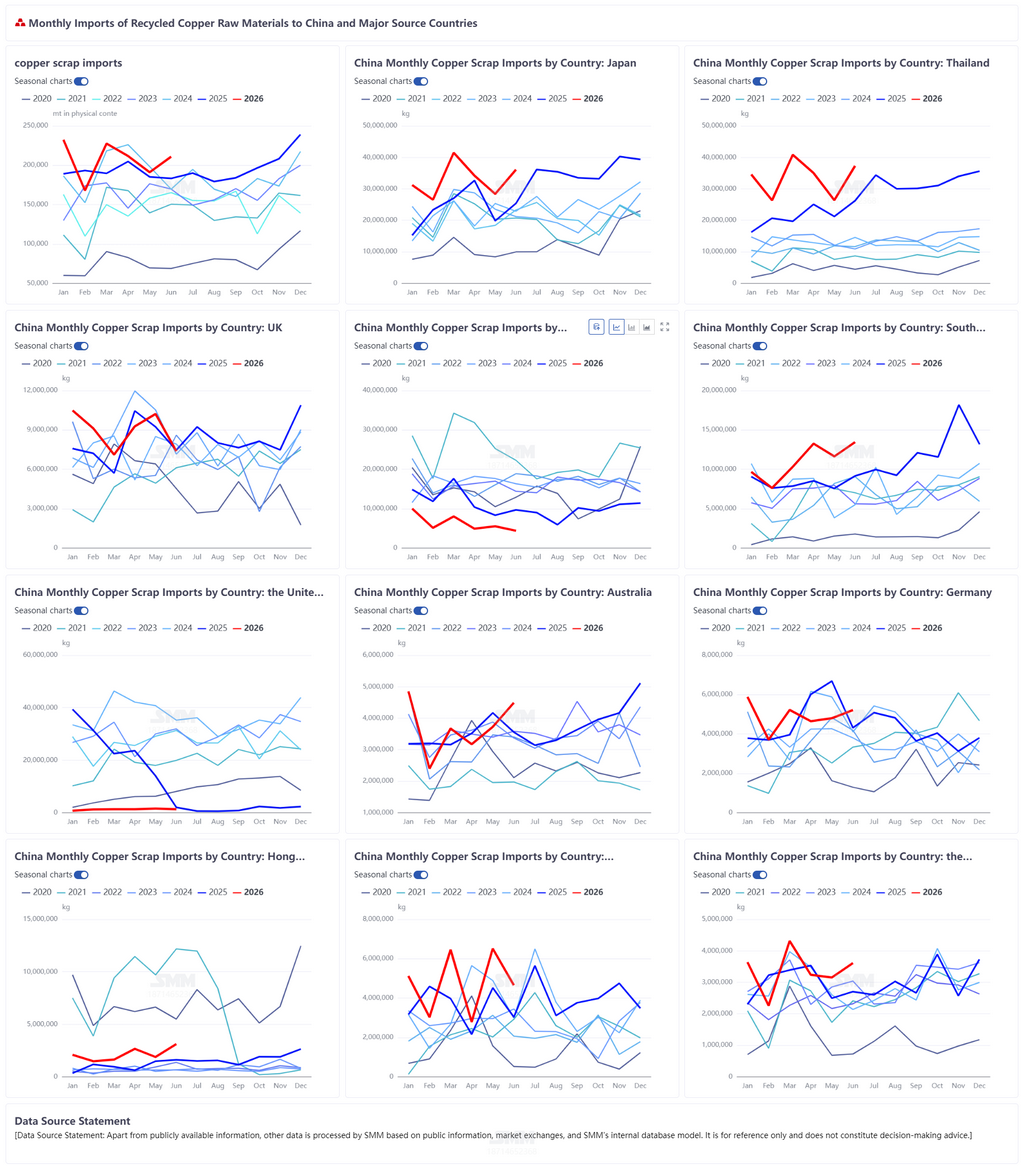
Domestic rigid procurement demand for compliant raw materials continued to be unleashed: the structural contradiction in invoices within China’s secondary copper industry has not eased materially, and the circulation of domestic duty-paid compliant copper scrap remains tight, with domestic trade raw material prices staying elevated. Downstream enterprises such as secondary copper rod, copper billet and bar, and secondary copper smelting, in order to meet environmental and tax compliance requirements for production, have a persistent rigid demand for imported copper scrap with complete customs documents, driving monthly imports higher MoM. Shipment pace from key suppliers recovers, and the earlier supply deficit is filled: In April, shipments from the two major sources—Thailand and Japan—both declined MoM, dragging down overall imports that month. By June, container shipments from Japan, South Korea, and Thailand arrived in China in batches, supplemented by new supplies from the Middle East and Southeast Asia arriving simultaneously, making up for the earlier gap and driving a notable MoM rebound in overall imports.
Imports maintained YoY growth, but key market constraints persist: Although June imports posted 10.43% YoY growth, the core contradiction of “high raw material costs and weak end-use consumption” remains unresolved, continuing to limit the room for significant import expansion.
First, LME copper prices consolidated at highs. Overseas secondary copper traders showed a strong willingness to hold prices firm, with the bare bright copper purchase coefficient staying high. Profit margins for import trade continued to shrink, and large traders remained cautious about bulk stockpiling and aggressive purchasing, mostly maintaining a purchase-as-needed approach.
Second, traditional downstream copper end-user sectors, such as real estate, home appliances, and plumbing hardware, lacked sufficient recovery momentum. Finished product orders were generally mediocre. Domestic secondary copper processing enterprises faced sluggish sales of finished products, leading to accumulation of finished product inventories. As a result, enterprises had limited motivation to restock aggressively, capping the growth ceiling for imports.
Third, traditional mainstream suppliers in Europe and the US saw divergent supply, making it difficult to provide sustained incremental support. Import growth increasingly relied on emerging markets in Southeast Asia and the Middle East.
Based on June import data, SMM expects copper scrap imports in July and August to continue to consolidate at highs, with no sustained sharp rally likely. The core logic supporting imports remains unchanged: the structural deficit in China’s tax-compliant secondary copper cannot be alleviated in the short term, and smelters’ just-in-time procurement needs persist; capacity in emerging supplier countries in Southeast Asia, the Middle East, and Africa continues to be released, and diversified sources will keep supplementing the Chinese market, making a sharp pullback in imports unlikely. (Please see below for June copper scrap import data by country.)