SMM July 17 –
This week (July 13-16), the copper scrap market operated under the triple framework of copper prices retreating after a rapid rise, continued reverse invoicing compliance constraints, and a deepening hot-weather off-season. The most-traded SHFE copper contract surged to 105,020 yuan/mt mid-week, gaining nearly 2,000 yuan/mt for the entire week compared with the start of the week. However, copper scrap received support from compliance costs and suppliers holding prices firm against declines, with its price fluctuating less than 1,000 yuan/mt for the whole week. The price spread between copper cathode and copper scrap widened from 2,445 yuan/mt at the start of the week to 3,925 yuan/mt, up over 2,200 yuan/mt from the previous weekend. The widening was entirely driven by the unilateral rise in copper cathode. Copper scrap’s resistance to declines was the core feature of this week’s supply side, which also directly triggered hedging-based purchase demand from secondary copper rod enterprises.
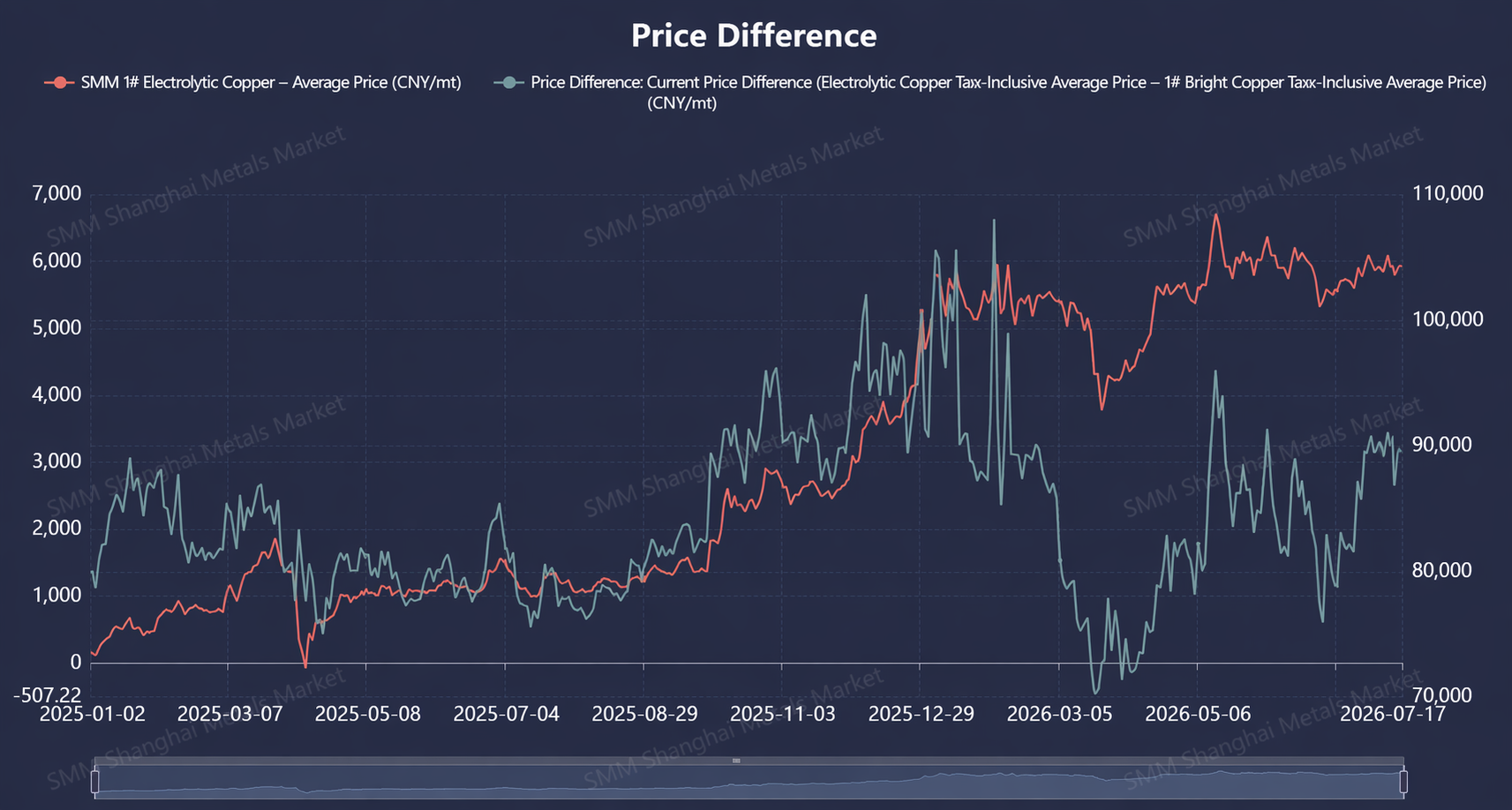
On the supply side, the structural tightness that has persisted since 2026 continued. The underlying constraints were, first, reverse invoicing compliance requirements: in south China’s Jiangxi and Hubei and other regions, the aftermath of compliance inspections had not yet dissipated, and invoice quotas in places like Shuyang, Jiangsu remained restricted, leaving available compliant and deductible copper scrap persistently tight; second, after Document No. 770 at the end of 2025 cleared local illegal tax rebates, small and medium-sized copper scrap traders that previously relied on subsidies and incentives had been exiting the market, and overall available supply contracted significantly compared with the same period in previous years. Combined with suppliers generally holding the psychological defense of “not selling cheaply before breaking 100,000 yuan,” shipment pace throughout the week entirely followed copper price fluctuations: at the start of the week, when copper prices pulled back, holding back from selling sentiment was strong, market available supply was tight, and secondary copper rod enterprises had difficulty sourcing low-priced material; mid-week, after copper prices surged above 105,000 yuan/mt, suppliers’ willingness to sell at fixed prices increased, yet due to weak off-season orders in downstream scrap-consuming sectors and low acceptance of high-priced material, shipments did not surge. Most of the material was purchased by secondary copper rod enterprises based on a hedging logic of “buy raw material and sell futures,” rather than for actual production restocking. Many rod enterprises stopped quoting prices after purchasing enough to meet their daily needs in the morning session, without chasing higher prices to take delivery. At the end of the week, copper prices consolidated and pulled back, and suppliers returned to holding back from selling, tightening available supply again. Regional divergence persisted. In the south, due to compliance costs and slow capital turnover, purchase prices for bare bright copper were 400–600 yuan/mt lower than in the north. The unusual structure of different prices for the same material continued. Traders still maintained a fast-in-fast-out low inventory strategy, not daring to stockpile in anticipation of price rises. The issue of payment collection cycles being extended to over two weeks remained unresolved, further limiting the elasticity of supply release. On the demand side, overall weakness persisted. Secondary copper rod enterprises received few new orders throughout the week. Although the price spread between copper cathode rod and secondary copper rod surged to 1,510 yuan/mt mid-week, hitting the economic threshold, it lacked sustainability and fell back to 950 yuan/mt by the weekend. Moreover, secondary copper rod remained at a premium to futures due to rigid raw material costs. End-user wire and cable enterprises also had weak new orders, still holding a wait-and-see expectation that “copper prices still have downside room,” with procurement mainly in rigid-demand pulses. Copper scrap transactions for the week were largely driven by copper price fluctuations and hedging demand, with very little restocking for actual production. After copper prices pulled back at the end of the week, rod enterprises’ purchase willingness weakened further. The market as a whole exhibited a weak equilibrium of “when copper prices rise, suppliers sell and rod enterprises buy for hedging; when copper prices fall, suppliers hold back and rod enterprises wait for even lower levels.”
The market currently remains constrained by the dual pressures of invoice compliance and off-season demand. Going forward, if the price difference between copper cathode and copper scrap stabilizes above 1,500 yuan/mt and the implementation guidelines for reverse invoicing become clearer, this may drive the release of some rigid demand; otherwise, the sluggish trading pattern will persist.

![Spot Transactions of Imported Copper Concentrates Increase, TCs Continue to Deteriorate [SMM Copper Concentrate Spot Weekly Review]](https://imgqn.smm.cn/usercenter/ULCXN20251217171714.jpeg)