Copper Prices Face Geopolitical and Macro Challenges, Supply Disruptions Drive Upward Momentum

Published: Jul 13, 2026 13:11
Looking ahead to H2, macro attention should be on the US Fed’s subsequent interest rate hike moves and the pending results of the Section 232 tariff survey.

Q1: Geopolitical and Macro Tug-of-War, Destocking and Stockpiling Consolidate at Lows

Macro shocks and retreat after rapid rise: At the start of the year, capital inflows drove futures to briefly break through the 110,000 yuan/mt mark. Warsh was subsequently nominated as Fed Chairman, and expectations for a strong US dollar quickly pushed copper prices to retreat under pressure.

Fundamentals provided support and stabilization at lows: At quarter-end, the US dollar index weakened from highs, and with the launch of China’s stockpiling spree and social inventory of copper cathode entering a rapid destocking phase, spot buying effectively supported prices.

Q2: Supply Disruptions Drive Upward, Tariff Expectations Set the Tone for Consolidation at Highs

Ore supply tightness and momentum-driven breakthrough: In April, destocking logic persisted and futures held steadily above the 100,000 yuan/mt mark. In May, production resumptions at the Grasberg mine fell short of expectations, reigniting the narrative of ore supply contraction and driving a rapid rise in copper prices.
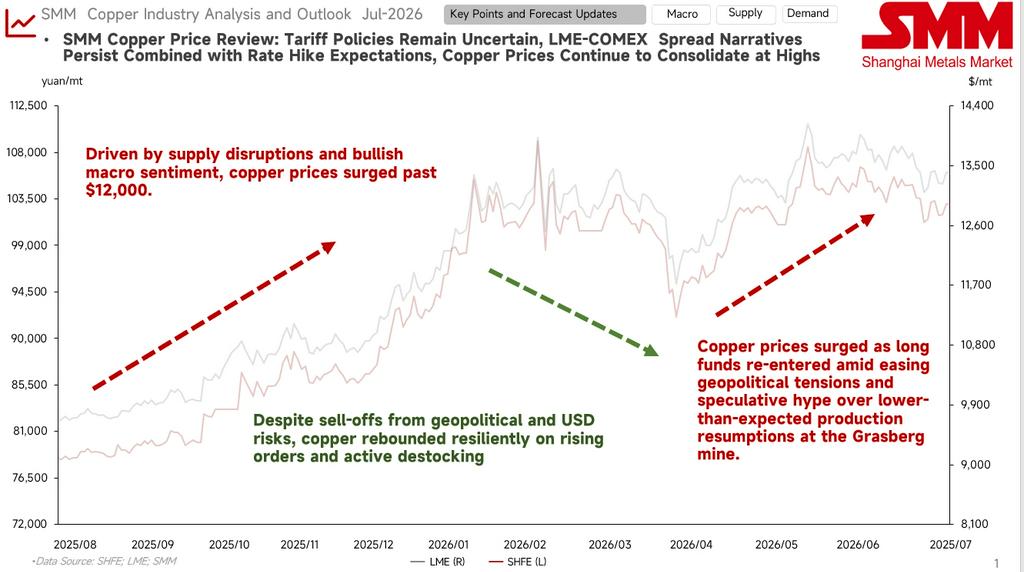


LC arbitrage and long-short stalemate: In June, with US copper tariff policy still up in the air, market pricing in advance caused the LC spread (COMEX-LME) to widen significantly. Cross-market arbitrage funds and expectations for restocking in the US market provided downside support for futures. However, as expectations for US Fed interest rate hikes later in the year heated up, coupled with China entering the traditional consumption off-season, sharp upward resistance emerged, and prices settled at 103,000 yuan/mt.

The current tug-of-war between longs and shorts in the copper market is intense, with an overall pattern of "support from below, resistance from above."

Bullish factors: Cooling US nonfarm payrolls has marginally eased macro pressure; doubts about mine production resumptions and early restocking triggered by tariff uncertainty have built a solid bottom for copper prices.

Bearish factors: Sticky inflation causes expectations for rate hikes to recur; as July enters the consumption off-season, high prices severely dampen downstream demand in traditional sectors, limiting upside momentum.


Based on fundamental data, are H2 copper prices "more likely to rise than fall"?

Ore supply disruptions are more likely than new additions.

Global copper cathode production continues to increase, with high expansion demand in China.

Copper demand growth in emerging sectors provides support, and traditional consumption takes over when copper prices are low.

Copper scrap remains overall influenced by policies, with selling sentiment depending on copper prices.


Mine disruptions are frequent, and currently TC/RCs continue to weaken, repeatedly hitting new historical lows; year-end negotiations without a fixed Benchmark have left the market unable to maintain an optimistic outlook on the ore supply situation.

In 2025, global copper cathode production distribution continued to concentrate in China. Smelting capacity further concentrated in a few regions, increasing industry concentration. Comparing annual averages, the dispersion in 2026 is already lower than the three-year average for 2022–2025. In terms of production changes, China's new production release in 2026 is expected to contribute 704 kt of growth, far exceeding other countries; while Japan, South Korea, Chile, and others show negative growth, partly due to technological transformation of aging facilities or raw material supply constraints. The DRC region maintains a relatively high growth rate, with an expected incremental production of 221 kt. Looking ahead, copper smelting profit in Q3 will maintain a hedging pattern of “strong sulphuric acid support, deeply negative TC,” with overall smelting profit remaining positive but already in the top range of this cycle. If high sulphuric acid prices persist into the peak season, the profit window may be extended longer than expected; however, once supply recovers and demand turns weak, the copper smelting loss pressure previously masked by high acid prices will re-emerge, and the risk of industry chain transmission warrants high vigilance.

Supply side, the main contradiction still lies on the ore side. Demand side, global demand continues to be driven by growth in emerging sectors; copper still has momentum to move higher amid the AI and other technology narratives, but this needs to be accompanied by macro sentiment.

Looking ahead to H2, macro attention should be on the US Fed’s subsequent interest rate hike moves and the pending results of the Section 232 tariff survey. The subsequent trend of high COMEX inventory and the year-end global annual long-term contract negotiations for ore and copper cathode will also be a focus. Fundamentals side, currently downstream acceptance at 103,000 yuan/mt is moderate, but when approaching the 100,000 level, end-user ordering sentiment is high, and the 100,000 level shows strong resistance to declines.


Data Source Statement: Except for publicly available information, all other data are processed by SMM based on publicly available information, market communication, and relying on SMM's internal database model. They are for reference only and do not constitute decision-making recommendations.

For any inquiries or for more information, please contact: lemonzhao@smm.cn
For more information on how to access our research reports, please contact:service.en@smm.cn
Related News
Barrick's Lumwana Expansion in Zambia on Track for Q1 2028 Copper Production
7 mins ago
Barrick's Lumwana Expansion in Zambia on Track for Q1 2028 Copper Production
Read More
Barrick's Lumwana Expansion in Zambia on Track for Q1 2028 Copper Production
The Lumwana Super Pit Expansion in Zambia remains on schedule, with first copper production targeted for the end of Q1 2028, keeping one of the country’s largest copper growth projects on its planned development timeline. According to the latest quarterly update from Barrick Mining Corporation, construction advanced during Q2 2026, with the second lift of the mill walls and roller slab completed and civil works for the primary crusher progressing. Civil construction also commenced on the transfer towers for the overland conveyor system. Most major long-lead equipment is now on site, including the mill shells and trunnions, primary crusher and tailings thickener. The expansion is expected to substantially increase Lumwana’s processing capacity and lift average annual copper production to around 240,000 tonnes once completed. The additional output would strengthen Lumwana’s role in Zambia’s medium-term copper supply growth and provide a significant contribution toward the country’s broader production expansion ambitions. From a copper supply perspective, maintaining the Q1 2028 first-production target improves visibility over Zambia’s medium-term mine supply pipeline. The project is particularly significant as Zambia seeks to translate a growing pipeline of mine expansions and new developments into sustained increases in national copper output. Continued progress at Lumwana will therefore be an important indicator of Zambia’s ability to deliver the next wave of additional mined copper supply from 2028 onward.
7 mins ago
India Explores Chilean Copper Supply to Boost Domestic Industry Amid Rising Demand
3 hours ago
India Explores Chilean Copper Supply to Boost Domestic Industry Amid Rising Demand
Read More
India Explores Chilean Copper Supply to Boost Domestic Industry Amid Rising Demand
According to foreign media reports, India's state-owned Hindustan Copper is exploring plans to supply copper concentrate sourced from Chilean state miner Codelco to domestic producers Hindalco Industries and Adani, as India seeks to secure raw materials for its expanding copper industry. Hindustan Copper, Coal India and NTPC Mining are reportedly assessing opportunities involving four copper mining blocks held by Codelco in Chile. Hindustan Copper signed a preliminary cooperation agreement with Codelco in 2025, followed by a non-disclosure agreement in May 2026, with due diligence now underway. The move comes against a widening gap between India's copper consumption and domestic supply. India currently produces around 573,000 mt of refined copper annually, while domestic demand is estimated at approximately 1.8 million mt. Government estimates suggest that the country could eventually depend on imports for 91%-97% of its copper concentrate requirements by 2047. India has been expanding domestic copper smelting and refining capacity as electricity infrastructure, renewable energy, manufacturing and transport increase demand for the metal. However, expanding processing capacity without a corresponding increase in domestic mine supply increases the country's exposure to the international concentrate market. Securing access to Chilean resources could therefore provide Indian smelters with greater long-term supply security while reducing reliance on spot concentrate purchases. Market Impact: India's push into overseas copper resources could introduce additional competition for internationally traded concentrate at a time when mine supply growth is struggling to keep pace with expanding global smelting capacity. As India builds out its copper processing industry, its growing requirement for imported feedstock could increasingly influence Asian concentrate trade flows and competition for long-term supply contracts.
3 hours ago
Copper Price Spread Widens, but Scrap Consumption Lags Due to Tax Compliance Issues
3 hours ago
Copper Price Spread Widens, but Scrap Consumption Lags Due to Tax Compliance Issues
Read More
Copper Price Spread Widens, but Scrap Consumption Lags Due to Tax Compliance Issues
【SMM Copper Scrap Flash】 The price difference between primary metal and scrap has historically been the "thermometer" for the secondary copper industry, and its widening typically effectively boosts copper scrap consumption. According to SMM, after end-June 2026, copper prices rose, and the price spread between primary metal and scrap expanded from less than 1,000 yuan/mt to around 4,400 yuan/mt, at a historically relatively high level. However, copper scrap consumption did not show a synchronized strong uptrend, and the indicator showed a "divergence," mainly disrupted by tax compliance factors: First, after the implementation of reverse invoicing, the circulation of uninvoiced copper scrap was hindered. The number of compliant individual accounts is limited, and the additional compliance cost is difficult to pass on downstream. Scrap utilization enterprises can only pass the pressure upstream by lowering the purchase price of copper scrap. Second, the supply of domestically produced, tax-inclusive copper scrap is scarce, and enterprises scramble for input VAT invoices. The invoice tax rate rose from 10.5% to 11.5%-12%, while the finished secondary copper rod sector faced fierce competition and could not raise prices, prompting enterprises to further depress raw material purchase prices. In summary, the rapid expansion of the price difference between primary metal and scrap in this round was not driven by demand; rather, it resulted from tax costs being passed upstream along the industry chain to the copper scrap side.
3 hours ago
Copper Prices Face Geopolitical and Macro Challenges, Supply Disruptions Drive Upward Momentum - Shanghai Metals Market (SMM)