2026 China's Copper Anode Market H1: Supply Contraction Reverses the Pattern [SMM Analysis]

Published: Jul 7, 2026 19:54
SMM Analysis: In H1 2026, the core operating logic of China’s copper anode market can be summarized as follows: overseas project startups drove a recovery in imports, but the tightening of domestic secondary copper policies rapidly shifted the supply-demand pattern from a surplus in Q1 to tightening in Q2...

SMM July 7 News:

I. China's H1 Market Review

Imports: Recovery Growth, with Africa Driving the Increment

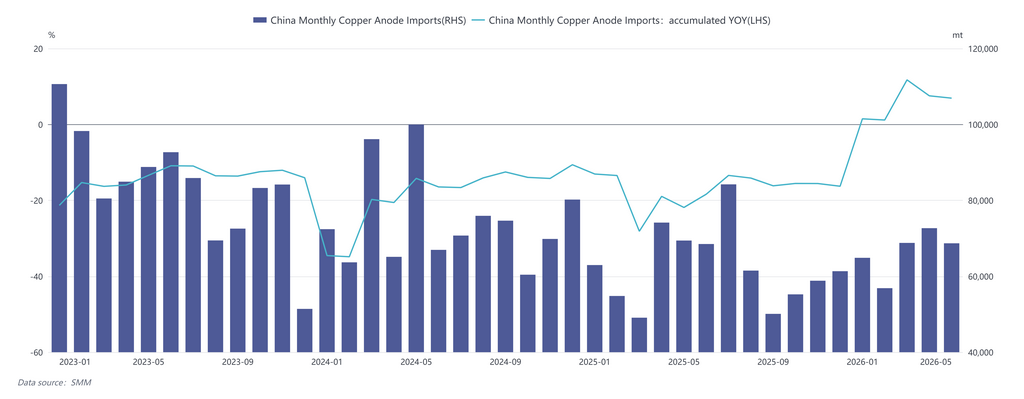
China's copper anode imports totaled 331,900 mt in January-May 2026, up 6.92% YoY, reversing the sluggish trend of a 15.88% YoY decline in full-year 2025. On a monthly basis, imports followed a "low-high-then-pullback" trend. The import source structure underwent significant changes. Zambia remained the top source, but its share gradually pulled back from 53% at the start of the year to around 40% in May. The DRC emerged as the largest source of increment, with its share of exports to China rapidly climbing from less than 10% in January to 22.60% in May, supported by continuous ramp-up of the Kamoa copper smelting project (with an annual blister capacity of 500,000 mt), and its YoY growth once exceeded 250%. In contrast, Chilean material continued to shrink due to persistent import price inversions, with its share falling to 4.48% in May.
Domestic Supply and Demand: Rapid Reversal from Easing to Tightening

The evolution of the domestic supply-demand pattern in H1 can be divided into two phases:

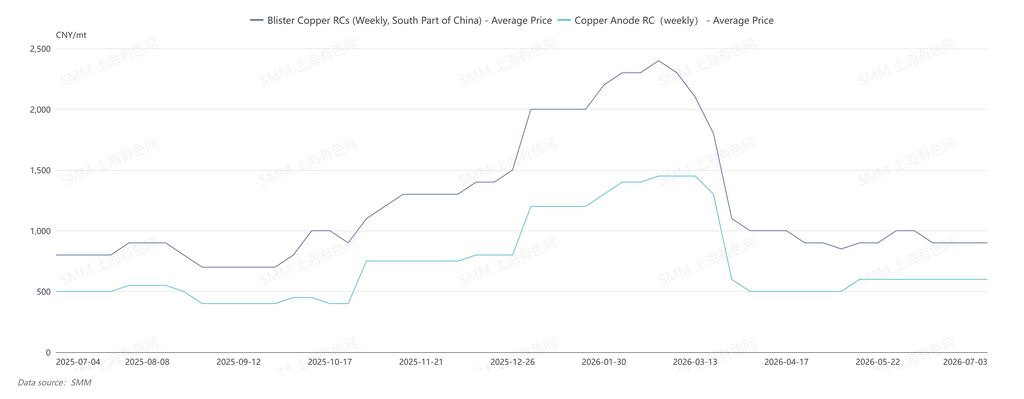
Q1 easing phase: Supply of scrap-derived blister copper and anode plates remained ample, extending the abundant state from the end of 2025. Smelters held high cold material inventories, and spot blister copper RCs in south China operated at high levels of 1,800-2,000 yuan/mt. Under the loose pattern, market reliance on imported copper anode temporarily declined.

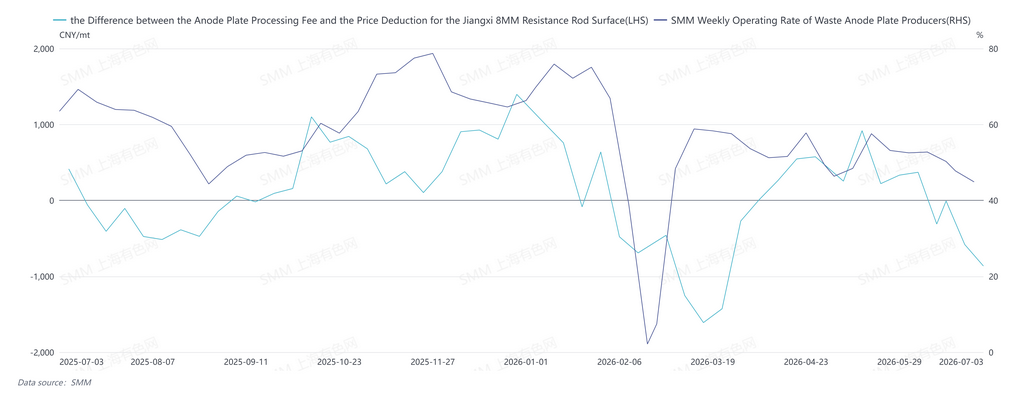
A turning point emerged in mid-to-late March: as copper prices fell below the 100,000 yuan/mt mark, the price spread between primary metal and scrap narrowed rapidly. At the same time, industry policies tightened intensively—stricter compliance inspections for secondary copper and reduced financial support squeezed scrap-derived copper anode producers with high raw material costs, quickly eroding their production willingness and causing market supply to start contracting.

Q2 tightening phase: The supply-demand imbalance erupted intensively in Q2. The overall operating rate of SMM copper anode enterprises dropped from 50.42% in March to 45.95% in June, with the scrap-derived segment declining from 40.58% to 36.00%. Meanwhile, Q2 coincided with concentrated maintenance among domestic smelters, which instead increased their external procurement needs for cold material. Supply contraction and demand pulse moved in opposite directions within the same window, sharply widening the supply-demand gap. The monthly average of spot blister copper RCs in south China plunged to 950 yuan/mt in April, down 850 yuan/mt MoM, and further declined to 900 yuan/mt in May.
II. Analysis of Key Drivers Behind Supply-Demand Changes

(1) Tightening of secondary copper policies is the primary variable for supply contraction

The core driver of the supply-demand pattern reversal in H1 came from policy shocks to the secondary copper industry. Purchasing activities for secondary smelting enterprises were hindered, accompanied by a simultaneous reduction in supportive financial policies. The markets for tax-included and non-tax-included raw materials became notably polarized, which became the primary reason for enterprises to cut or halt production.

(2) Narrowing price spread between primary metal and scrap amplified supply imbalances

As copper prices lacked upward momentum, the price spread between primary metal and scrap narrowed rapidly. Copper scrap suppliers held back from selling, making it difficult to support a large inflow of secondary copper into the smelting segment, accelerating the reversal of the supply-demand pattern.

(3) Extremely low TCs pushed up cold material reliance from the cost side

Copper concentrate TCs continued to deteriorate in 2026. Against this backdrop, smelters proactively adjusted their raw material mix, increasing the usage ratio of cold materials such as copper scrap and copper anode. This substitution logic provided rigid and continuously expanding bottom support for copper anode demand.
III. H2 Outlook
H2 imports are expected to face pressure: Zambia’s scheduled maintenance of crude smelting capacity will extend into Q3, while rising demand from countries such as India intensifies competition for copper anode supply.

China's supply: The core variables on the domestic supply side remain the direction of secondary copper policies and the price difference between primary metal and scrap. The structural shortage of tax-inclusive copper scrap is hard to improve before any substantial policy relaxation, keeping the supply elasticity of scrap-derived copper anode constrained; under this condition, RC also face difficulty rebounding significantly. If policy easing emerges at the margin in H2, supply from the scrap-derived segment is expected to recover; otherwise, the tight supply pattern will persist.

China's demand: The demand side remains supported: low TC levels continue to boost substitution demand for cold materials; the medium and long-term trend of expanding refined copper capacity remains unchanged, and the raw material deficit persists.

IV. Summary

In H1 2026, the core operating logic of China’s copper anode market can be summarized as follows: overseas project startups drove a recovery in imports, but the tightening of domestic secondary copper policies rapidly shifted the supply-demand pattern from a surplus in Q1 to tightening in Q2. In H2, barring any policy stimuli, domestic supply elasticity remains limited, while smelters’ substitution demand for cold materials stays strong, keeping the overall market in a tight balance.

In the long term, the structural contradiction of refined copper capacity growth persistently outpacing crude smelting capacity growth persists, and the market position of copper anode as a key supplementary raw material will continue to strengthen. The rising share of scrap-derived copper anode, diversification of import sources, and the evolution of the supply system characterized by “supplementing ores with scrap” and “supplementing external sources with domestic sources” represent the core directions of copper anode market development.

Data Source Statement: Except for publicly available information, all other data are processed by SMM based on publicly available information, market communication, and relying on SMM's internal database model. They are for reference only and do not constitute decision-making recommendations.

For any inquiries or for more information, please contact: lemonzhao@smm.cn
For more information on how to access our research reports, please contact:service.en@smm.cn
Related News
Resolution Copper Awards $110M in Contracts for Arizona Mine Development
2 hours ago
Resolution Copper Awards $110M in Contracts for Arizona Mine Development
Read More
Resolution Copper Awards $110M in Contracts for Arizona Mine Development
According to foreign media reports, Resolution Copper has awarded approximately $110 million in drilling and underground development contracts as work advances at its proposed copper mine in Arizona, one of the world’s largest undeveloped copper deposits. Major Drilling America will undertake deep-hole directional diamond core drilling over the next two-and-a-half years, including drilling from the surface and from approximately 6,800 feet underground. Four large surface drilling rigs are planned for the programme, with two already on site and another two expected by the end of 2026. Redpath USA Corporation will undertake the first phase of underground development, including converting two existing shafts, each approximately 7,000 feet deep, for development activities. The contractor will also install underground infrastructure, construct a mine station at around 6,800 feet below surface and develop approximately 1,500 feet of new tunnels and supporting facilities. The contracts form part of an early phase of Resolution Copper’s planned $500 million investment programme, following completion of key environmental review and land-exchange processes earlier this year. The project is jointly owned by Rio Tinto with a 55% stake and BHP with 45%. If developed, Resolution Copper is expected to have the capacity to meet up to a quarter of annual US copper demand. However, a final investment decision remains subject to further data collection, permitting and partner approvals. From a copper-market perspective, the latest contract awards mark another step in advancing a potentially significant source of long-term US mine supply. While commercial production remains dependent on an eventual investment decision and further development, progress at Resolution is increasingly relevant as the US seeks to strengthen domestic copper supply amid rising requirements from power infrastructure, manufacturing and electrification.
2 hours ago
Barrick's Lumwana Expansion in Zambia on Track for Q1 2028 Copper Production
3 hours ago
Barrick's Lumwana Expansion in Zambia on Track for Q1 2028 Copper Production
Read More
Barrick's Lumwana Expansion in Zambia on Track for Q1 2028 Copper Production
The Lumwana Super Pit Expansion in Zambia remains on schedule, with first copper production targeted for the end of Q1 2028, keeping one of the country’s largest copper growth projects on its planned development timeline. According to the latest quarterly update from Barrick Mining Corporation, construction advanced during Q2 2026, with the second lift of the mill walls and roller slab completed and civil works for the primary crusher progressing. Civil construction also commenced on the transfer towers for the overland conveyor system. Most major long-lead equipment is now on site, including the mill shells and trunnions, primary crusher and tailings thickener. The expansion is expected to substantially increase Lumwana’s processing capacity and lift average annual copper production to around 240,000 tonnes once completed. The additional output would strengthen Lumwana’s role in Zambia’s medium-term copper supply growth and provide a significant contribution toward the country’s broader production expansion ambitions. From a copper supply perspective, maintaining the Q1 2028 first-production target improves visibility over Zambia’s medium-term mine supply pipeline. The project is particularly significant as Zambia seeks to translate a growing pipeline of mine expansions and new developments into sustained increases in national copper output. Continued progress at Lumwana will therefore be an important indicator of Zambia’s ability to deliver the next wave of additional mined copper supply from 2028 onward.
3 hours ago
India Explores Chilean Copper Supply to Boost Domestic Industry Amid Rising Demand
6 hours ago
India Explores Chilean Copper Supply to Boost Domestic Industry Amid Rising Demand
Read More
India Explores Chilean Copper Supply to Boost Domestic Industry Amid Rising Demand
According to foreign media reports, India's state-owned Hindustan Copper is exploring plans to supply copper concentrate sourced from Chilean state miner Codelco to domestic producers Hindalco Industries and Adani, as India seeks to secure raw materials for its expanding copper industry. Hindustan Copper, Coal India and NTPC Mining are reportedly assessing opportunities involving four copper mining blocks held by Codelco in Chile. Hindustan Copper signed a preliminary cooperation agreement with Codelco in 2025, followed by a non-disclosure agreement in May 2026, with due diligence now underway. The move comes against a widening gap between India's copper consumption and domestic supply. India currently produces around 573,000 mt of refined copper annually, while domestic demand is estimated at approximately 1.8 million mt. Government estimates suggest that the country could eventually depend on imports for 91%-97% of its copper concentrate requirements by 2047. India has been expanding domestic copper smelting and refining capacity as electricity infrastructure, renewable energy, manufacturing and transport increase demand for the metal. However, expanding processing capacity without a corresponding increase in domestic mine supply increases the country's exposure to the international concentrate market. Securing access to Chilean resources could therefore provide Indian smelters with greater long-term supply security while reducing reliance on spot concentrate purchases. Market Impact: India's push into overseas copper resources could introduce additional competition for internationally traded concentrate at a time when mine supply growth is struggling to keep pace with expanding global smelting capacity. As India builds out its copper processing industry, its growing requirement for imported feedstock could increasingly influence Asian concentrate trade flows and competition for long-term supply contracts.
6 hours ago
2026 China's Copper Anode Market H1: Supply Contraction Reverses the Pattern [SMM Analysis] - Shanghai Metals Market (SMM)