SMM July 2 News:
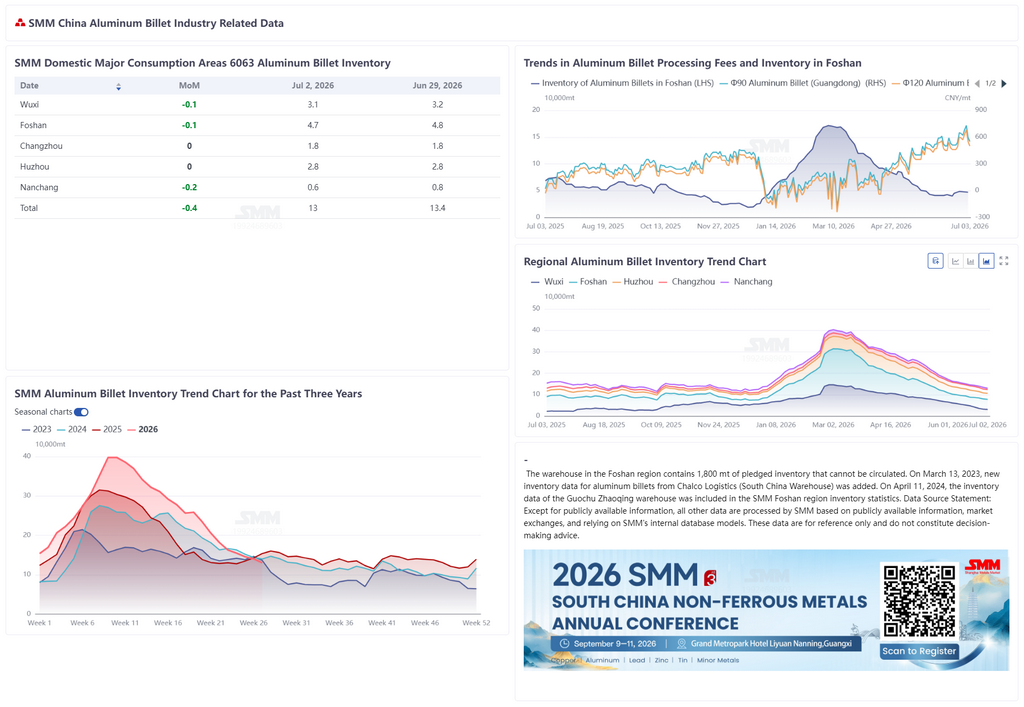
According to SMM statistics, on July 2, aluminum billet inventory in major domestic consumption areas fell to 130,000 mt, down 4,000 mt from last Monday and 10,000 mt from last Thursday, with the pace of destocking visibly accelerating. On a year-over-year basis, it was down 23,500 mt from the same period in 2025 and 9,700 mt from 2024, pushing total inventory to the lowest level for the same period in nearly three years. In terms of warehouse withdrawals, aluminum billet withdrawals totaled 45,300 mt from June 23 to June 29, up 6,500 mt WoW, ending the four-week pullback trend, while market trading activity improved marginally. This week, current aluminum billet inventory fell to the 130,000 mt mark, with inventories in Foshan, Wuxi, and Nanchang all continuing destocking. Nanchang destocked by 2,000 mt, posting the most significant decline. The earlier logic of supply-demand pattern improvement continued to materialize, and inventory entered a sustained destocking trend. Given that current inventory is already at a low for the same period and warehouse withdrawals are stabilizing and rebounding, aluminum billet inventory is expected to pull back further to around 125,000 mt next week, but attention should be paid to whether downstream consumption strength can sustain.
This week, the center of aluminum prices continued to move lower. SMM A00 spot aluminum price fell from 22,850 yuan/mt last Thursday to 22,540 yuan/mt, a cumulative decline of about 310 yuan/mt. Against the backdrop of persistently weakening aluminum prices, processing fees performed divergently across regions, overall fluctuating at highs. By region, in Foshan, φ90 aluminum billet processing fee was 600 yuan/mt and φ120 was 550 yuan/mt, each down 50 yuan/mt from last Thursday. In Wuxi, φ90 was 700 yuan/mt, flat with last Thursday, and φ120 was 480 yuan/mt, down 120 yuan/mt from last Thursday. In Nanchang, φ90 was 700 yuan/mt and φ120 was 650 yuan/mt, flat with last Thursday. From the transaction structure perspective, after the sharp decline in aluminum prices, sentiment for restocking by end-users recovered somewhat. Aluminum billet producers reported marginal improvement in end-use consumption, but transactions were mainly concentrated in long-term contract orders involving direct shipments from upstream and weekly or monthly average prices. Meanwhile, in the warehouse spot order market, as processing fees continued to fluctuate at highs, purchase costs for end-users were relatively high, and spot order trading sentiment was rather sluggish. As high-priced aluminum billet supply curbed sporadic purchases, some end-users turned to purchasing aluminum ingots to produce billets on their own, partially substituting the need for externally purchased aluminum billets. The overall market exhibited a divergent pattern of "active long-term contracts and sluggish spot orders." Next week, aluminum billet processing fees are expected to consolidate in a high range, with attention needed to whether aluminum prices can stabilize and spot order market sentiment recovers.