New National Standard Implementation Coupled with Stricter Tax Compliance Accelerates Rare Earth Scrap Recycling Industry's Shift from "Chaos" to "Order" [SMM Commentary]

Published: Jul 2, 2026 19:09
[SMM Comment: New National Standard Implementation Combined with Tightening Tax Compliance Accelerates Rare Earth Scrap Recycling Industry from "Chaos" to "Order"] On July 1, GB/T 46992-2025, "Technical specification for classification and comprehensive utilization of recyclable rare earth secondary resources," officially came into effect. The standard systematically classifies rare earth secondary resources into nine major categories for the first time and innovatively designs a three-level "SRRE" coding system. Together with GB/T 23588-2020, "NdFeB production and processing recycled materials," they form a complementary framework—the latter provides detailed technical specifications for the single NdFeB category, while the former offers a management framework covering all categories. Both standards are now in effect simultaneously, marking a new stage of systematic management for rare earth secondary resources.

SMM July 2 News: On July 1, GB/T 46992-2025, Technical specification for classification and comprehensive utilization of recyclable rare earth secondary resources, officially came into effect. The standard systematically classifies rare earth secondary resources into nine major categories for the first time and introduces an innovative three-level “SRRE” coding system. It and GB/T 23588-2020, Recyclable materials from NdFeB production and processing, form a complementary pattern—the latter is a detailed technical specification for a single NdFeB category, while the former provides a management framework covering all categories. The concurrent implementation of the two standards marks a new phase of systematic management for rare earth secondary resources.

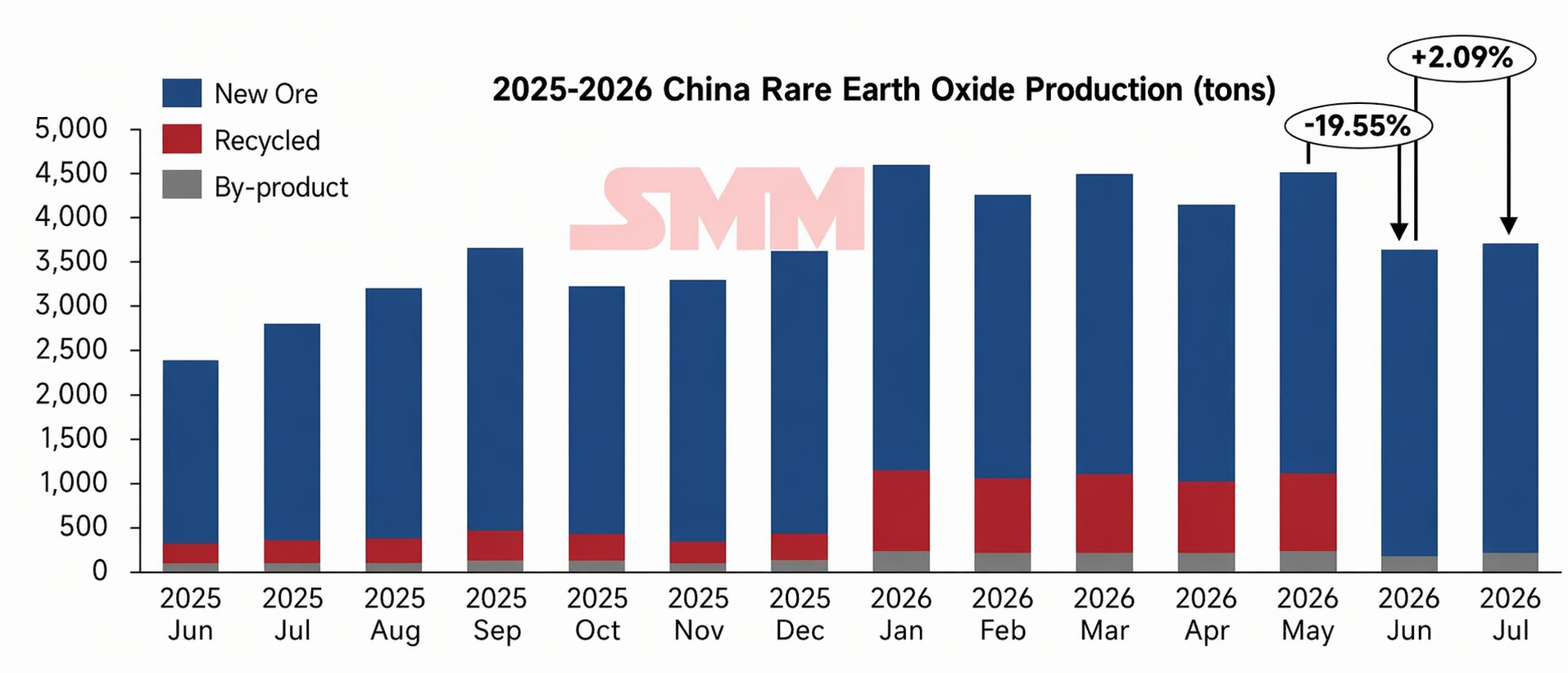
The new national standard arrives amid drastic industry changes. Since H2 2025, local fiscal rebates have been canceled, and the industry tax burden has risen from 9% to 13%; tax compliance audits continued to intensify in 2026. Recycling enterprises have largely suspended purchases of untaxed scrap, which previously accounted for about 50% of the total, including old scrap (20–30%) and scrap from small and medium-sized magnetic material enterprises and traders (30–40%). The industry is generally facing the dilemma of “no invoices to purchase.” The sharp supply contraction quickly fed through to production: in June, secondary oxide production fell 19.5% MoM, and the proportion of Pr-Nd oxide dropped from 42% to 37%.
Against this backdrop, the significance of the new national standard’s implementation becomes particularly pronounced. Previously, rare earth secondary resources long lacked a unified classification and coding system, with scrap from diverse sources and inconsistent naming, creating severe difficulties for compliant transactions and tax administration. The “SRRE” three-level coding system established by the new standard assigns a clear “identity” to each type of secondary resource. This is not only an upgrade of technical specifications but also an infrastructure for industry governance—when every batch of scrap can be accurately classified, coded, and traced, the compliance cost for taxed transactions will drop significantly, and tax audits will have a clear basis.
Looking ahead, the recovery of secondary supply will not happen overnight. The recycling market is undergoing rectification of scrap invoicing and tax compliance, and overall operating rates will remain low in the near term. Although the subsequent peak demand season may raise operating rates at magnetic material enterprises and thereby increase taxed scrap supply, it will be difficult to fully offset the production cut gap. H2 production of secondary Pr-Nd oxide is expected to fall short of H1 levels. Against the backdrop of steadily advancing raw ore capacity, the proportion of secondary Pr-Nd oxide will continue to decline, with the full-year proportion estimated at around 40%. Over a longer horizon, as the new national standard promotes standardized and tax-compliant scrap trading, and capacity concentration at major magnetic material plants gradually increases, the rare earth scrap recycling industry is expected to move from “chaos” to “order” after short-term pain.
Data Source Statement: Except for publicly available information, all other data are processed by SMM based on publicly available information, market communication, and relying on SMM's internal database model. They are for reference only and do not constitute decision-making recommendations.

Images in this article contain AI-translated captions for reference only.

For any inquiries or for more information, please contact: lemonzhao@smm.cn
For more information on how to access our research reports, please contact:service.en@smm.cn
Related News
Amaroq Commences 2026 Drilling at Ilua Rare Earth Project in Greenland
1 hour ago
Amaroq Commences 2026 Drilling at Ilua Rare Earth Project in Greenland
Read More
Amaroq Commences 2026 Drilling at Ilua Rare Earth Project in Greenland
A listed mine development company, Amaroq, has commenced drilling at the Ilua pegmatite rare earth project, located in Greenland, marking the initial launch of the company's 2026 exploration activities. This drilling represents the next phase of evaluation for one of Greenland's emerging conventional rare earth targets, Amaroq states. The 2026 plan aims to test three initial exploration drill targets distributed across the Ilua pegmatite belt, a prospective conventional Amaroq-hosted system with a strike extent of at least 5 kilometers.
1 hour ago
Proterial to Invest $225M in Rare Earth Magnet Plant in Andhra Pradesh, India
2 hours ago
Proterial to Invest $225M in Rare Earth Magnet Plant in Andhra Pradesh, India
Read More
Proterial to Invest $225M in Rare Earth Magnet Plant in Andhra Pradesh, India
Japanese company Proterial will invest 22.5 billion rupees to build a rare earth permanent magnet manufacturing plant in Andhra Pradesh. The project, located in Achyutapuram, Anakapalli district, will have an annual production capacity of 1,200 mt of sintered NdFeB permanent magnets upon completion. Proterial (formerly Hitachi Metals) is one of the world's leading suppliers of advanced magnetic materials, with consolidated revenue reaching 450 billion rupees last year.
2 hours ago
Pr-Nd prices surge, while medium-heavy rare earth market prices remain relatively stable [SMM Rare Earth Weekly Review]
4 hours ago
Pr-Nd prices surge, while medium-heavy rare earth market prices remain relatively stable [SMM Rare Earth Weekly Review]
Read More
Pr-Nd prices surge, while medium-heavy rare earth market prices remain relatively stable [SMM Rare Earth Weekly Review]
[SMM Rare Earth Weekly Review: Pr-Nd Prices Surge, Medium-Heavy Rare Earth Market Prices Relatively Stable] This week, Pr-Nd oxide prices held up well overall. Driven by large-scale purchases and the arrival of the peak season, bullish sentiment in the market strengthened significantly. Downstream procurement inquiries also improved in activity, and suppliers raised their quoted prices. As of today, the price of Pr-Nd oxide was raised to 750,000-755,000 yuan/mt.
4 hours ago
Register to Continue Reading
Gain access to the latest insights in metals and new energy
Already have an account?Sign in here
New National Standard Implementation Coupled with Stricter Tax Compliance Accelerates Rare Earth Scrap Recycling Industry's Shift from "Chaos" to "Order" [SMM Commentary] - Shanghai Metals Market (SMM)