[SMM Analysis] Section 232 Copper Investigation: What June 30 Could Mean for Global Copper Markets

Published: Jun 29, 2026 14:04 (GMT+8)
SMM Analysis | June 30 marks a critical milestone in the U.S. Section 232 copper investigation. Will refined copper tariffs proceed as expected? Whether the outcome is a broad tariff, targeted measures, or a delay and exemption, the decision could reshape the COMEX–LME arbitrage, U.S. physical premiums, global copper trade flows, and regional supply dynamics.

I. Scenario One: Full Implementation of the Refined Copper Tariff

Should the U.S. Department of Commerce formally confirm the proposed tariff roadmap for refined copper on June 30, the market will be repricing U.S. copper supply rather than simply reacting to the tariff rate itself.

The current Section 232 measures primarily cover semi-fabricated copper products and copper-intensive derivative products. Refined copper cathodes, copper concentrates, copper anodes and copper scrap have so far remained outside the scope of the existing 50% tariff. The key issue is whether the Administration confirms the proposed phased tariff schedule of 15% in 2027 and 30% in 2028 on refined copper imports.
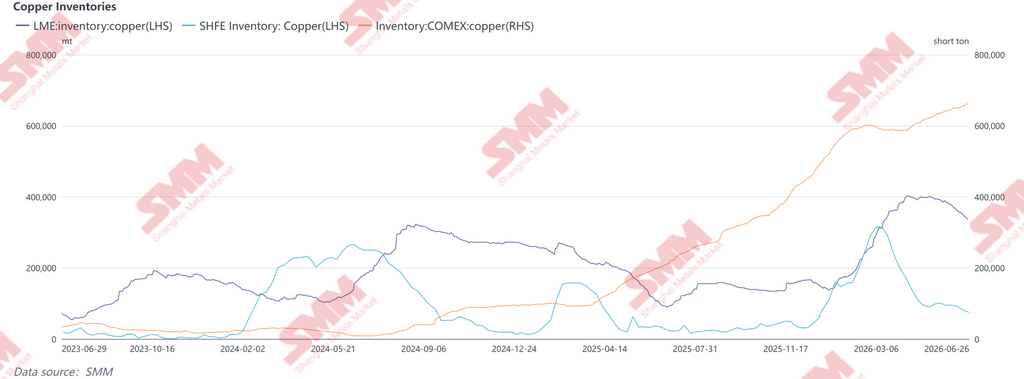
If implemented, the U.S. spot market would likely be the first to react. The substantial build-up of COMEX inventories over recent months has largely been driven by front-loaded imports and cross-market arbitrage ahead of potential tariff implementation. Following confirmation, these inventories are expected to serve as a short-term supply buffer, easing immediate tightness in the domestic market. Nevertheless, higher replacement costs for future imports are likely to support a structural premium for COMEX relative to LME.

Traditional refined copper shipments from Chile and Peru into the U.S. may also be affected. As tariffs erode import economics, part of these volumes could be redirected to Asia and Europe, increasing near-term availability outside the U.S. and placing relative pressure on LME and SHFE prices while widening regional market differentials.

Ultimately, the impact would extend beyond upstream trade flows into downstream manufacturing. Copper is no longer merely an industrial metal—it has become a strategic input for AI infrastructure, electrification and advanced manufacturing.


II. Scenario Two: Targeted or Phased Tariffs

If Washington opts against imposing a blanket tariff on refined copper and instead adopts targeted measures based on HTS classifications, country of origin, purity or product form, the resulting market impact may be less visible but significantly more disruptive to global supply chains.

The first area of risk lies in copper scrap. Should the U.S. tighten export restrictions on high-grade scrap, or impose quotas, tariffs or stricter origin verification on transshipped material, global secondary copper flows would likely undergo significant restructuring. High-quality U.S. scrap has long been an important feedstock for China's and Southeast Asia's recycled copper industries. Any restriction on exports would compress processing margins in Malaysia, Thailand and Vietnam while tightening recycled copper feedstock availability in China.

The second risk concerns origin arbitrage. If USMCA members receive preferential treatment or exemptions, Mexico and Canada could emerge as regional redistribution hubs for refined copper. Traders may increasingly reroute shipments through these markets to optimize tariff exposure, making rules of origin, substantial transformation requirements and HTS classifications more important than the headline tariff rate itself.

The third implication is the increasing segmentation of the copper value chain. Copper concentrates primarily affect domestic smelting security, refined copper directly impacts manufacturing and power infrastructure, while copper scrap underpins the global recycled copper ecosystem. Tightening measures at any stage would likely transmit through the value chain, with downstream processing hubs across Asia expected to bear a disproportionate share of the adjustment.


III. Scenario Three: Exemption or Postponement

Should the Department ultimately recommend exempting refined copper from additional import tariffs, market expectations priced into the COMEX-LME spread are likely to unwind. If implementation is merely postponed, tariff expectations would remain in place, with the spread likely to remain volatile. In either case, the front-loading of imports and cross-market arbitrage driven by tariff expectations is likely to moderate. U.S. physical premiums may come under pressure, while part of the inventories accumulated in recent months could gradually return to normal consumption channels, increasing available supply in the U.S. spot market. However, this would not alter copper's medium- to long-term structural outlook. A delay in tariff implementation would merely postpone supply chain reconfiguration rather than resolve the structural shortage of domestic refined copper production or the U.S.'s long-term reliance on imported material. Meanwhile, demand from advanced manufacturing, electrification and AI infrastructure is expected to remain supportive. At the same time, the growing integration of tin, tungsten, tantalum and silver into AI hardware supply chains continues to reinforce copper's strategic role as a "computing infrastructure metal."


IV. COMEX-LME Spread: The Market Has Already Priced in Tariff Expectations
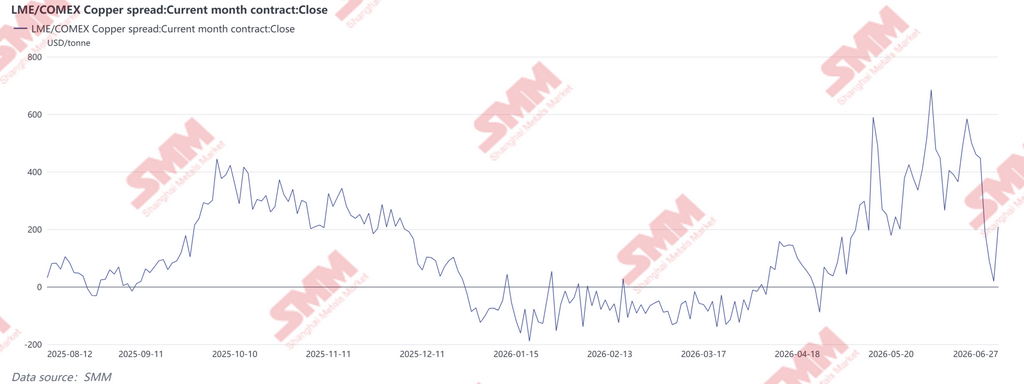
Since April 2026, the COMEX-LME copper spread has widened significantly, repeatedly exceeding US$400/t and reaching nearly US$690/t in early June, reflecting aggressive positioning ahead of a potential refined copper tariff announcement. By late June, the COMEX-LME copper spread narrowed rapidly as arbitrage cargoes gradually arrived in the U.S., the Section 232 investigation entered its key policy phase, and a stronger U.S. dollar exerted increasing pressure on COMEX copper prices. The spread briefly compressed to near zero before rebounding to around US$200/t, indicating that the market remains in a wait-and-see mode ahead of the policy announcement. The recent volatility in the COMEX-LME spread has not been driven by changes in global copper supply-demand fundamentals, but rather by tariff expectations, cross-market arbitrage activity, and front-loaded inventory accumulation. Anticipating potential import tariffs on refined copper, traders accelerated shipments into the U.S., leading to a sharp build-up in COMEX inventories, while COMEX prices consistently traded at a premium to the LME, opening a substantial arbitrage window.

As inventory front-loading has largely run its course, part of the tariff premium has already been priced in. Nevertheless, should the Department formally endorse the phased refined copper tariff framework on June 30, the COMEX-LME spread could widen again. Conversely, any postponement or exemption may trigger a partial unwinding of existing arbitrage positions, increasing the likelihood of normalization in both COMEX physical premiums and cross-market price differentials. Ultimately, the significance of the Section 232 investigation extends beyond copper prices themselves. The real issue is the potential repricing of global copper trade flows, regional physical premiums and cross-market spreads. Regardless of the policy outcome, strengthening the resilience of the U.S. copper supply chain will remain a strategic priority.

Data Source Statement: Except for publicly available information, all other data are processed by SMM based on publicly available information, market communication, and relying on SMM's internal database model. They are for reference only and do not constitute decision-making recommendations.

For any inquiries or for more information, please contact: lemonzhao@smm.cn
For more information on how to access our research reports, please contact:service.en@smm.cn
Related News
Centinela Strike Could Cut November Copper Output by Half, Unions Say
7 hours ago
Centinela Strike Could Cut November Copper Output by Half, Unions Say
Read More
Centinela Strike Could Cut November Copper Output by Half, Unions Say
A workers’ strike at Antofagasta’s Centinela copper mine in Chile could reduce the operation’s November copper production by around 50% if the work stoppage continues, according to union representatives. The strike began on October 7 after two unions rejected further negotiations with Antofagasta Minerals following the failure of government-mediated talks to produce an agreement. The labour groups represent more than half of Centinela’s critical mine operators and more than 60% of equipment maintenance workers. The unions said the initial operational impact is expected to worsen gradually because mining and mine-development activities have been affected, while a large volume of waste rock still needs to be removed. They expect the full effect of the strike to become more visible in November, when production could fall by as much as half. Antofagasta has said it continues to maintain its production guidance despite the strike and declined to comment on the unions’ estimate of the potential November production impact. The dispute centres on differences in pay and benefits between union groups. Labour representatives are seeking equivalent benefits for employees regardless of union affiliation, while Antofagasta has said bargaining schedules have been separated since 2020 and wage adjustments have been negotiated at different times. The union estimate of a potential 50% decline in November production materially increases the supply significance of the Centinela strike compared with the initial work stoppage. However, the estimate has not been confirmed by Antofagasta, which continues to maintain its production guidance. The scale of any actual copper loss will therefore depend on the duration of the strike, the extent of disruption to mining and maintenance activities, and whether negotiations resume before November.
7 hours ago
Magna Mining Approves Levack Mine Restart, Targets Mid-2028 Commercial Production
7 hours ago
Magna Mining Approves Levack Mine Restart, Targets Mid-2028 Commercial Production
Read More
Magna Mining Approves Levack Mine Restart, Targets Mid-2028 Commercial Production
Magna Mining has approved the restart of its fully permitted Levack Mine in Ontario, Canada, following completion of a Preliminary Economic Assessment that outlines 7.3 years of commercial production and estimated initial capital requirements of C$70.1 million. The PEA outlines average annual payable production of approximately 36.8 million lb of copper-equivalent over the commercial production period, with output comprising nickel, copper and precious metals. Magna is targeting the start of commercial production in mid-2028. The study estimates an after-tax NPV at a 7% discount rate of C$227.0 million, an after-tax IRR of 92.4%, and a payback period of 0.6 years under the base-case assumptions used in the PEA. The development plan involves restarting the existing underground operation and utilizing established mine infrastructure. Following board approval, Magna plans to advance detailed engineering, underground development and other activities required to support the proposed restart schedule. The PEA includes approximately 2.1 million short tons of Inferred Mineral Resources. Magna cautioned that the assessment is preliminary in nature and that the restart decision was not based on a feasibility study of Mineral Reserves demonstrating economic and technical viability. The board approval moves Levack from technical evaluation toward restart execution, with commercial production targeted for mid-2028 and initial capital estimated at C$70.1 million. The strong PEA economics indicate potentially attractive project returns under the study assumptions, but the inclusion of Inferred Mineral Resources and the absence of a feasibility-level reserve case mean execution and economic uncertainty remain material. Attention will now turn to detailed engineering, underground development and capital deployment as Magna advances toward the planned restart.
7 hours ago
Ivanhoe Reports 76,401 mt Q3 Copper in Saleable Products at Kamoa-Kakula, Guidance Trends Toward Lower End
7 hours ago
Ivanhoe Reports 76,401 mt Q3 Copper in Saleable Products at Kamoa-Kakula, Guidance Trends Toward Lower End
Read More
Ivanhoe Reports 76,401 mt Q3 Copper in Saleable Products at Kamoa-Kakula, Guidance Trends Toward Lower End
Ivanhoe Mines reported that the Kamoa-Kakula Copper Complex in the Democratic Republic of Congo produced 76,401 mt of copper in saleable products in Q3 2026, up approximately 19% from 64,328 mt in Q2. The company maintained its 2026 production guidance of 290,000–310,000 mt, while stating that output is trending toward the lower end of the range. Q3 saleable copper comprised 61,506 mt of copper in anode, 2,347 mt of toll-treated copper in blister, 5,645 mt of copper in slag concentrate, and 6,904 mt of high-grade copper fines designated for sale. Ivanhoe said the high-grade fines had been produced previously and stockpiled before being assayed, surveyed and designated for sale during the quarter. The Phase 1, 2 and 3 concentrators processed a combined 3.493 million mt of ore during Q3, compared with 2.968 million mt in Q2. Combined feed grade averaged 2.22% copper, while recovery reached 87.6%, compared with 87.4% in the previous quarter. Copper contained in concentrate increased to 68,188 mt from 61,134 mt in Q2. Mining rates across Kamoa and Kansoko increased by approximately 30% to more than 700,000 mt/month, equivalent to around 8.5 million mt/year. Ivanhoe said higher mining rates are expected to continue supporting production as underground operations recover. Kamoa-Kakula’s on-site smelter remained at around 60% of its 500,000 mt/year design capacity during the quarter. The smelter also produced a record 118,638 mt of high-strength sulphuric acid in Q3. Ivanhoe continues to work on improving concentrate quality and reducing silica levels that have contributed to increased slag concentrate production. Kamoa-Kakula’s Q3 saleable copper output increased approximately 19% quarter on quarter, supported by higher mining rates, increased concentrator throughput and the designation of previously stockpiled high-grade copper fines for sale. However, Ivanhoe’s indication that 2026 production is trending toward the lower end of its 290,000–310,000 mt guidance range shows that the complex remains in a recovery and ramp-up phase.
7 hours ago