India's Aluminum Can Stock Shortage Drives Import Window Opening, Structural Dependency Conceals Sustainability Concerns

Published: Jun 17, 2026 15:52
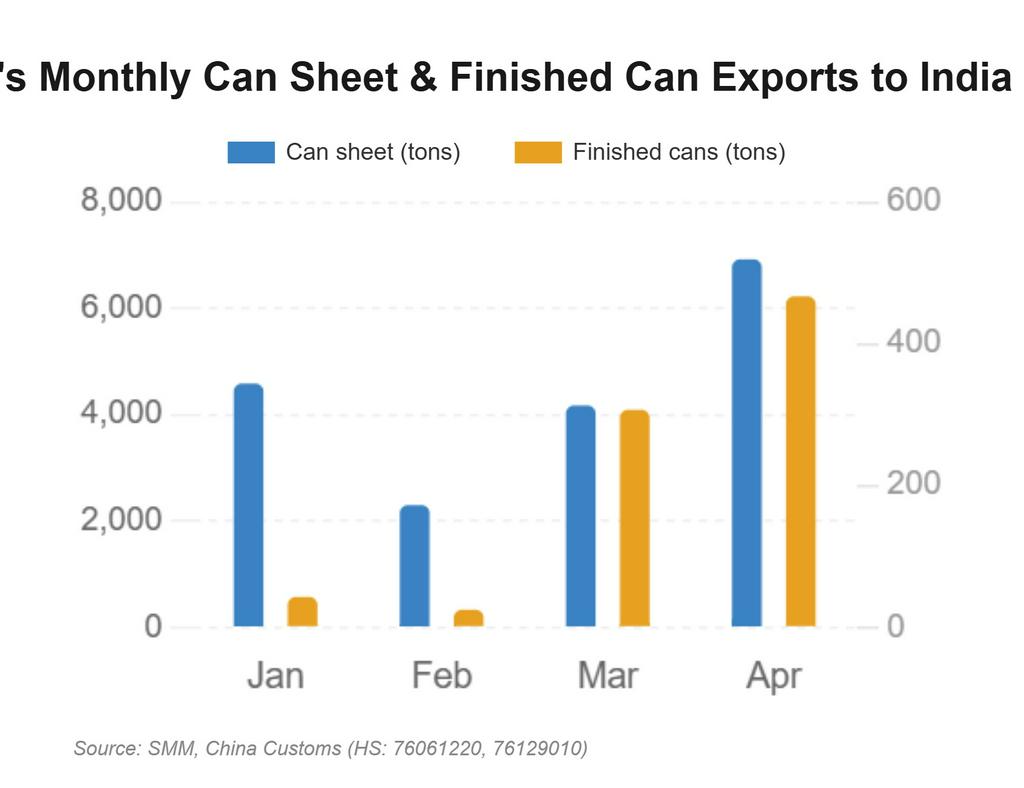
According to China Customs data, from January to April 2026, India's imports of can stock (highly correlated with HS 76061220) from China rose from 4,587 mt to 6,923 mt, while imports of finished cans (HS 76129010) also increased from 43 mt to 467 mt (equivalent to approximately 38.9 million cans) over the same period. Starting in May, China's can stock exports to India are expected to further expand, forming a phased export peak.
SMM, June 17, 2026:

I. India's Supply-Demand Imbalance: Structural Anatomy of the Shortage

In the summer of 2026, India encountered extreme heatwaves, causing soft drink and beer consumption to surge sharply and driving a rapid expansion in the aluminum beverage can market. However, the rapid demand growth was not met with an effective response from domestic supply—India's domestic aluminum can stock capacity has long been insufficient, with can stock supply heavily reliant on imports, primarily from West Asian countries like the UAE and Saudi Arabia. Since March 2026, transportation disruptions in West Asia, combined with escalating BIS import certification delays, have plunged the supply chain into systemic strain.

From an industrial structure perspective, although India is one of the world's major aluminum producers, the deep processing segment of can stock manufacturing has consistently been a weak link. Currently, only Hindalco's planned expansion of approximately 50 kt at its Aditya plant in Odisha and Ball Corporation's $60 million expansion project in Sri City, Andhra Pradesh are in progress, yet these capacity releases are expected to take 2-3 years. The inherent insufficiency on the supply side dictates that India will maintain structural dependence on external can stock sources for a considerable period to come.

According to China Customs data, from January to April 2026, India's imports of can stock (highly correlated with HS 76061220) from China rose from 4,587 mt to 6,923 mt, while imports of finished cans (HS 76129010) also increased from 43 mt to 467 mt (equivalent to approximately 38.9 million cans) over the same period. Starting in May, China's can stock exports to India are expected to further expand, forming a phased export peak.


II. China's Export Window: Policy Exemptions and Demand Resonance

In terms of trade policy, China's aluminum can stock exports to India have a relatively clear compliance pathway. India's anti-dumping duties on Chinese aluminum flat-rolled products (HS 7606/7607) are valid until December 5, 2026, but its exemption list explicitly excludes "aluminum can body blanks (including can end stock)" from the scope of duties. In December 2025, India's Ministry of Commerce and Industry further included wide-width Lithograde aluminum coil in the exemption, effectively broadening the range of exportable Chinese products.

Worth noting is that in March 2026, India's Ministry of Commerce and Industry initiated the first sunset review of anti-dumping duties on Chinese aluminum flat-rolled products, with the dumping investigation period spanning from April 2024 to September 2025. If the review results in maintaining the existing duties, China's aluminum flat-rolled product exports to India (approximately 330,000 mt in full-year 2025) will face substantive blockage. While the current exemption policy remains effective, as the review progresses, policy uncertainty will notably rise, becoming a core risk for export enterprises in H2 2026.

III. Sustainability Concerns: Limited Window, Guard Against Overoptimism

In summary, against the backdrop of India's unresolved supply gap, ongoing Middle East transportation uncertainties, and domestic expansion projects being a distant cure for immediate thirst, China's can stock export window to India is likely to remain open throughout 2026. Nevertheless, it must be recognized soberly that this round of export expansion is driven largely by supply-side disruptions and policy exemptions, rather than an active shift in India's procurement demand toward China, thus lacking a foundation for long-term cooperation. Coupled with policy risks from the sunset review, the uneconomical nature of finished can transportation, and India's gradually recovering domestic supply capacity, the incremental space for and sustainability of future Chinese can stock exports to India still face considerable uncertainty.
Data Source Statement: Except for publicly available information, all other data are processed by SMM based on publicly available information, market communication, and relying on SMM's internal database model. They are for reference only and do not constitute decision-making recommendations.

For any inquiries or for more information, please contact: lemonzhao@smm.cn
For more information on how to access our research reports, please contact:service.en@smm.cn
Related News
【SMM Aluminum Flash News】VBX secures environmental approvals to expand Wuudagu bauxite project
1 hour ago
【SMM Aluminum Flash News】VBX secures environmental approvals to expand Wuudagu bauxite project
Read More
【SMM Aluminum Flash News】VBX secures environmental approvals to expand Wuudagu bauxite project
VBX Limited has obtained approval from the Western Australian Environmental Protection Authority (EPA) and the Australian Government's environment department to modify the development plan for its Wuudagu bauxite project in northern Western Australia. The revised proposal reduces the project's indicative footprint by almost 10 per cent to about 1,775 hectares while increasing planned mining and beneficiation rates to up to 9 million tonnes per annum (Mtpa). One of the major changes involves shifting the beneficiation plant inland from Guy Point. VBX said the move is intended to lower potential impacts on coastal and marine environments. Other proposed changes include narrower sealed haul roads, a distributed bore field with an optional desalination plant for water supply, and the co-location of port infrastructure to limit disturbance across the project area.
1 hour ago
[SMM Aluminum Flash News] Rising UK Aluminium Scrap Exports Raise Concerns Over Domestic Supply Security
1 hour ago
[SMM Aluminum Flash News] Rising UK Aluminium Scrap Exports Raise Concerns Over Domestic Supply Security
Read More
[SMM Aluminum Flash News] Rising UK Aluminium Scrap Exports Raise Concerns Over Domestic Supply Security
[SMM Aluminum Flash News] Rising UK Aluminium Scrap Exports Raise Concerns Over Domestic Supply Security
Britain’s growing aluminium scrap exports are raising concerns about the long-term availability of a critical raw material for domestic industries. According to Make UK, aluminium scrap exports reached 624,314 tonnes in 2025, up 43% from 2016 levels, while shipments to India increased 94% to nearly 199,000 tonnes. Exports to the US surged 989% year-on-year to 23,560 tonnes after aluminium scrap was excluded from Section 232 tariff measures. Make UK estimates the UK could require up to 6 million tonnes of recyclable aluminium scrap to support total aluminium demand of 8 million tonnes by 2035. The organisation warned that continued scrap outflows could weaken domestic manufacturing, discourage investment and reduce supply chain resilience. It called for greater investment in scrap collection, sorting and processing infrastructure, improved recycling standards and measures to retain critical aluminium alloys within the UK’s circular economy.
1 hour ago
[SMM Aluminum Flash News] UK Scrap Aluminium Sector Needs 25% Annual Growth to Meet Future Demand
1 hour ago
[SMM Aluminum Flash News] UK Scrap Aluminium Sector Needs 25% Annual Growth to Meet Future Demand
Read More
[SMM Aluminum Flash News] UK Scrap Aluminium Sector Needs 25% Annual Growth to Meet Future Demand
[SMM Aluminum Flash News] UK Scrap Aluminium Sector Needs 25% Annual Growth to Meet Future Demand
New analysis from Make UK suggests the UK’s aluminium scrap collection and sorting sector will need to grow by around 25% annually to meet future demand outlined in the country’s Modern Industrial Strategy. The report highlighted that aluminium scrap exports have risen 84% over the past decade, reducing domestic availability of a key raw material for industries including defence, clean energy, digital technologies and automotive manufacturing. In 2024-25, UK scrap aluminium exports to the US surged from 2,000 tonnes to 24,000 tonnes after Section 232 tariffs excluded aluminium scrap, while exports to India reached approximately 200,000 tonnes. Make UK estimates total UK aluminium demand could reach 8 million tonnes by 2035, requiring around 6 million tonnes of recyclable scrap. The organisation warned that continued export growth could weaken domestic manufacturing competitiveness, investment and supply chain resilience, and called for greater investment in scrap collection, sorting and processing capacity within the UK.
1 hour ago
Register to Continue Reading
Gain access to the latest insights in metals and new energy
Already have an account?Sign in here