Executive Summary
South America remains the cornerstone of global copper supply, with Chile and Peru collectively accounting for more than one-third of global mined copper production. As electrification, grid modernisation, renewable energy deployment and AI-driven infrastructure investment continue to reinforce long-term copper demand growth, policy developments across the region are becoming increasingly important determinants of future supply availability.
Over 2025–2026, copper policy in both Chile and Peru has increasingly focused on two strategic priorities: maximising resource rent capture while improving the efficiency and value creation of the domestic mining sector. Policymakers are seeking to strengthen fiscal returns through royalty reforms, enhance environmental and community governance, accelerate project permitting, and expand participation across the copper value chain.
In Chile, policy initiatives have centred on the implementation of the new mining royalty framework (Ley 21.591), permitting reform and downstream processing expansion. Collectively, these measures reflect a broader effort to increase domestic value retention while preserving Chile's strategic role within the global copper supply chain. However, declining ore grades, ageing assets, water scarcity and operational disruptions continue to constrain production growth, highlighting the growing disconnect between policy ambition and supply reality.
In Peru, government efforts remain focused on sustaining investment attractiveness, advancing large-scale mining projects and addressing long-standing social and permitting challenges. While Peru retains one of the industry's largest undeveloped copper project pipelines, permitting bottlenecks, community unrest, political uncertainty and infrastructure constraints continue to limit the pace at which future supply can be brought to market.
From a global market perspective, the implications are increasingly clear:
- Chile's royalty reform raises the development cost of future mining projects;
- Permitting reform may improve project execution efficiency, although environmental and social constraints remain significant;
- Expansion of domestic smelting capacity could alter future concentrate trade flows;
- Peru retains substantial long-term supply potential, but project execution risk remains elevated;
- South American mine supply growth remains uncertain, with implications for TC/RC negotiations and global concentrate market tightness.
Chile
Chile's copper policy framework has gradually evolved from a production-growth model toward a dual-track strategy focused on increasing resource rent capture while upgrading domestic value-added capacity.
Key Policy Objectives
- Increase national and regional fiscal revenues from mining;
- Shorten permitting timelines for large-scale projects;
- Expand domestic smelting capacity;
- Enhance value capture across the copper supply chain;
- Strengthen Chile's strategic position within the global copper market.
Mining Royalty Reform: Higher Resource Rent Capture, Higher Development Costs
Chile's mining policy agenda has increasingly shifted toward maximizing fiscal participation in the mining sector while preserving the country's long-term competitiveness as a leading copper-producing jurisdiction. The implementation of Ley 21.591 on January 1, 2024 marks one of the most significant changes to Chile's mining fiscal framework in recent decades.
Compared with the previous Specific Mining Tax regime, the new framework restructures the royalty system through a combination of:
- A 1% ad valorem royalty for operations producing more than 50 kt of copper annually;
- A progressive royalty linked to operating profit margins, ranging from 8% to 26%;
- An effective tax burden cap of 45.5%-46.5%.
The Ministry of Finance estimates that the reform could generate approximately US$1.35 billion of additional annual fiscal revenue, with a portion earmarked for regional governments and mining communities. For investors, the impact differs significantly between operating assets and future developments. For mature, low-cost operations such as Escondida and Collahuasi, capital investment has largely been sunk and cash costs remain near the lower end of the global cost curve. While the royalty reform may compress margins, it is unlikely to materially alter production plans. By contrast, greenfield projects and high-capex brownfield expansions are considerably more sensitive to fiscal changes. Higher royalty burdens may reduce project IRRs, extend payback periods, and potentially delay or cancel marginal developments. Importantly, several large-scale mining projects continue to benefit from tax stability agreements, implying that the practical impact of Ley 21.591 will be phased in over time rather than immediately affecting the entire industry. The more important long-term implication is not current production, but future supply elasticity. By raising development thresholds for new projects, the reform may constrain medium- to long-term mine supply growth.
Permitting Reform: Improving the Mining Investment Environment
In 2025, Chile's Congress approved the Sectoral Permit Reform Law aimed at accelerating project approvals for large-scale investments. Government and industry estimates suggest that permitting timelines for certain projects could be reduced by 30%-70%. The reform extends beyond mining assets themselves to include critical supporting infrastructure such as desalination facilities, transmission networks, tailings storage facilities, ports, and logistics corridors. As Chilean copper operations increasingly depend on desalination and long-distance power infrastructure, permitting delays have become a key constraint on project development. While permitting reform should improve overall investment efficiency and partially offset the negative effects of higher royalties, environmental permitting, water management requirements, and community consultation processes remain significant hurdles. As a result, any supply response is likely to materialize only over a multi-year timeframe.
Domestic Smelting Expansion: From Concentrate Exporter to Value Chain Upgrader
Chile remains the world's largest exporter of copper concentrates, yet its domestic smelting capacity remains relatively limited, with a substantial portion of concentrate production shipped to Asia, particularly China. Against a backdrop of increasing supply chain security concerns and resource nationalism, Chile has renewed efforts to strengthen domestic processing capacity. In December 2025, Codelco and Glencore signed a Memorandum of Understanding (MoU) to advance a new smelting project in the Antofagasta region.
According to publicly available information:
- Processing capacity: approximately 1.5 Mtpa of copper concentrate;
- Codelco concentrate supply commitment: up to 800 ktpa;
- Offtake duration: minimum 10 years;
- Construction expected to commence around 2030;
- Commercial operation targeted for 2032-2033.
If ultimately developed, the project would increase Chile's domestic concentrate absorption capacity and potentially reduce concentrate volumes available to Asian smelters, reshaping future concentrate trade flows and refining competition. However, the project remains in the early development stage, and its ultimate market impact remains uncertain.
Chile's Policy versus Reality: Structural Constraints Continue to Limit Supply Growth
Despite ongoing royalty reform, permitting optimization, and downstream investment initiatives, policy objectives have yet to translate into meaningful production growth. Chile's copper output declined to approximately 5.41 Mt in 2025, down 1.73% year-on-year from 5.51 Mt in 2024. The decline was driven primarily by declining ore grades, ageing operations, underground mining disruptions, water constraints, power system disturbances, and broader energy shortages rather than fiscal policy itself. Delays to Codelco's production growth initiatives further underscore these structural challenges. From a market perspective, policy reform may improve the investment environment and increase domestic value capture, but it does not eliminate the fundamental constraints associated with declining resource quality, infrastructure bottlenecks, and long mine development cycles.
Peru
Peru remains the world's third-largest copper producer and one of the most important sources of future mine supply growth. Compared with Chile, Peru's policy focus is centered on preserving investment competitiveness, advancing large-scale mining projects, and mitigating long-standing permitting and social challenges.
Key Policy Objectives
- Attract and retain mining investment;
- Advance major copper developments;
- Improve permitting efficiency;
- Reduce social conflict risks;
- Maintain Peru's position as a leading global copper producer.
Mining Investment Pipeline: A Critical Source of Future Supply Growth
Peru continues to expand and update its Mining Investment Portfolio, with copper projects accounting for the majority of planned capital investment.
Key projects include:
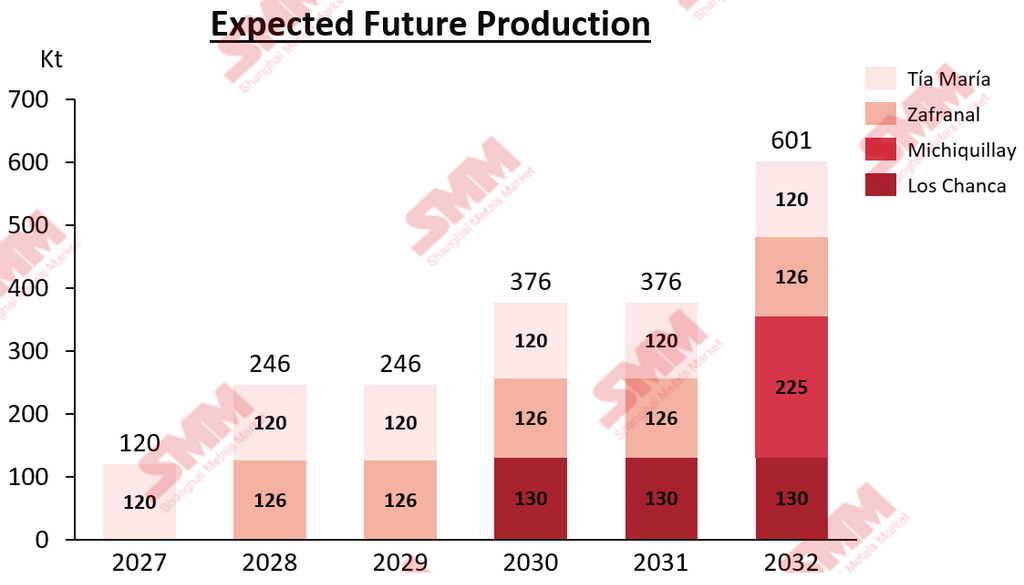
- Tía María (120 ktpa, targeted start-up in late 2026/early 2027);
- Zafranal (126 ktpa average annual production during the first five years, expected 2028-2029 start-up);
- Michiquillay (225 ktpa, targeted 2032 start-up);
- Los Chancas (130 ktpa, expected 2030-2031 start-up).
Nevertheless, project pipelines do not automatically translate into supply growth. Following Quellaveco, Peru has yet to develop another project of comparable scale, and future production growth remains highly dependent on successful project execution.
Fiscal Stability: Predictability Matters More Than Tax Rates
Peru's mining tax regime consists of mining royalties, a special mining tax, corporate income tax, and VAT refund mechanisms. Unlike Chile, Peru's key competitive advantage lies in its Tax Stability Agreement framework, which allows major projects to lock in fiscal terms over extended periods, reducing regulatory uncertainty and supporting long-duration investment decisions. For international miners, Peru is therefore viewed less as a low-tax jurisdiction and more as a relatively predictable fiscal environment.
Permitting Bottlenecks: The Critical Challenge for Future Growth
Peru's mining sector continues to face complex permitting requirements involving environmental approvals, water rights, land access, community consultation, transportation infrastructure, and power supply. As a result, permitting timelines remain lengthy, creating significant uncertainty around project development schedules. The country's future production growth therefore depends not only on the size of its resource base, but also on its ability to streamline approvals and reduce administrative friction.
Community Unrest and Illegal Mining: Key Supply-Side Risks
Community unrest remains one of the most significant operational risks facing Peru's copper industry. Las Bambas has repeatedly experienced road blockades and disruptions to concentrate transportation, periodically affecting production and logistics. While tensions have eased at times, underlying disputes regarding benefit sharing, transportation corridors, and local development remain unresolved. In addition, the government has intensified efforts to combat illegal mining since 2025. Elevated gold prices have encouraged the expansion of informal mining activity, creating additional challenges for social stability and investment confidence. Both community conflicts and illegal mining enforcement actions have the potential to disrupt operations, logistics networks, and concentrate supply.
Peru's Policy Outlook: The 2026 Election and Future Mining Direction
Peru's 2026 presidential election could become a key variable for the mining sector. Right-wing candidate Keiko Fujimori supports market-oriented policies, fiscal stability, foreign investment protection, and accelerated mining project development. Left-wing candidate Roberto Sánchez has advocated higher taxation of large mining companies, a review of existing mining contracts, and a stronger resource nationalism agenda. Given the long development timelines associated with large-scale copper projects, future policy direction on taxation, permitting, and investment will directly influence the development trajectory of projects such as Tía María, Michiquillay, Los Chancas, and Zafranal. For mining companies, policy stability and permitting efficiency remain more important than resource endowment alone.
Peru's Policy versus Reality: Project Pipelines Are Not Production Growth
Although Peru possesses one of the world's largest undeveloped copper resource bases, project pipelines do not necessarily translate into actual production growth. Progress on major projects has consistently lagged market expectations. Slow-moving permitting reforms, recurring community conflicts, and inadequate supporting infrastructure continue to constrain project development. Meanwhile, Peru's 2026 energy crisis and mine-level power curtailments highlight the practical challenges facing the sector. From a market perspective, Peru retains substantial long-term supply potential, but future production growth is likely to emerge gradually and may ultimately fall short of earlier market expectations.
Implications for Copper Demand, Supply, and Pricing
On the demand side, global copper consumption continues to be supported by energy transition investment, grid modernization, AI-related data center construction, and broader industrial electrification. While policy developments in Chile and Peru are unlikely to alter demand directly, they significantly influence market confidence in future supply availability.
On the supply side, Chile and Peru collectively account for more than 35% of global mined copper production. However, policy ambitions have yet to translate into meaningful supply growth. Chile continues to face declining ore grades, ageing mines, and resource constraints, while Peru remains challenged by political uncertainty, permitting bottlenecks, community unrest, and slow project execution. Although South America retains substantial long-term supply potential, the pace of new capacity additions is likely to remain slower than market expectations, limiting global mine supply elasticity. A particularly important trend is the growing competition for copper concentrates. Chile's downstream expansion strategy and Peru's project development ambitions are both competing for the same concentrate resource base. If Chile successfully expands domestic smelting capacity while mine supply growth remains constrained, TC/RCs are likely to remain under structural pressure, intensifying competition among global smelters.
From a pricing perspective, Chilean and Peruvian policy developments do not directly influence regional arbitrage spreads in the way that U.S. Section 232 investigations do. However, they play a critical role in shaping expectations for future mine supply. Chile's efforts to capture more resource value and expand domestic processing capacity could alter concentrate trade flows, while Peru's project execution risks and social conflicts remain key variables in determining future supply growth.
Overall, while South American policy developments do not alter the structural demand growth outlook for copper, they are increasingly shaping the trajectory of future supply growth. In the short term, policy developments are likely to manifest through supply disruptions and project delays. Over the longer term, resource nationalism, downstream industrialization, and increasingly lengthy project development cycles may further reduce global supply responsiveness, providing structural support for copper prices while maintaining pressure on concentrate availability and TC/RC negotiations.