Southeast Asia Boosts China's April Aluminum Foil Exports; Middle East Turmoil Clouds Full-Year Outlook [SMM Analysis]

Published: May 24, 2026 19:19
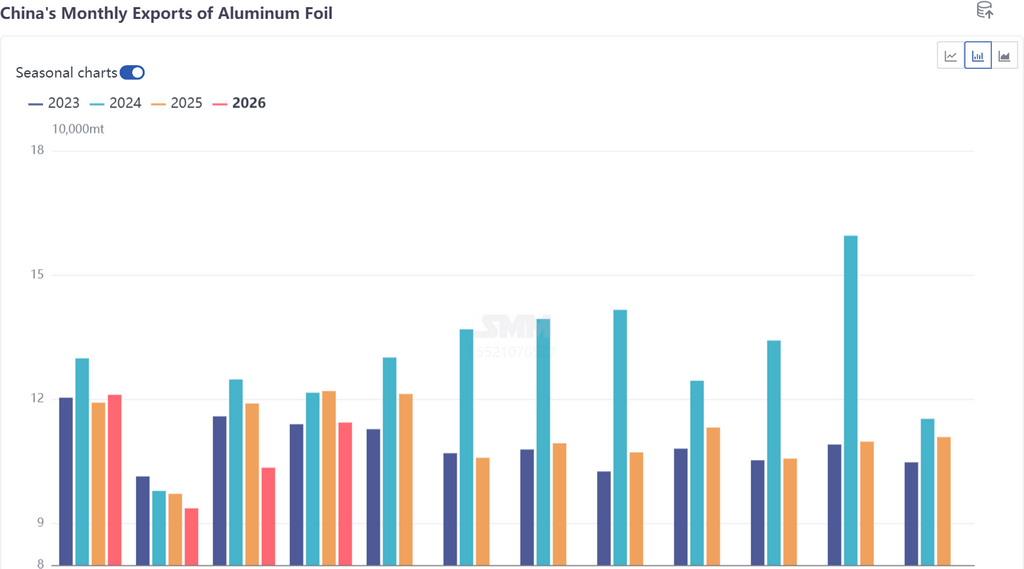
According to customs data, China's total aluminum foil exports (tariff codes 76071110, 76071120, 76071190, 76071900, 76072000) reached 114,400 mt in April 2026, up 10.5% MoM but down 6.2% YoY.
SMM, May 24, 2026:

According to customs data, China's total aluminum foil exports (tariff codes 76071110, 76071120, 76071190, 76071900, 76072000) reached 114,400 mt in April 2026, up 10.5% MoM but down 6.2% YoY.

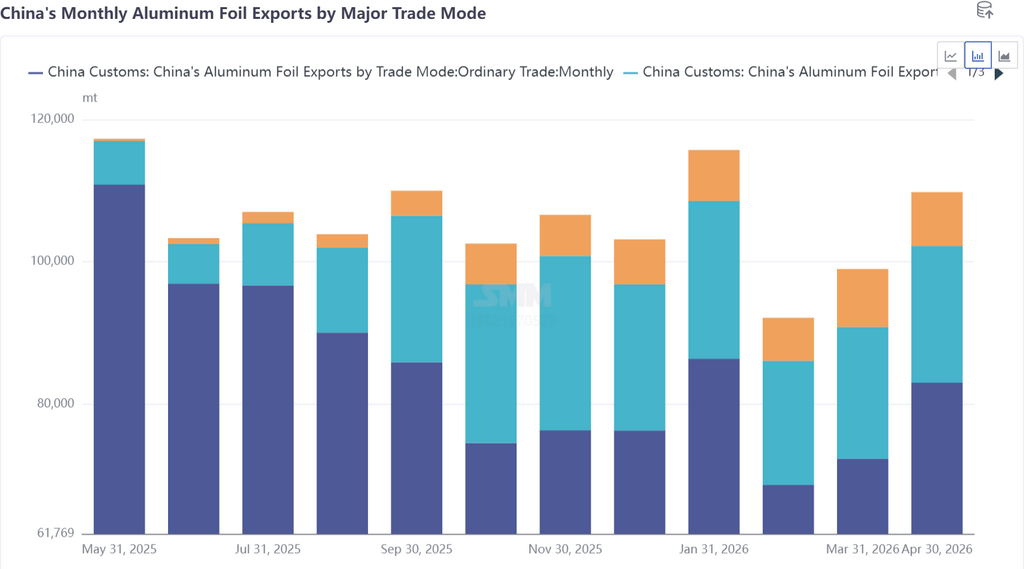
Trade mode: In April 2026, China's aluminum foil exports via processing trade with imported materials were approximately 19,200 mt, accounting for about 16.8%; exports via processing trade with supplied materials were approximately 7,500 mt, accounting for 6.6%.
By country, the top five destinations for China's aluminum foil exports in April 2026 were Indonesia (9,600 mt, 8.43%), Thailand (8,900 mt, 7.79%), South Korea (8,800 mt, 7.72%), India (8,500 mt, 7.43%), and Mexico (0.84 mt, 7.38%), with the remaining countries accounting for approximately 61.2% in total. The Southeast Asian market maintained a stable contribution. Notably, exports to the Middle East showed a preliminary recovery: exports to the UAE rebounded from 2,515 mt in March to 4,441 mt in April, and exports to Saudi Arabia rebounded from 4,868 mt to 6,387 mt. However, according to an SMM survey, the recovered volumes were mainly rerouted via the Red Sea and represented only a small fraction of normal levels. Most clients had not yet resumed placing orders, and the Middle East trade chain was far from returning to normal.

Entering Q2, China's aluminum foil exports exhibited a typical geopolitically-driven cyclical boom: On one hand, some double zero foil production lines switching to battery foil led to supply contraction in traditional packaging foil. Combined with overseas clients rushing to export due to concerns over prolonged Strait of Hormuz blockade, enterprise production schedules had been extended to late June through July, with processing fees for double zero standard pouch export surging to $1,000-1,200/mt. On the other hand, high processing fees themselves were already slowing the pace of additional client orders, and the widening price spread between domestic and overseas markets had not brought significant order growth (above 20%), indicating limited actual shortages overseas, with incremental volumes driven more by precautionary restocking rather than a comprehensive recovery in end-use demand. For the full year, cumulative aluminum foil exports from January to April were still down 5.4% YoY. To recover the ground lost in 2025 (1.3406 million mt), subsequent monthly exports would need to reach 113,500 mt. In an optimistic scenario, if the strait blockade continues into Q3 and the export rush persists, full-year exports will reach 1.4 million mt; in a conservative scenario, if the blockade is lifted, leading to convergence of overseas market premiums and demand being front-loaded, full-year exports will only reach 1.3 million mt. The duration of geopolitical conflict and the extent of actual overseas shortages are the core variables determining whether full-year exports can "recover lost ground."

Data Source Statement: Except for publicly available information, all other data are processed by SMM based on publicly available information, market communication, and relying on SMM‘s internal database model. They are for reference only and do not constitute decision-making recommendations.

For any inquiries or to learn more information, please contact: lemonzhao@smm.cn
For more information on how to access our research reports, please contact:service.en@smm.cn
Related News
BoE Governor Signals Dovish Stance, Tolerating Inflation Above 2% Amid Economic Weakness
12 hours ago
BoE Governor Signals Dovish Stance, Tolerating Inflation Above 2% Amid Economic Weakness
Read More
BoE Governor Signals Dovish Stance, Tolerating Inflation Above 2% Amid Economic Weakness
Bank of England Governor Bailey sent a clearly dovish signal. He noted that given the current economic weakness, the central bank could tolerate inflation exceeding the 2% target for a period of time. This remark significantly lowered market expectations for a rate hike in June. However, Bailey also warned that once signs of second-round effects emerged, the central bank's tolerance for inflation would diminish accordingly.
12 hours ago
Eurozone Inflation Surges, ECB Signals Likely Rate Hikes in June and Beyond
13 hours ago
Eurozone Inflation Surges, ECB Signals Likely Rate Hikes in June and Beyond
Read More
Eurozone Inflation Surges, ECB Signals Likely Rate Hikes in June and Beyond
The eurozone was facing a broad-based intensification of inflationary pressures. Specifically, the Consumer Price Index (CPI) in France and Spain rose 2.8% and 3.6% YoY in May, respectively, both hitting their highest levels since 2024. Meanwhile, Italy's inflation rate climbed to 3.3%, reaching its peak since 2023, while Germany's core inflation also accelerated to 2.5%. Against this backdrop, ECB Governing Council member Simkus noted that a rate hike in June was almost a foregone conclusion, and that further rate hikes would "very likely" be needed thereafter.
13 hours ago
Fed Officials Diverge on Impact of Middle East Conflict on Inflation and Rate Hike Necessity
13 hours ago
Fed Officials Diverge on Impact of Middle East Conflict on Inflation and Rate Hike Necessity
Read More
Fed Officials Diverge on Impact of Middle East Conflict on Inflation and Rate Hike Necessity
US Fed Vice Chair Bowman noted that it was still too early to judge the impact of the Middle East conflict on US inflation, and that temporary price shocks should be overlooked. However, Kansas City Fed President Schmid argued that it was difficult to continue viewing the current energy price shock as a "transitory" factor, and that officials needed to clearly express their willingness to take necessary measures to maintain price stability. The Fed's Kashkari stated that it was too early to determine whether rate hikes were needed, and that all possible policy options should be kept open. Fed official Paulsen said there had been no structural change in inflation.
13 hours ago
Register to Continue Reading
Gain access to the latest insights in metals and new energy
Already have an account?sign in here