SMM May 19 News:
Metals market:
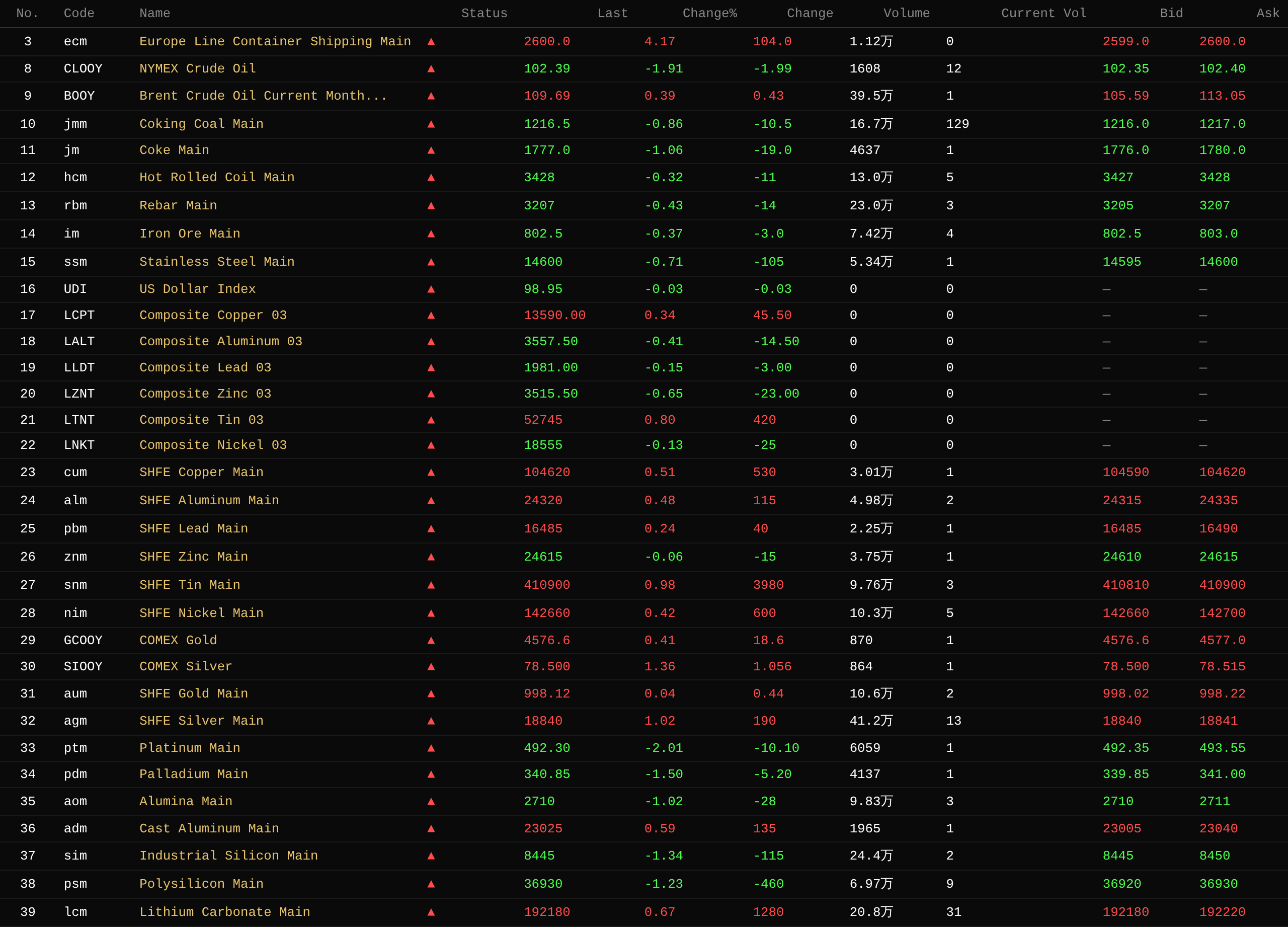
Overnight metals showed mixed performance across domestic and overseas markets. On the overseas market, LME copper, LME aluminum, LME zinc, and LME nickel all declined, with LME zinc leading the losses at 0.65%. SHFE zinc fell 0.06%, while other metals rose, with SHFE tin leading the gains at 0.98%; fluctuations in other metals were relatively small. Alumina main contract fell 1.02%, and casting aluminum main contract rose 0.59%.
Ferrous metals generally declined, with stainless steel down 0.71%; fluctuations in other varieties were relatively small. For coking coal and coke, coking coal fell 0.86% and coke fell 1.06%.
Overnight precious metals: COMEX gold rose 0.2% and COMEX silver rose 0.74%. In China, SHFE gold rose 0.04% and SHFE silver rose 1.02%.
Overnight closing prices as of 6:44 AM on May 19:
Macro Front
China:
[NBS: Industrial Value-Added of Enterprises Above Designated Size Up 5.6% YoY in January-April, National Economy Maintains Steady and Progressive Development]In January-April, under the strong leadership of the CPC Central Committee with Comrade Xi Jinping at its core, all regions and departments earnestly implemented the decisions and deployments of the CPC Central Committee and the State Council, adhered to the general principle of seeking progress while maintaining stability, fully and faithfully applied the new development philosophy, accelerated the construction of a new development pattern, effectively implemented more proactive and impactful macro policies, and focused on stabilizing employment, enterprises, markets, and expectations. Production and supply grew steadily, market sales continued to expand, foreign trade resilience was further demonstrated, employment and prices remained generally stable, new momentum grew stronger, and high-quality development advanced toward new and better directions. NBS data showed: in January-April, industrial value-added of enterprises above designated size nationwide was up 5.6% YoY. By three major sectors, mining industry value-added was up 5.5% YoY, manufacturing up 5.8%, and production and supply of electricity, heat, gas, and water up 4.5%. Equipment manufacturing value-added was up 8.7% YoY, and high-tech manufacturing value-added up 12.6%, faster than overall industrial value-added above designated size by 3.1 and 7.0 percentage points respectively. By economic type, state-controlled enterprises' value-added was up 4.4% YoY; joint-stock enterprises up 6.0%, foreign-invested and Hong Kong, Macao, and Taiwan-invested enterprises up 3.9%; private enterprises up 5.2%. By product, production of 3D printing equipment, lithium-ion batteries, and industrial robots was up 50.9%, 36.0%, and 25.7% YoY respectively. In April, industrial value-added of enterprises above designated size nationwide was up 4.1% YoY and up 0.05% MoM. In April, the manufacturing PMI was 50.3%; the business activity expectations index was 54.5%, up 1.1 percentage points MoM. From January to March, industrial enterprises above designated size nationwide achieved total profits of 1,696 billion yuan, up 15.5% YoY.
[NBS: Selling prices of commercial residential properties in first-tier cities rose MoM in April; MoM declines in second- and third-tier cities narrowed or remained unchanged from the previous month]National Bureau of Statistics (NBS): In April, new commercial residential selling prices in first-tier cities rose 0.1% MoM, with the increase pulling back 0.1 percentage points from the previous month. Among them, Shanghai, Guangzhou, and Shenzhen rose 0.4%, 0.1%, and 0.1% respectively, while Beijing fell 0.2%. New commercial residential selling prices in second-tier cities fell 0.1% MoM, with the decline narrowing 0.
US Dollar:
As of the overnight close, the US dollar index fell 0.29% to 98.99. A CICC research report noted that multiple recent US inflation data exceeded expectations, while the labor market trended toward stability. Bonds saw a sell-off, and market concerns over inflation continued to intensify. Meanwhile, US-Iran peace negotiations showed no substantive progress, the Strait of Hormuz remains effectively closed, and upside risks to energy prices are difficult to dissipate. In our base case, we expect US PCE inflation to remain above 3.5% for the full year, with core PCE inflation above 3%, both significantly higher than the Fed's 2% policy target. Against this backdrop, the Fed's policy stance is expected to shift toward greater caution, making further interest rate cuts unlikely this year (previously, the next cut was expected in Q4). After new Chairman Warsh takes office, establishing policy credibility will be the top priority, and promptly conveying clear anti-inflation signals to the market is both a proper course of action and a necessary step to stabilize expectations. For markets, this means a rising probability of marginal tightening in US dollar liquidity, and assets driven purely by liquidity are likely to remain under pressure. (Jin10 Data APP)
According to the Wall Street Journal, White House officials revealed that Trump will host a swearing-in ceremony at the White House on Friday for incoming Fed Chairman Kevin Warsh. This ceremony underscores the high importance Trump places on this appointment. Powell, whom Trump nominated to lead the Fed during his first term in 2018, had his swearing-in ceremony held at the Fed, which Trump did not attend. The last Fed Chairman to be sworn in at the White House was Greenspan, who took office in 1987. Subsequent ceremonies were all held at the Fed. The last president to attend such a ceremony was George Bush, who attended Bernanke's swearing-in ceremony in 2006. Later that year, Wash was sworn in as a Fed Governor at the Eisenhower Executive Office Building, with the ceremony presided over by Vice President Dick Cheney. Friday's swearing-in ceremony will bring to a close an unusually prolonged transition at the top of the US Fed. (Jin Shi Data APP)
The market no longer believes the US Fed will cut interest rates; in fact, the probability of a rate hike has been steadily rising. Current pricing shows that the probability of a rate hike by the end of this year has reached 42%. Market veteran Ed Yardeni, President of Yardeni Research, stated: "The US Fed must catch up with the bond market to avoid losing control of borrowing costs and to appease the 'Bond Vigilantes.'" Fed Chairman-designate Kevin Wash was originally sent to the US Fed with the intention of lowering interest rates, but now he may instead have to push for rate hikes to establish his policy credibility. (Wallstreetcn)
Data:
Today will see the release of US ADP employment change for the week ending May 2, US April pending home sales index MoM, eurozone March seasonally adjusted trade balance, UK March three-month ILO unemployment rate, UK April unemployment rate, UK April claimant count, and Canada April CPI MoM, among other data.
Crude oil:
As of the overnight close, oil prices on both markets rose together, with WTI up 1.46% and Brent up 0.39%. Tensions between the US and Iran eased slightly, and crude oil gains narrowed. The head of commodities and derivatives research at Bank of America stated that in his best-case oil price scenario, Brent crude is expected to average $90 per barrel for the remainder of this year, and prices could be even higher if the standoff with Iran persists or the situation escalates due to new conflicts. (From Wallstreetcn APP)
On the 18th local time, International Energy Agency (IEA) Executive Director Fatih Birol, speaking on the sidelines of the G7 finance ministers' meeting in Paris, France, said that due to the Middle East conflict, commercial oil inventories were "declining sharply" and could sustain supply for "only a few more weeks." Birol said the IEA's March decision to coordinate member states' release of strategic petroleum reserves could increase daily market supply by approximately 2.5 million barrels, but these reserves are "not inexhaustible," and all parties should recognize the urgency of the situation. The IEA's latest monthly oil report released on the 13th of this month showed that in March and April, global observable oil inventories, including offshore crude oil, decreased by 250 million barrels, equivalent to a daily average reduction of 4 million barrels. As the summer demand peak approaches, international oil prices may fluctuate further. (CCTV) (Jin Shi Data APP)
Data released by the US Department of Energy (DOE) on Monday showed that a record 9.9 million barrels of crude oil were released from the US Strategic Petroleum Reserve (SPR) last week. This directly pushed down the total inventory of the US government's emergency reserves, bringing it to approximately 374 million barrels, the lowest level since July 2024. (Wallstreet CN)
![[SMM Tin Flash: He Lifeng Met With Chilwee Semiconductor Board Chair and CEO Su Zifeng]](https://imgqn.smm.cn/usercenter/wRltl20251217171750.jpg)
![LME Lead Closed Slightly Lower, SHFE Lead Edged Up in Weak Trading [SMM Lead Morning Meeting Summary]](https://imgqn.smm.cn/usercenter/bAjSC20251217171721.jpg)