[SMM Analysis] Sodium-Ion Battery Cathode and Anode Supply-Demand Recovery and Capacity Expansion Accelerate

Published: May 8, 2026 16:05
As the sodium-ion battery scaling and commercialization process continues to accelerate, industry dividends are being released at a faster pace in 2026. April, as a key period at the start of Q2, saw a notable recovery in the sodium-ion battery cathode and anode materials market. Demand-side stockpiling willingness increased, capacity expansion pace accelerated, product mix differentiation became more prominent, and the industry as a whole moved toward a positive supply-demand synergy.

As the sodium-ion battery scaling and commercialization process continues to accelerate, industry dividends are being released at a faster pace in 2026. April, as a key period at the start of Q2, saw a notable recovery in the sodium-ion battery cathode and anode materials market. Demand-side stockpiling willingness increased, capacity expansion pace accelerated, product mix differentiation became more prominent, and the industry as a whole moved toward a positive supply-demand synergy.

I. Cathode Materials: Stockpiling Heats Up Ahead of Peak Season, NFPP Becomes Core Growth Driver

In April, sodium-ion battery cathode material demand recovered with a strong stockpiling atmosphere, and production achieved growth both YoY and MoM. SMM data showed that monthly production edged up 4% MoM and was up 111% YoY, demonstrating strong growth momentum.
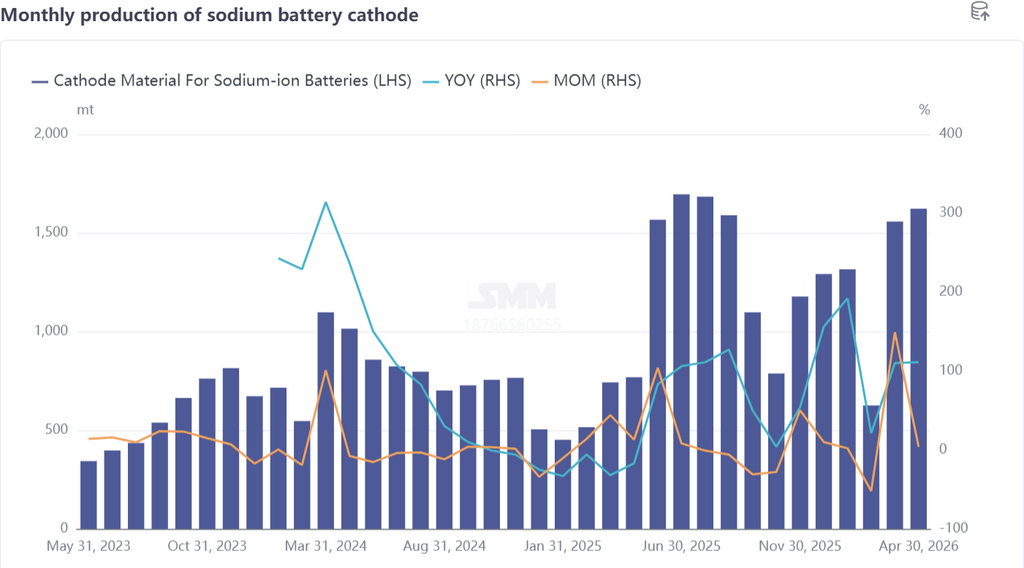
In terms of product mix, polyanion materials held an absolute dominant position, accounting for nearly 82% of the total, up 5 percentage points MoM, with their excellent performance meeting the needs of energy storage and start-stop systems. Among them, NFPP (sodium iron phosphate pyrophosphate) performed outstandingly, becoming the core growth driver.

Demand side, NFPP pre-purchase intent orders increased significantly in April, mostly for May-June delivery. Shipments had already begun by month-end April, and NFPP enterprises are expected to see a mini shipments peak in Q2. In contrast, layered oxide cathode production declined. Except for integrated enterprises, most enterprises faced precursor undersupply — previously, due to weak layered oxide demand and insufficient cost-effectiveness, most precursor enterprises had switched their production lines back to ternary materials, making it difficult to quickly fill the supply gap.

Notably, high-compaction NFPP products are highly dependent on precursors, but current NFPP precursor capacity is severely insufficient and prices have been raised, driving up high-compaction NFPP costs. As the sodium-ion battery market is still in its development phase, downstream battery cell manufacturers maintain strict cost control, and NFPP price raises may face resistance. In April, demand was released from start-stop, two-wheeled vehicle, and ESS sectors, supporting the cathode market. Looking ahead to May, cathode production is entering peak season, and new battery cell capacity release is expected to drive dual growth in supply and demand, with production forecast to increase 19% MoM and 23% YoY.

II. Hard Carbon Anode: Production Surge Fills Gap, Accelerated Expansion Breaks Bottleneck

The sodium-ion battery hard carbon anode market delivered a strong performance in April, with production growing significantly as enterprises accelerated expansion to fill the supply-demand gap. According to SMM data, sodium-ion battery anode production was up 32% MoM and up 108% YoY, with hard carbon as the mainstream material seeing particularly notable production growth. Recently, new hard carbon capacity has come online, and subsequent capacity ramp-up is expected to gradually alleviate the capacity shortage that previously constrained sodium-ion battery development.
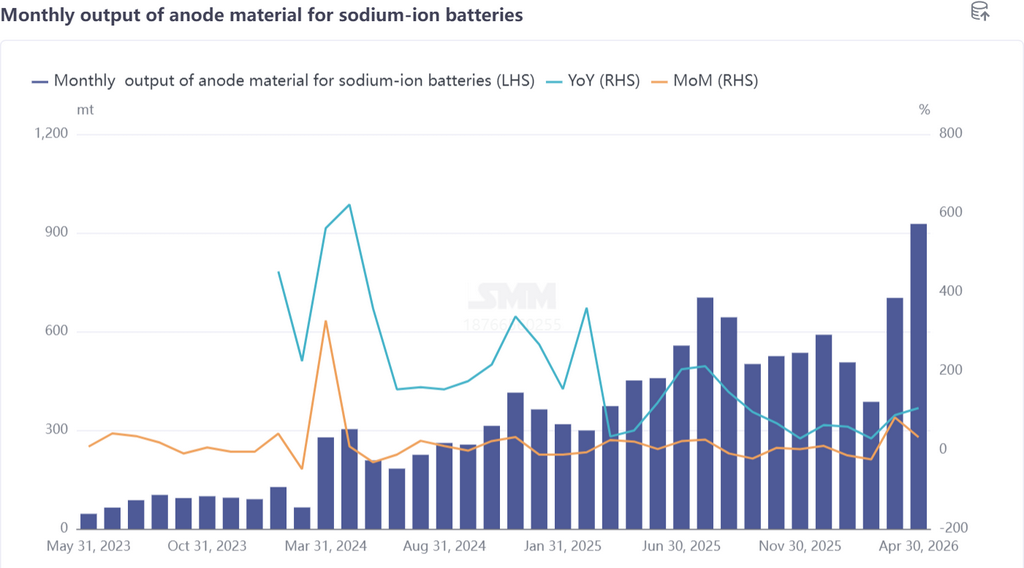
Previously, hard carbon had become a core bottleneck for sodium-ion battery development due to insufficient capacity and inconsistent product quality. Currently, downstream demand is concentrated among leading major

manufacturers, with the large-scale energy storage sector seeing rapid demand growth and imposing stringent requirements on hard carbon performance (long cycle life and low-temperature performance), driving up high performance hard carbon prices. Robust demand has fueled rapid growth in intended hard carbon orders, with some enterprises in the capacity ramp-up stage and others planning new capacity. Production schedule for hard carbon is expected to further increase in May, with production up 16% MoM and up 134% YoY.

III. Market Summary and Outlook: Improving Supply and Demand, Q2 Entering a Key Growth Period

Overall, the sodium-ion battery cathode and anode markets in April exhibited a pattern of "recovering demand, accelerating capacity, and structural differentiation." On the cathode side, polyanion materials maintained a solid dominant position, with NFPP leading growth, while layered oxide declined due to cost-performance constraints. Meanwhile, insufficient NFPP precursor capacity and rising costs remained short-term pain points. On the anode side, hard carbon production surged, new capacity coming online alleviated supply gaps, large-scale energy storage demand boosted high-end product demand, and accelerated expansion broke through bottlenecks, confirming the continued advancement of sodium-ion battery commercialization.

Q2 is expected to usher in a key growth period for the industry. Cathode side, the peak season arrives in May, with new battery cell capacity release driving demand growth. NFPP is expected to see a minor shipments peak, though attention should be paid to precursor supply and cost pressure. Anode side, hard carbon capacity ramp-up continues, the supply-demand pattern keeps improving, and product performance iteration is accelerating to adapt to high-end scenarios.

In the long term, as sodium-ion battery commercialization accelerates and downstream application scenarios continue to expand, cathode and anode demand will sustain capacity expansion. The industry is expected to gradually resolve capacity and cost pain points, optimize product structure, and consolidate the mainstream positions of polyanion cathodes and hard carbon anodes, driving the sodium-ion battery industry toward large-scale, high-quality development.

Data Source Statement: Except for publicly available information, all other data are processed by SMM based on publicly available information, market communication, and relying on SMM's internal database model. They are for reference only and do not constitute decision-making recommendations.

For any inquiries or for more information, please contact: lemonzhao@smm.cn
For more information on how to access our research reports, please contact:service.en@smm.cn
Related News
[SMM Cobalt Morning Meeting Minutes] New Energy Industry Chain Demand Differentiation, Market Awaits Gradual Recovery in Peak Season
Jul 31, 2026 10:43
[SMM Cobalt Morning Meeting Minutes] New Energy Industry Chain Demand Differentiation, Market Awaits Gradual Recovery in Peak Season
Read More
[SMM Cobalt Morning Meeting Minutes] New Energy Industry Chain Demand Differentiation, Market Awaits Gradual Recovery in Peak Season
[SMM Cobalt Morning Meeting Minutes] New Energy Industry Chain Demand Differentiation, Market Awaits Gradual Recovery in Peak Season
This week, the industry chain exhibited a diverging pattern, with upstream raw material and cobalt salt prices weakening while midstream and downstream material prices remained relatively stable. Trading in refined cobalt, intermediate products, cobalt sulphate, cobalt chloride, Co3O4, and cobalt powder was generally sluggish. Downstream buyers mostly maintained just-in-time procurement, as off-season demand was insufficient, and inventory pressure along with low-priced supply continued to weigh on market prices. Although some miners and smelters, supported by high-cost inventory, still intended to hold prices firm, traders and recycling companies became more active in selling, and the decline in the cost of refined cobalt reverse dissolution further strengthened market expectations of pushing for lower prices. In the short term, related product prices still face downward pressure. Ternary cathode precursor, ternary cathode material, and LCO prices remained stable overall. Leading ternary cathode precursor companies performed well in export orders, and domestic production schedules recovered somewhat, but small and medium-sized enterprises were still affected by the off-season. Demand for ternary cathode materials from the EV sector stayed at a high level; some battery cell enterprises stockpiled in advance, and August orders are expected to be stable with slight growth. Consumer-side demand remained mediocre. Affected by sluggish end-use demand and substitution by ternary cathode materials, LCO production and sales remained low, further narrowing enterprises' profit margins. Subsequent market recovery will still depend on the restocking pace in mid-to-late August and the release of demand during the September-October peak season.
Jul 31, 2026 10:43
[SMM Cobalt Lithium Morning Meeting Minutes] Raw Material Price Divergence Intensifies, Energy Storage Demand Sustains Industry Prosperity
Jul 31, 2026 10:31
[SMM Cobalt Lithium Morning Meeting Minutes] Raw Material Price Divergence Intensifies, Energy Storage Demand Sustains Industry Prosperity
Read More
[SMM Cobalt Lithium Morning Meeting Minutes] Raw Material Price Divergence Intensifies, Energy Storage Demand Sustains Industry Prosperity
[SMM Cobalt Lithium Morning Meeting Minutes] Raw Material Price Divergence Intensifies, Energy Storage Demand Sustains Industry Prosperity
[SMM Cobalt Lithium Morning Meeting Summary: Raw Material Price Divergence Intensifies; Energy Storage Demand Supports Continued Industry Prosperity] This week, the relevant material markets continued to diverge in performance. Upstream ore prices stopped falling and rebounded, but high-price transactions remained constrained. Some ex-China capacities gradually recovered, and market attention shifted from supply disruptions to the pace of new capacity releases. Salt products were supported by maintenance outages, tightening circulation of spot orders, and low inventories, leading to somewhat active spot transactions. However, downstream players still mainly made just-in-time procurement on price dips, and concentrated stockpiling has yet to emerge. The cobalt industry chain remained under pressure overall, with the price centers of refined cobalt, intermediate products, cobalt salts, and cobalt powder shifting downward. Off-season demand, inventory pressure, and low-priced cargoes continued to weigh on the market. Nickel sulphate inventories declined, and cost support strengthened somewhat. Prices of ternary cathode precursors and ternary cathode materials generally remained stable. The LFP, electrolyte, and sodium-ion battery sectors performed relatively strongly, with demand from energy storage, commercial vehicles, and Q3 stockpiling driving production schedules higher. Inventories of some products continued to decline. The anode and separator markets were generally stable. Different raw material varieties in the recycling sector showed divergent performance. The overall industry chain remained in a phase of concurrent demand improvement and cost pass-through.
Jul 31, 2026 10:31
[SMM Cobalt Morning Brief] Weakness in the cobalt industry chain persists, Q3 restocking remains to be seen.
Jul 28, 2026 10:43
[SMM Cobalt Morning Brief] Weakness in the cobalt industry chain persists, Q3 restocking remains to be seen.
Read More
[SMM Cobalt Morning Brief] Weakness in the cobalt industry chain persists, Q3 restocking remains to be seen.
[SMM Cobalt Morning Brief] Weakness in the cobalt industry chain persists, Q3 restocking remains to be seen.
SMM Cobalt Morning Briefing: This week, the cobalt industry chain continued to be in the doldrums. Refined cobalt prices were lowered to 360,000 yuan/mt, with off-season demand sluggish; for cobalt intermediate products, the price spread between upstream and downstream diverged noticeably, hindering deal progress. In the cobalt salt and Co3O4 markets, inquiries and order signing were limited, and prices mainly moved sideways. Cobalt powder transaction prices remained at 455,000 yuan/mt, but demand was cautious, and there was still short-term pressure to test the bottom. Orders for ternary cathode precursors and ternary cathode materials were relatively stable; LCO prices were lowered due to falling raw material costs; and the market focused on the pace of restocking in Q3.
Jul 28, 2026 10:43
[SMM Analysis] Sodium-Ion Battery Cathode and Anode Supply-Demand Recovery and Capacity Expansion Accelerate - Shanghai Metals Market (SMM)