SMM May 6 News:
On April 24, 2026, the State Taxation Administration officially released the "Positive and Negative List for Taxpayers' Compliant Invoice Issuance," providing clear and itemized guidance that both better safeguards taxpayers' legitimate rights and promotes the rectification of circular invoicing, mutual invoicing, and invoicing with artificially inflated transaction links — collectively known as the "invoice economy" — as well as tax-related issues in non-compliant investment attraction, thereby supporting the construction of a unified national market. This move quickly transmitted to China's bulk commodity market, with trading in copper, aluminum, zinc, silver, and other commodities visibly impacted.
How Does the Rectification of "Invoice Economy" Impact the Zinc Trading Market?
With the implementation of the new policy, zinc metal, as one of the basic non-ferrous metal varieties, saw its related trading business significantly affected. According to market sources, starting from late April, tax authorities conducted strict compliance inspections on relevant enterprises. Invoice quotas for trading companies in east China, south China, north China, and other regions were notably reduced, with some enterprises forced to suspend operations as a result.
First, zinc ingot, as one of the standard bulk commodities, has been subject to certain bill arbitrage activities in the trading industry. In bill arbitrage, enterprises typically profit from the price spread between structured deposit rates and bill discount rates, with VAT invoices serving as important financing credentials in the process. With the tightening of invoice quotas, bill arbitrage activities in the zinc trading market have been largely curbed recently.
Second, the rectification of the "invoice economy" helps squeeze out the "water" in GDP. Some local governments, through non-compliant implementation of tax-linked fiscal rebates, attracted shell companies engaged solely in invoicing to register locally. Without substantively transferring ownership of goods, these entities frequently traded "warrants" to achieve "account flows and invoice flows without goods flows," or inflated business performance through "circular invoicing" and "mutual invoicing" among affiliated enterprises, creating an illusion of "digital prosperity." Focusing on the zinc trading industry, the rectification of "circular invoicing" and "mutual invoicing" has achieved notable results. Trading volumes of traders primarily engaged in "brick-moving" (arbitrage) business have essentially been suspended, while zinc ingot traders with genuine upstream and downstream enterprises engaged in actual trade have seen relatively limited impact on their tax invoice quotas. Trading activity in China's zinc ingot spot market declined significantly, with "whether invoices are available" becoming a key factor determining whether spot transactions can be concluded. Traders "having goods but no invoices" has become a prominent feature of the spot market recently.
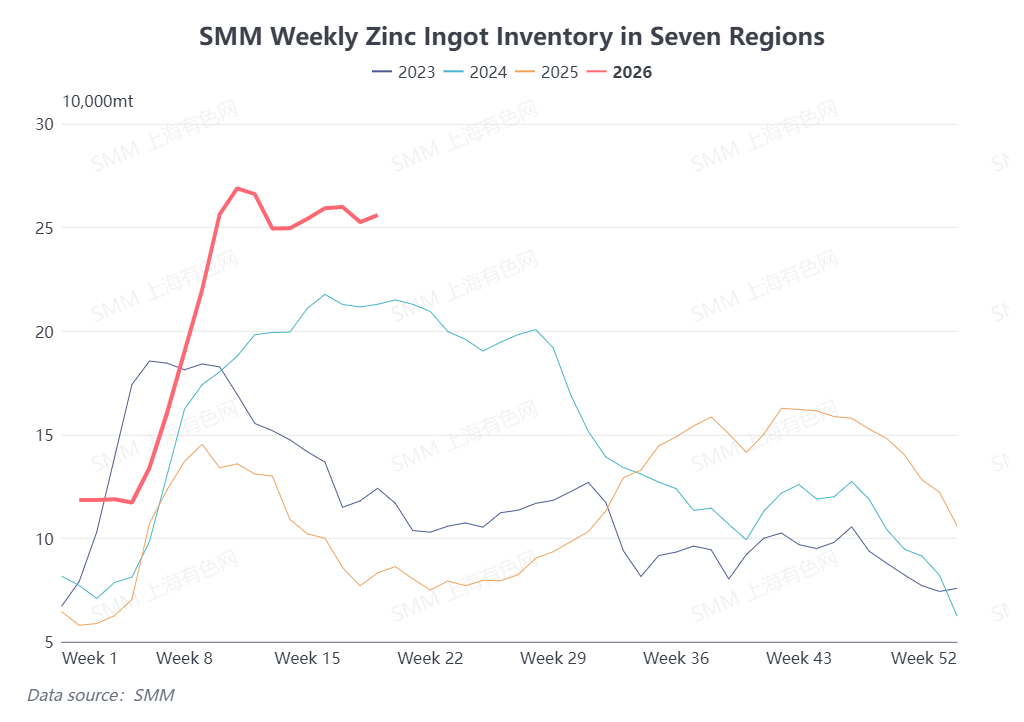
Finally, although futures zinc prices have remained at elevated levels recently and SMM's seven-region zinc ingot inventory levels are also at four-year highs, with local government tax rebates being fully halted across China, trading costs for domestic zinc ingot traders have risen, and some enterprises have passed these costs on to actual spot prices, resulting in zinc ingot spot prices strengthening MoM.
What Is the Market Outlook Going Forward?
In the short term, entering May, the ongoing tax invoice issue continues to affect zinc spot market trading, with zinc ingot spot trading liquidity remaining tight. However, rectifying the "invoice economy" can both squeeze out the "water" in statistical data and promote solid development of local economies while improving the quality of tax revenue. In the long term, enterprises engaged in genuine trade within the zinc industry will benefit from this, and SMM will continue to monitor subsequent developments.
(The above information is based on market collection and comprehensive evaluation by the SMM research team. The information provided in this article is for reference only. This article does not constitute direct advice for investment research and decision-making. Customers should make cautious decisions and should not replace their independent judgment with this information. Any decisions made by customers are not related to SMM.)



![Zinc Concentrate TCs Continue to Decline, SHFE Zinc Fluctuates at Highs [SMM Zinc Futures Brief]](https://imgqn.smm.cn/usercenter/kdRPs20251217171754.jpg)