[SMM Global Steel Company Special] POSCO Business Performance Report
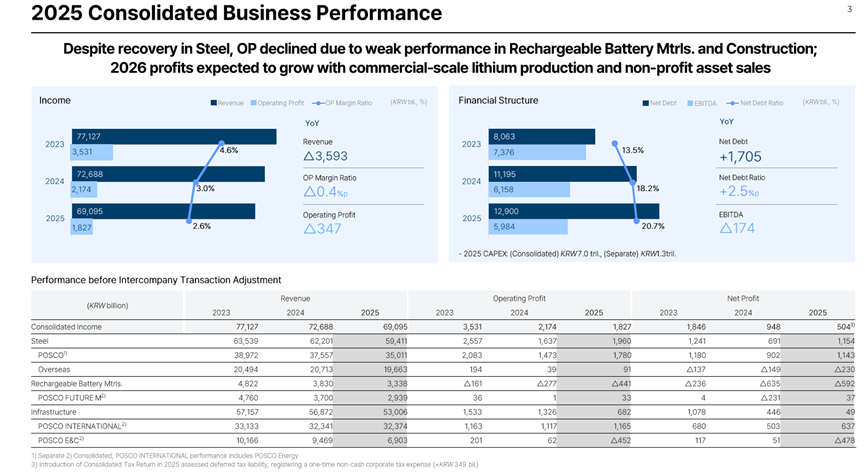
POSCO Holdings Inc. released its 2025 consolidated results, reporting revenue of 69.095 trillion won, operating profit of 1.827 trillion won, and net profit of 504 billion won. The details of the steel segment's 2025 performance are as follows.

Data source: POSCO Annual Report
POSCO (Standalone) Operating Performance
- Production and Sales

Data source: POSCO Annual Report
- Earnings Overview
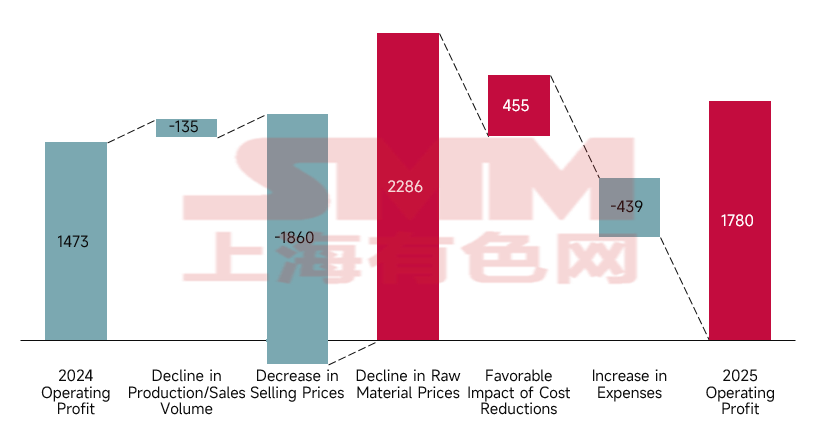
① 2025 revenue: 35.011 trillion won, down 2.545 trillion won YoY;
② 2025 operating profit: 1.78 trillion won, up 307 billion won YoY;
③ Operating profit margin: 5.1%, up 1.2% YoY.
- Performance Analysis
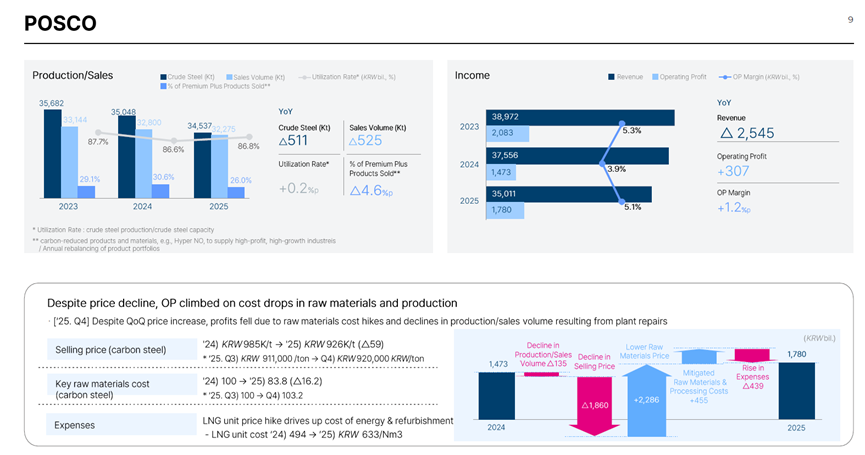
On a full-year basis, although selling prices in 2025 declined compared to 2024, operating profit still rose as raw material and production costs fell by a larger margin.
① Carbon steel selling price dropped from 985,000 won/mt in 2024 to 926,000 won/mt in 2025, down approximately 59,000 won/mt.
② Key raw material cost index: fell from 100 in 2024 to 83.8 in 2025, down 16.2.
Although annual growth was still achieved, it is worth noting that the sharp rise in LNG prices also significantly impacted costs, pushing up energy and maintenance expenses from 494 won/m³ in 2024 to 633 won/m³ in 2025. More detailed changes are as follows (unit: 1 billion won).
Data source: POSCO Annual Report
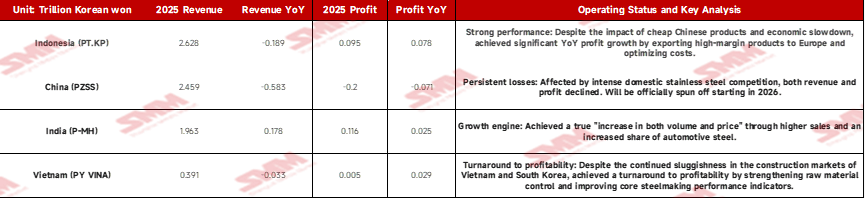
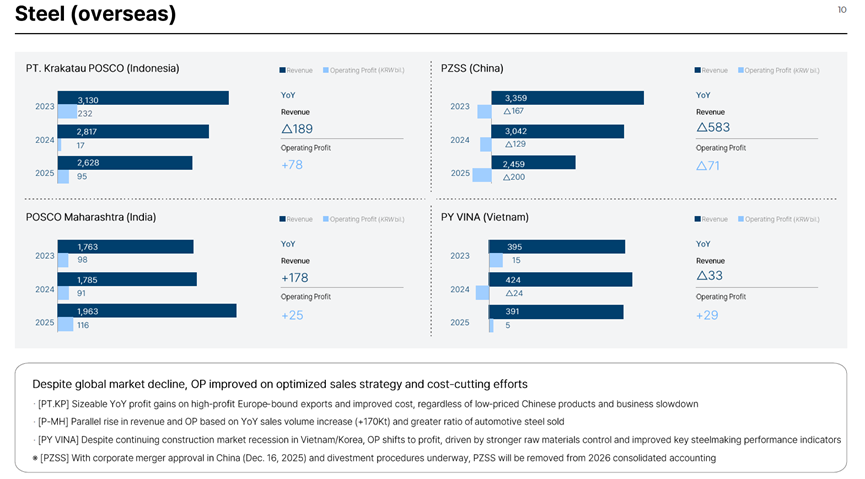
Ex-China Steel Operating Performance Details
Data source: POSCO Annual Report
Core Steel Business Operating Activities
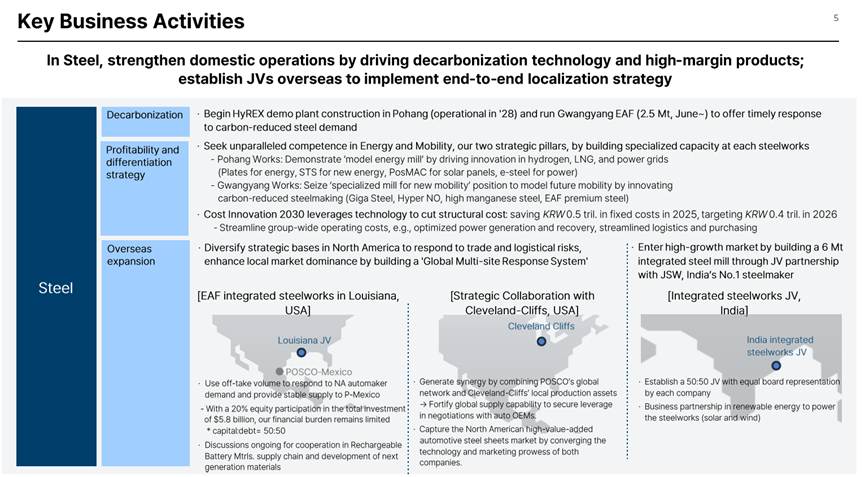
- Decarbonisation
① Commenced construction of the HyREX (hydrogen reduction ironmaking) demonstration plant in Pohang (expected to be operational in 2028).
② Operating the Gwangyang Electric Arc Furnace (EAF, capacity of 2.5 million mt, operational from June) to quickly respond to market demand for low-carbon steel products.
- Building Two Pillars: Energy and Mobility
① Pohang Plant (Energy): Building a "model plant for energy-use steel," deepening capabilities in steel for hydrogen energy, LNG, and power grid applications (including PosMAC, e-steel, etc.).
② Gwangyang Plant (Mobility): Positioned as a "dedicated plant for new mobility," conducting R&D on Giga Steel, silicon steel (Hyper NO), and other low-carbon high-end materials.
- Cost Innovation 2030
Leveraging technology to reduce structural costs through technology-driven structural cost reduction, targeting fixed cost reductions of 50 billion Korean won in 2025 and 40 billion Korean won in 2026. Optimizing group-wide operating costs: such as optimizing power generation and waste heat recovery, and streamlining logistics and procurement.
- Overseas Expansion
① [US Louisiana: EAF Integrated Steel Mill]
Total investment of $5.8 billion, with POSCO holding a 20% stake and a relatively small financial burden (capital-to-debt ratio of 50:50).
Products will be directly supplied to North American automakers and POSCO's Mexico plant.
Discussions are underway on battery materials supply chain and next-generation materials collaboration.
② [Strategic Partnership with US Cleveland-Cliffs]
Combining POSCO's global network with Cleveland-Cliffs' domestic production assets.
Goal: Capturing the North American high-value-added automotive sheet market through the integration of technology and marketing.
③ [India: Integrated Steel Mill Joint Venture]
Establishing a 50:50 joint venture with JSW, India's largest steel manufacturer, with equal representation on the board of directors.
Constructing an integrated steel mill with a capacity of 6 million mt, and conducting business collaboration in renewable energy (wind and solar) to supply power to the steel mill.
Source: POSCO Annual Report
Copyright and Intellectual Property Statement:
This report is independently created or compiled by SMM Information & Technology Co., Ltd. (hereinafter referred to as "SMM"), and SMM legally enjoys complete copyright and related intellectual property rights.
The copyright, trademark rights, domain name rights, commercial data information property rights, and other related intellectual property rights of all content contained in this report (including but not limited to information, articles, data, charts, pictures, audio, video, logos, advertisements, trademarks, trade names, domain names, layout designs, etc.) are owned or held by SMM or its related right holders.
The above rights are strictly protected by relevant laws and regulations of the People's Republic of China, such as the Copyright Law of the People's Republic of China, the Trademark Law of the People's Republic of China, and the Anti-Unfair Competition Law of the People's Republic of China, as well as applicable international treaties.
Without prior written authorization from SMM, no institution or individual may:
1. Use all or part of this report in any form (including but not limited to reprinting, modifying, selling, transferring, displaying, translating, compiling, disseminating);
2. Disclose the content of this report to any third party;
3. License or authorize any third party to use the content of this report;
4. For any unauthorized use, SMM will legally pursue the legal responsibilities of the infringer, demanding that they bear legal responsibilities including but not limited to contractual breach liability, returning unjust enrichment, and compensating for direct and indirect economic losses.
Data Source Statement:
(Except for publicly available information, other data in this report are derived from publicly available information (including but not limited to industry news, seminars, exhibitions, corporate financial reports, brokerage reports, data from the National Bureau of Statistics, customs import and export data, various data published by major associations and institutions, etc.), market exchanges, and comprehensive analysis and reasonable inferences made by the research team based on SMM's internal database models. This information is for reference only and does not constitute decision-making advice.
SMM reserves the final interpretation right of the terms in this statement and the right to adjust and modify the content of the statement according to actual circumstances.