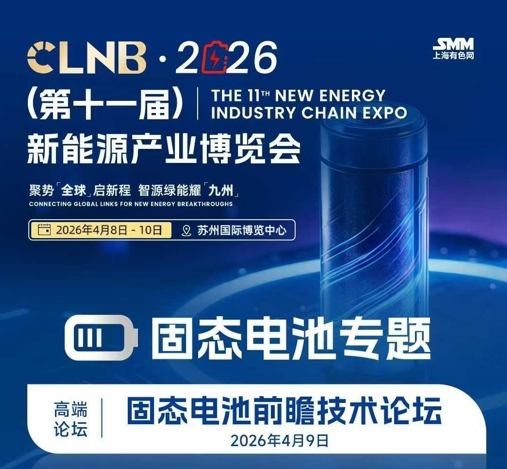
Key Point: The CLNB 2026 Solid-State Battery Conference was held in Suzhou on April 9, with experts reaching a consensus that 2026-2030 will be the critical period for industrialisation. The conference focused on breakthroughs in technology pathways such as oxide and sulphide, elaborating on progress in mass production of lithium sulphide, high specific energy cathode innovation, and equipment and process upgrades. Three major bottlenecks — materials, processes, and standards — were identified, with a clear industry timeline of small-batch production by 2027 and large-scale mass production by 2030.
Overview of Expert Perspectives from the CLNB 2026 Solid-State Battery Conference
Date: April 8-10, 2026
Venue: Suzhou International Expo Centre
Forum: High-End Solid-State Battery Forward-Looking Technology Forum (April 9)
I. Overall Assessment: Industrialisation of Solid-State Batteries Entering a Critical Window
Multiple experts reached a consensus: the period from 2026 to 2030 will be the critical five years for all-solid-state batteries to transition from the laboratory to large-scale production. Zhu Jian, SMM Consulting Director, noted that the global penetration rate of all-solid-state batteries is expected to approach 10% by 2035, with consumer electronics (3C) set to achieve breakthroughs first, high-end EVs holding the greatest potential, and the ESS sector being cost-sensitive with limited short-term demand. The sulphide route is gradually becoming the mainstream due to its highest ionic conductivity, but cost and stability remain the biggest challenges.
II. Competition Among Technical Routes: Breakthroughs in Oxide, Sulphide, and Polymer Respectively
1 Oxide Route (Professor Tang Weiping, Shanghai Jiao Tong University / Lihe Technology)
Professor Tang Weiping unveiled a new-type oxide solid-state electrolyte LZSP (Li₃Zr₂Si₂PO₁₂), prepared via Na⁺/Li⁺ ion exchange, inheriting the large-framework lattice of NZSP, featuring large lithium transport channels, containing no rare earth elements, and offering controllable costs. The NLZSP-coated NCM811 cathode material developed by his team can significantly reduce battery impedance and mitigate particle damage, with Na⁺ diffusing toward the cathode during charge and discharge, positively contributing to performance improvement. In 2025, global oxide electrolyte shipments were approximately 3,500–4,000 mt, with China contributing over 85%, primarily LLZO and LATP, mainly used in semi-solid-state batteries.
2 Sulphide Route (Wanbang Shenghui, Hongkang New Energy)


Wanbang Shenghui — Yu Yanan, Vice President of Wanbang Shenghui Research Institute: Leveraging Yuneng Lithium, the company built the world's first continuous 100-mt-scale lithium sulphide production line (200 mt/year, with construction completed in December 2025), adopting a Li₂O + H₂S gas-solid reaction process with proprietary intellectual property and fully automated operations. Monthly shipments are expected to continue rising in 2026, with pricing composed of "benchmark price + lithium chemicals floating", striving to become an industry leader in cost reduction.
Hongkang New Energy — Sun Changcheng, Senior Engineer at Hongkang New Energy: Achieved 99.99% purity lithium sulphide (whiteness 92.5), using a lithium carbonate + sulphur high-temperature solid-phase reaction + vacuum sublimation purification process. The 100 mt/year lithium sulphide production line has been commissioned, and the 1,000 mt/year production line is under construction, planned to be completed by the end of 2026. Production costs can be controlled at 800,000–1 million yuan/mt, with plans to invest an additional 650 million yuan to build a 5,000 mt/year facility, targeting a cost reduction to 500,000 yuan/mt. The company is also developing porous carbon (10,000 mt/year) and silicon carbon anode (1,000 mt/year).
Shared assessment: Lithium sulphide is the core cost bottleneck of sulphide electrolytes, and continuous mass production and intellectual property breakthroughs are the biggest challenges in the next phase. Currently, the supply-demand gap for high-quality lithium sulphide exceeds 90%, with significant room for cost reduction.
3 Polymer / Semi-Solid-State Route (Marco Loglio, Dongchi New Energy)

Dongchi New Energy, leveraging technology from Jilin Normal University, focuses on polymer-based semi-solid-state batteries and has obtained GB/T, UL, IEC and other certifications. Its semi-solid-state batteries feature an energy density of 180 Wh/kg, over 12,000 cycles, and an operating temperature range of -40–70°C. The planned roadmap: liquid content of 5%–10% and 350 Wh/kg in 2025; <5% and 400 Wh/kg from 2025 to 2027; all-solid-state with 0% liquid and 500 Wh/kg from 2027 to 2030. The company has established a joint venture with Wenzhou Cangsheng Group (with an investment of $286 million) for battery swapping applications.
4. Lithium Metal Battery (Sriram Ramanoudjame, Blue Solutions)

The Chief Marketing Officer of Blue Solutions stated that the lithium metal anode is the core breakthrough for high energy density. Its Gen4 solid-state battery can achieve: 450 Wh/kg for the NMC system, 350 Wh/kg for the LMFP system, and 315 Wh/kg for the LFP system. Lithium metal batteries eliminate the need for copper current collectors (lithium coated on both sides, approximately 10 μm per layer), significantly reducing weight. The company has over 25 years of product and process experience, with mass production since 2011 and a cumulative output of over 3.5 million solid-state batteries.
The commercialization strategy is divided into two phases: before 2028, focusing on small-format applications (drones, eVTOL, wearables, two-wheelers, etc.); after 2032, entering the large-scale passenger vehicle market. Notably, 90% of the lithium in lithium metal batteries can be recovered from EOL batteries, addressing sustainability concerns.
III. Progress in High Specific Energy Cathode Materials (Wang Ronggang, General Manager, Yili Technology)

Wang Ronggang, General Manager of Yili Technology, systematically elaborated on the restructuring impact of solid-state batteries on cathode materials:
High-nickel ternary: Currently the mainstream choice. NCM9055 achieved a first discharge capacity of 229 mAh/g in all-solid-state evaluation, with a first-cycle efficiency of 86.46%. After coating, the thermal runaway temperature increased by 10–15°C (above 160°C).
Lithium-rich manganese-based: The next-generation high specific energy direction, with an energy density potential of 250–350 mAh/g and a working voltage of 4.5–4.8 V. Yili's AC213 delivered a first discharge capacity of 232 mAh/g at 4.55 V with a first-cycle efficiency of 88%; AC513 achieved a full-cell energy density exceeding 1,000 Wh/kg at 4.65 V (high temperature, 45°C).
High-voltage spinel (LNMO): Working voltage of 4.7 V. Yili's BS023 is in a leading position in customer testing, with stable cycling at 45°C high temperature.
O2-phase high-voltage LCO: Discharge capacity ≥260 mAh/g (4.65 V), first-cycle efficiency ≥94%.
Key challenges: Solid-solid interface impedance is 10–100 times higher than that of liquid systems; the side reaction rate between high-voltage cathodes and sulphide electrolytes increases by 5 times; and 5%–8% volume change during charge-discharge of lithium-rich manganese-based materials leads to interface cracking. Countermeasures include composite modification technologies such as monocrystalline processing, elemental doping, surface coating, and dry synthesis.
Impact on upstream resources: Sulphide all-solid-state batteries require 1,482 mt of lithium (LCE) per GW (lithium metal anode), far exceeding the 684 mt for liquid ternary systems; the oxide LLZO route requires approximately 76 mt of zirconium per GW; the penetration of high-nickel ternary is expected to significantly boost demand for nickel, cobalt, and manganese.
IV. Equipment and Process Innovation: Dry Electrode and Isostatic Pressing Become Key
1. Gaonengshu Zao (Yang Kang)Proposed an "equipment + process" solution approach targeting key challenges of all-solid-state batteries:

Mixing and fibrillation: Self-developed equipment achieved homogeneous mixing of multi-component powders, building a process parameter database with one-click retrieval.
Film-forming uniformity: Improved equipment precision to enable highly consistent preparation of cathode, anode, and electrolyte membranes across all systems.
Interface optimisation: Adopted adhesive frame printing (screen printing and laser prefabrication available) and isostatic pressing (proprietary dynamic pressurisation moulds for ultra-high-pressure densification) to improve solid-solid contact.
A dry-process equipment line solution at the 100 MW-plus level has been launched, providing integrated solutions ranging from lab-scale lines to mass-production lines.
2. Lead Intelligent Equipment (Ye Zhengping, Marketing General Manager)

Focused on full-tab assembly lines for cylindrical batteries, achieving stable production at 355 PPM (globally leading). The turntable structure reduced floor space by 53%, energy consumption by 33%, and manpower by 50% compared with linear layouts. Innovative laser welding technology achieved "zero auxiliary time," increasing laser utilization rate by over 600%. A proprietary pre-treatment process shortened electrolyte injection infiltration time by 20% and multi-step injection process time by 80%. RFID-based full-process traceability for individual battery cells, with a code-reading NG rate of <0.005%.
3. Microluna (Shao Zhushan)

Mr. Shao: In response to the extremely stringent moisture and oxygen requirements (<1 ppm) for lithium metal/solid-state batteries, proposed a sealed dry box solution: fully welded stainless steel construction, vacuum-grade sealing, leak rate of 10⁻⁶, employing desiccant wheel dehumidifiers and purification column molecular sieves for moisture removal, saving 50–60% in energy consumption compared with traditional dry rooms, portable, with a construction period of only two weeks. Already applied to lithium metal battery pilot lines, all-solid-state battery pilot lines, and sulphide electrolyte preparation (resistant to H₂S corrosion).
V. Lithium Sulphide Industrialisation: Progress Comparison of Two Major Players
Company: Wanbang Shenghui. Process route: Li₂O + H₂S gas-solid reaction. Capacity status: 200 mt/year (construction completed by December 2025), pilot scale 10 mt/year. Purity superior to industry standards. Cost target: industry price-reduction leader. Features: the world's first continuous 100 mt-level production line, fully automated.
Company: Hongkang New Energy. Process route: Li₂CO₃ + S high-temperature solid-phase reaction + vacuum sublimation. Capacity status: 100 mt/year construction completed, with 5,000 mt/year planned. Purity: ≥99.99% (up to 99.9999%). Cost target: currently 800,000–1 million yuan/mt, targeting 500,000 yuan/mt. Features: proprietary catalyst, recyclable by-products, green process.
Consensus view: Lithium sulphide prices have declined significantly from their 2024 highs, and the market size is expected to exceed 10 billion yuan over the next five years. Continuous production, low cost, and high consistency are the core competitive factors.
VI. AI-Driven Materials Design (Xu Kang, SES AI)

Dr. Xu Kang noted that traditional electrolyte R&D, reliant on "human intuition + trial and error," has long been unable to cope with the vast chemical design space (on the order of 10⁶⁰). SES AI developed the Molecular Universe platform:
Database: 10¹² molecular structures (up to 20 heavy atoms; C, N, O, S, P, Si, B, F), 2×10⁸ DFT calculation data points, 100,000 molecular dynamics-simulated electrolyte formulation properties driven by highly accurate polarisable force fields, and 17 million publications (updated weekly). Tools: battery-domain large language models, multi-agent systems, RAG retrieval augmentation.
Successful cases: Thousands of new molecular structures identified as valuable by AI have been generated and synthesised>Ten new molecules were tested, and six electrolytes were ultimately validated in batteries, demonstrating significant performance enhancement across multiple practical battery application scenarios.
While it is premature to say that "the era of human-centred science has ended," AI can enable exhaustive search and high-throughput screening. Whether AI can fully replace human genius and discover and establish entirely new physical laws remains an open question.
VII. Challenges and Outlook
SMM's Zhu Jian summarised the three major bottlenecks facing all-solid-state batteries:
Material bottleneck: Insufficient lithium sulphide capacity and high cost; low cost-effectiveness of CVD silicon carbon anodes (cost per capacity per gram is four times that of artificial graphite); consistency of porous carbon needs improvement.
Process bottleneck: Dry process technology is immature, with yield rates 30 percentage points lower than traditional lithium batteries; localisation of equipment such as isostatic pressing and roll pressing requires breakthroughs.
Standards bottleneck: There is a global lack of unified solid-state battery testing standards, with significant discrepancies among enterprise standards.
Cost status: The manufacturing cost of all-solid-state batteries is approximately 6–8 times that of traditional liquid lithium batteries (2025 benchmark). Cost reduction pathways include: scaling up upstream raw materials (lithium sulphide, silane gas), equipment localisation, and process innovation (replacing wet processes with dry processes).
Timeline consensus: Small-batch mass production is expected in 2027, large-scale mass production is expected in 2030, with energy density reaching 400 Wh/kg or above and costs declining rapidly.
VIII. Conclusion and Outlook
This CLNB Solid-State Battery Forum showcased the innovation vitality across the entire industry chain, spanning from materials (cathodes, electrolytes, anodes) and equipment (dry processing, isostatic pressing, sealed environments) to AI-driven design. China has already achieved a globally leading position in areas such as oxide electrolytes, continuous production of lithium sulphide, and high specific energy cathodes. Although the sulphide route is expected to hold great promise, cost and stability remain the last bastions before commercialization. In 2026, solid-state batteries are transitioning from "laboratory stories" to "production line reality."
**Note:** For further details or inquiries regarding solid-state battery development, please contact:
Phone: 021-20707860 (or WeChat: 13585549799)
Contact: Chaoxing Yang. Thank you!