Recently, geopolitical tensions in the Middle East have escalated abruptly, and the military conflict between Iran and Israel has shown signs of broadening. As a vital global energy and trade artery, the security situation in the Strait of Hormuz has deteriorated sharply. As the conflict intensified, major shipping companies and insurers moved to reassess the risks in the region. At present, war risk premiums for vessels transiting Persian Gulf routes have surged significantly, and some insurers have suspended coverage for cargoes involving Israel, Iran, and related sensitive waters, obstructing the “arteries” of trade circulation and delivering an unprecedented sudden shock to China’s aluminum processing industry, which is highly dependent on global supply chains.
In 2025, as the world’s largest production site for aluminum plate/sheet, strip and foil, China posted strong export performance to the Middle East market. Data showed that in 2025, China’s cumulative exports of aluminum plate/sheet and strip totaled about 3.0742 million mt, while cumulative aluminum foil exports totaled about 1.3407 million mt. Among them, the Gulf region is an important consumer market for China in the Middle East: China’s trade volume of aluminum plate/sheet and strip exports to Saudi Arabia was 42,500 mt, and aluminum foil 58,000 mt; aluminum plate/sheet and strip exports to the UAE were 103,500 mt, and aluminum foil 93,800 mt; the other four countries (Bahrain, Qatar, Kuwait, and Oman) accounted for combined aluminum plate/sheet and strip exports of about 22,000 mt and aluminum foil exports of about 11,000 mt. Combined, exports of aluminum plate/sheet and strip to the six Middle Eastern countries accounted for about 5.5%, while combined aluminum foil exports accounted for about 12.1%. However, with the outbreak of the Iran-Israel conflict and the deterioration of the security situation in the Strait of Hormuz, the region’s trade chain has been materially disrupted. According to the SMM survey, all of China’s aluminum plate/sheet, strip and foil orders involving the Middle East have now been suspended, and even some in-transit orders that had already been loaded have been returned or left stranded at ports. The core reason is that insurers, citing war risks, have refused to provide coverage for cargoes entering or leaving the region, leaving traders unable to fulfill contracts and sharply amplifying risks.
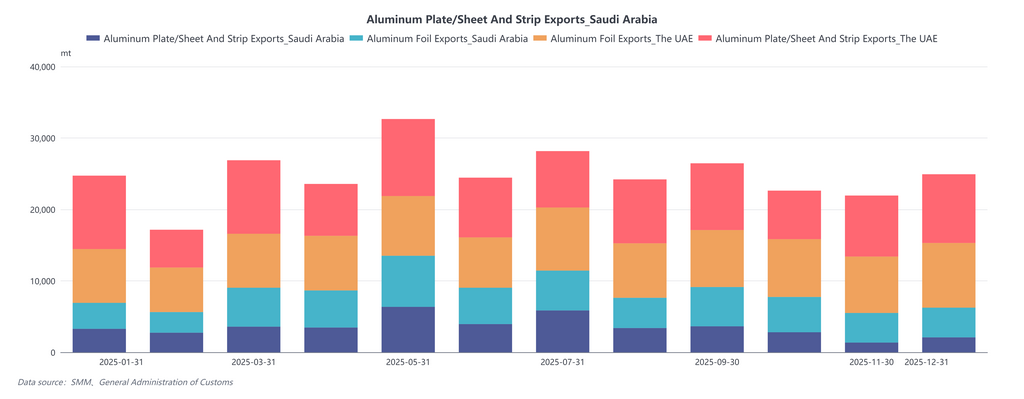
In addition to the sudden military conflict, China’s aluminum enterprises have already been facing increasingly severe trade barriers in the Middle East market. The Gulf Cooperation Council (GCC) had previously launched an anti-dumping investigation into China’s aluminum plate/sheet and strip. Although some responding enterprises secured lower separate duty rates, the generally high tariff barriers still remain. Originally, in 2026, many export enterprises were expected to prioritize the development of the high-potential Middle East market against the backdrop of difficulties in the European and US markets. But even if the fighting subsides in the future, high anti-dumping duties will still become a long-term “ceiling” constraining sales of China’s aluminum products in the Gulf states. In the short term, the most pressing crisis is not tariffs, but “force majeure.” The risk of controls over the Strait of Hormuz directly led major global shipping companies to reroute or suspend calls at relevant ports. More importantly, the lack of war-risk insurance means that even if vessels are willing to carry the cargo, once uninsured goods are damaged, enterprises will face a 100% loss, directly resulting in a deadlock in which “orders are in hand but cannot be accepted, and goods are ready but cannot be shipped.” Therefore, before Iran and Israel reach a ceasefire agreement, China’s aluminum plate/sheet, strip and foil exports to the Middle East are expected to remain at a “freezing point.”
In summary, the Middle East market at the beginning of 2026 is fraught with tremendous uncertainty for China’s aluminum plate/sheet, strip and foil industry. The “instant shock” effect brought about by geopolitical conflict, compounded by the long-term barriers of trade protectionism, has turned this potential market into a high-risk minefield for now.

![Raw Material Trends Diverge with Firm Costs, Aluminum Fluoride Market Remains Stable and Cautious [SMM Fluoride Salts Weekly Review]](https://imgqn.smm.cn/usercenter/ceevU20251217171653.jpg)