According to SMM’s post-holiday survey, as of February 27, the weekly operating rate of secondary copper rod enterprises was 2.15%, down 1.22% from the first week after the Chinese New Year holiday in previous years, while the weekly operating rate of scrap-based anode plate was 7.45%, down 51.74% YoY. The pace of work and production resumptions among domestic secondary copper utilization enterprises showed clear regional divergence. In Anhui, Jiangxi, Hubei, and other areas, only a limited number of secondary copper rod enterprises resumed production, whereas most enterprises in Henan, Sichuan, Jiangsu, and other areas had resumed procurement and sales by the eighth day of the first lunar month (February 24). Enterprises generally reported that, as local fiscal and tax policies had yet to become clear and the specific implementation details of “reverse invoicing” remained unclear, many secondary copper rod enterprises, out of caution, had not yet fully resumed production. By contrast, scrap-based anode plate enterprises, due to long-term contract delivery requirements, saw a smoother production recovery and had basically returned to normal.
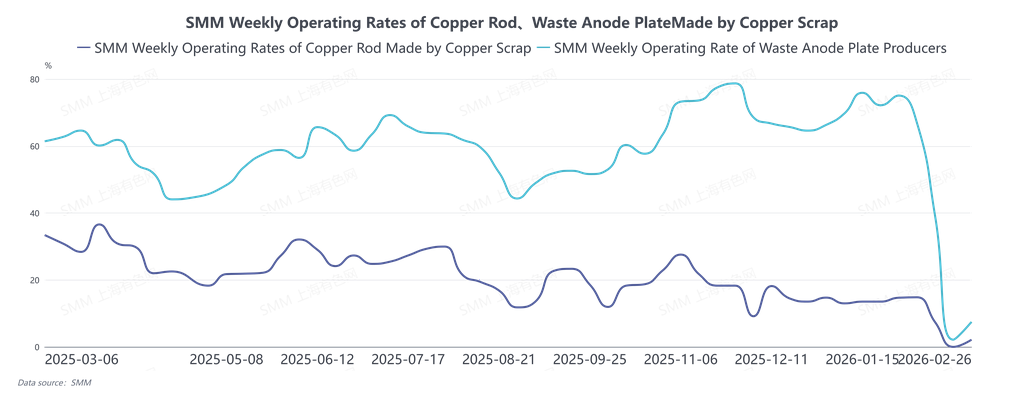
Before the holiday, most secondary copper rod enterprises expected workers to return to their posts between February 24 and 26. Considering the time required for equipment warming and material feeding, new products could be produced as early as around March 1. However, due to policy uncertainties, especially the potential impact of "reverse invoicing" on obtaining input invoices, many enterprises have postponed their resumption plans until after the Lantern Festival (March 3). According to the SMM survey, it is anticipated that in early March, some scrap utilization enterprises in Henan, Jiangxi, Sichuan, Hebei, and Jiangsu will gradually increase their procurement of copper scrap to ensure raw material inventory upon resuming production. Despite continuous efforts by various national ministries to clear local irregular investment attraction policies, most enterprises in the industry have accepted the reality that "local fiscal and tax support policies may be canceled in 2026." However, local governments have not yet made clear statements regarding unfulfilled subsidy funds from 2025, which has led secondary copper rod enterprises to cautiously observe between break-even and policy risks, further delaying their decisions to resume production.
Affected by the slow resumption progress of scrap utilization enterprises and the ineffective release of capacity, transactions in the copper scrap market have been generally sluggish. Many copper scrap traders reported low post-holiday purchasing sentiment. Even among those who have resumed procurement, there is a general lack of enthusiasm in quotations, with only "moderate restocking at lower prices" being the main strategy. Meanwhile, after acquiring raw materials, traders are not in a hurry to sell, leading to an accumulation of their own inventories. In major import distribution centers like Ningbo, trader inventories have also continued to rise due to weak downstream demand, and this inventory buildup trend is expected to persist in the short term.
In summary, unclear policies have become the key constraint on the current recovery of the secondary copper industry. Most secondary copper rod enterprises are still delaying resuming production while waiting to see how local fiscal and tax policies will be implemented going forward; production will remain affected over the next 1–2 weeks. Meanwhile, waste anode plate enterprises have maintained relatively stable production due to long-term contract constraints. Overall, the market has entered a wait-and-see phase, awaiting clearer policies and a substantive recovery in end-user orders.
![Diverging African Supply: June China Copper Anode Imports Recover, Q3 Maintenance May Weigh on Imports [SMM Analysis]](https://imgqn.smm.cn/usercenter/Bwtty20251217171714.jpeg)
![Copper Prices Continue to Rise, Copper Scrap Suppliers Actively Selling [SMM Secondary Copper Daily Review]](https://imgqn.smm.cn/usercenter/EFLYr20251217171714.jpeg)