How Will the Israel-Iran Conflict Affect Zinc Concentrates?

Published: Feb 28, 2026 20:56
On February 28, Israeli Air Force fighter jets crossed thousands of kilometers of airspace to conduct a daylight precision strike on the center of Tehran, Iran's capital, drawing significant market attention. How will this conflict impact zinc concentrates? .

SMM Feb 28 News:

On February 28, Israeli Air Force fighter jets crossed thousands of kilometers of airspace to conduct a daylight precision strike on the center of Tehran, Iran's capital, drawing significant market attention. How will this conflict impact zinc concentrates?

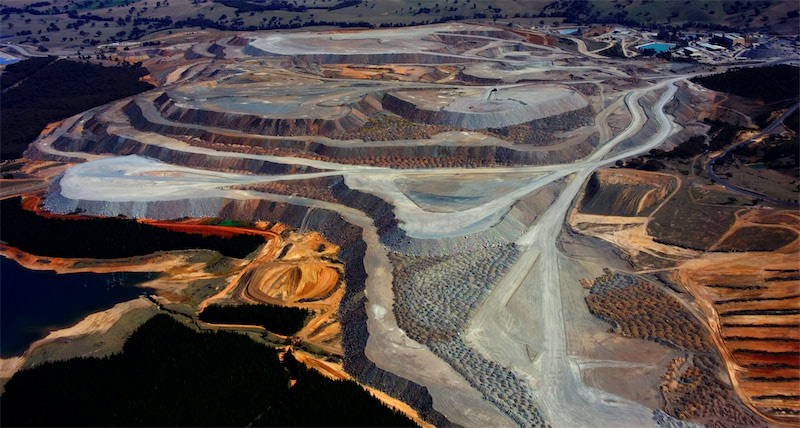
According to SMM, Iran's main lead and zinc mines are the Angouran Lead-Zinc Mine and the Mehdiabad Lead-Zinc Mine. In recent years, Iran's zinc concentrate production has been around 200,000 mt in metal content. From a global perspective, Iran's zinc concentrate production accounted for less than 2% of the global total in 2025. Although Mehdiabad Lead-Zinc Mine began gradually releasing capacity last year, with the first phase expected to produce about 200,000 mt of zinc concentrates annually, and subsequent capacity releases could double production, the overall base is relatively small. SMM expects that Iran's production share in the global total from 2026-2030 will remain limited.
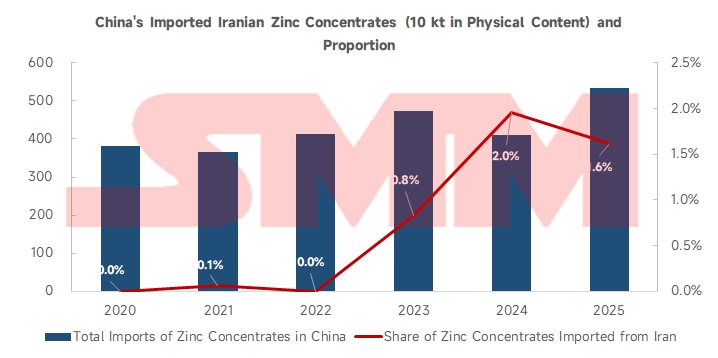
From a trade perspective, according to data from China's General Administration of Customs, China imported approximately 86,000 mt in physical content of Iranian zinc concentrates in 2025, accounting for 1.62% of total imports. As one of China's sources of zinc concentrate imports, Iran has attracted more attention in recent years due to the new capacity release at the Mehdiabad Lead-Zinc Mine. If geopolitical conflicts persist, Iran's zinc concentrate exports may be affected to some extent.
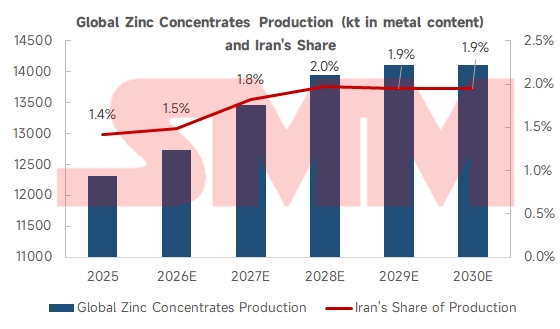
Overall, although Iran's zinc concentrate production has a relatively small impact on global output, the rapid expansion of China's smelting capacity in recent years, coupled with a noticeable pullback in overseas zinc concentrate growth YoY in 2026, means that China's zinc concentrate supply, excluding Huoshaoyun, will see limited increases. China is expected to face a slight shortage of zinc concentrates in 2026. If Iran's zinc concentrate exports significantly decrease, it could exacerbate the shortage of zinc concentrates in China this year.

(The above information is based on market collection and comprehensive evaluation by the SMM research team. The information provided in this article is for reference only. This article does not constitute direct advice for investment research and decision-making. Customers should make cautious decisions and should not replace their independent judgment with this information. Any decisions made by customers are not related to SMM.)



Data Source Statement: Except for publicly available information, all other data are processed by SMM based on publicly available information, market communication, and relying on SMM‘s internal database model. They are for reference only and do not constitute decision-making recommendations.

For any inquiries or to learn more information, please contact: lemonzhao@smm.cn
For more information on how to access our research reports, please contact:service.en@smm.cn
Related News
How Are Expectations for China’s Galvanized Sheet Exports in March Amid Continued Turmoil in the Middle East?
2 hours ago
How Are Expectations for China’s Galvanized Sheet Exports in March Amid Continued Turmoil in the Middle East?
Read More
How Are Expectations for China’s Galvanized Sheet Exports in March Amid Continued Turmoil in the Middle East?
According to the latest customs data, galvanized sheet exports stood at 926,600 mt in January 2026 and 1.1677 million mt in February, bringing cumulative exports in January-February to 2.0942 million mt, down 0.14% YoY. China’s total galvanized sheet exports in January-February this year were basically flat YoY. .
2 hours ago
South Korea to Exempt Tariffs on Overseas-Sourced Critical Minerals
6 hours ago
South Korea to Exempt Tariffs on Overseas-Sourced Critical Minerals
Read More
South Korea to Exempt Tariffs on Overseas-Sourced Critical Minerals
On the 25th, it was confirmed that the South Korean government will exempt tariffs of 3–8% on critical minerals such as lithium, graphite, and rare earth elements when domestically owned companies directly produce and import them from overseas. The Ministry of Trade, Industry and Energy has pre-announced a new regulation outlining tariff exemptions for overseas resource development projects. Under the policy, a total of 14 critical minerals—including lithium, graphite, nickel, cobalt, manganese, copper, zinc, and rare earth elements such as lanthanum, cerium, neodymium, terbium, dysprosium, yttrium, and scandium—will be eligible for duty exemption when brought into the country. The regulation is set to take effect on April 3.
6 hours ago
Data: SHFE, DCE market movement (Mar 26)
8 hours ago
Data: SHFE, DCE market movement (Mar 26)
Read More
Data: SHFE, DCE market movement (Mar 26)
The following table shows the ferrous and nonferrous metals movement on the SHFE and DCE on 26 Mar , 2026
8 hours ago