SMM, February 28th,
Driven by the global clean energy transition, the energy storage industry is achieving steady growth. Its core value lies in effectively mitigating the inherent intermittency and volatility of renewable energy sources like wind and solar power, providing critical assurance for stable clean electricity output. This development trend will sustainably drive demand for key metals across the energy storage supply chain. As one of the core materials, aluminum applications in energy storage systems primarily focus on aluminum sheets, strips, foils, and extrusions.
I. Scale of Aluminum Consumption in ESS
According to SMM calculations, each 1GWh energy storage system consumes approximately 1,780 tons of aluminum, of which aluminum extrusions account for about 44%, aluminum sheets and strips account for about 39%, and aluminum foil accounts for about 18%.
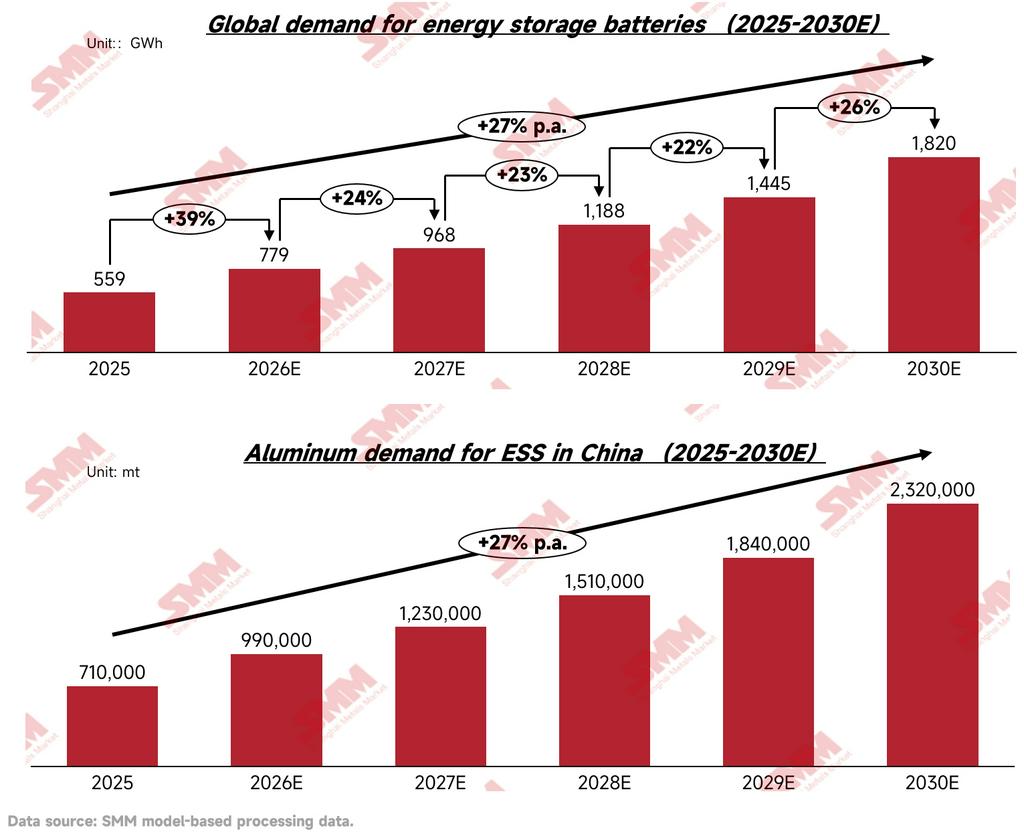
From the perspective of industry growth drivers, global energy storage cell production is entering a period of rapid growth: According to SMM estimates, the global demand for energy storage cells will be approximately 559 GWh in 2025, and is expected to reach 779 GWh in 2026, with a year-on-year increase of 39%; even as the base expands, the annual demand from 2027 to 2030 will still maintain a growth rate of over 20%.
In terms of aluminum demand, Chinese enterprises dominate the energy storage market, driving increased domestic aluminum consumption. SMM research indicates China's energy storage battery cabinet shipments will reach approximately 400GWh in 2025, accounting for over 80% of global share. Based on SMM's calculation of 1,780 tons of aluminum per GWh for energy storage systems and global battery cabinet shipments, the global aluminum demand for energy storage systems in 2025 will reach 850,000 tons, with China consuming approximately 710,000 tons. Domestic demand for aluminum in energy storage is projected to increase by 280,000 tons in 2026. However, it should be noted that with the continuous iteration of large-cell technology, the unit consumption of aluminum structural components in energy storage systems has room for reduction. In the long term, there is still potential for optimizing aluminum consumption per unit.
II. Calculation of Aluminum Profile Materials per Unit of ESS
Due to design variations across different energy storage products, this section separates aluminum consumption calculations for energy storage cells from other system components.
1.Core Application Scenarios of Aluminum Materials in EES
Aluminum materials, with advantages such as lightweight, corrosion resistance, and excellent processing performance, have been deeply integrated into the core components of ESS, with their main applications concentrated in three major areas:
Energy Storage Cell Component: Primarily used for cell aluminum foil, aluminum casings, and tabs.
Pack Component: Primarily used for battery trays, liquid cooling plates, battery end plates, and battery enclosures, etc.
Energy Storage System Component: Main applications include energy storage system enclosures, radiators, etc.
2.Aluminum Consumption in Energy Storage Cells
Aluminum usage in energy storage cells primarily involves battery foil, aluminum casings, and tabs. Currently, the aluminum consumption per cell is approximately 615t/GWh, with aluminum foil accounting for 300-330 t/GWh.
3.Aluminum Consumption in ESS
Due to variations in technical approaches and application scenarios, different manufacturers employ distinct design solutions for energy storage systems. When calculating aluminum consumption, we use industry average values:
-
In industrial, commercial, and residential energy storage projects, each rack is on average configured with 4.5 battery packs.
-
In grid-side energy storage projects, each rack averages 8 battery packs, with each system containing an average of 12 rack.
The aluminum components of the battery pack include the tray, liquid cooling plate, box body, and end plate. The structure of the battery tray is similar to that of new energy vehicle battery trays, but the product specifications are smaller and the cross-sectional design is more simplified. SMM calculates the aluminum consumption of a single battery pack based on the average weight data of components provided by mainstream aluminum production enterprises.
In addition, the core equipment of the energy storage system, the power conversion system (PCS), and its supporting radiator also need to consume aluminum materials.While aluminum enclosures exist for ESS, market research indicates steel enclosures currently dominate the market, with aluminum enclosures holding less than 20% market share. The weight range per unit is from several hundred kilograms to 2 tons.
Based on the above parameter calculations: the comprehensive aluminum consumption of industrial, commercial, and residential energy storage systems is 2030 tons/GWh,while for grid-side energy storage systems it is 1,720 tons/GWh. Weighted by the shipment share of different energy storage system types, the final comprehensive aluminum consumption for energy storage systems is calculated as 1,780 t/GWh.
4.Consumption Structure of Aluminum Materials in Energy Storage Systems
From a production process perspective, the manufacturing methods for core components such as aluminum casings and liquid cooling plates encompass multiple pathways including sheet metal stamping, profile processing, and casting. This section breaks down the consumption structure of aluminum material categories in energy storage systems based on the proportion of mainstream process applications: aluminum extrusions account for approximately 44%, aluminum sheets and strips account for approximately 39%, and aluminum foil accounts for approximately 18%.